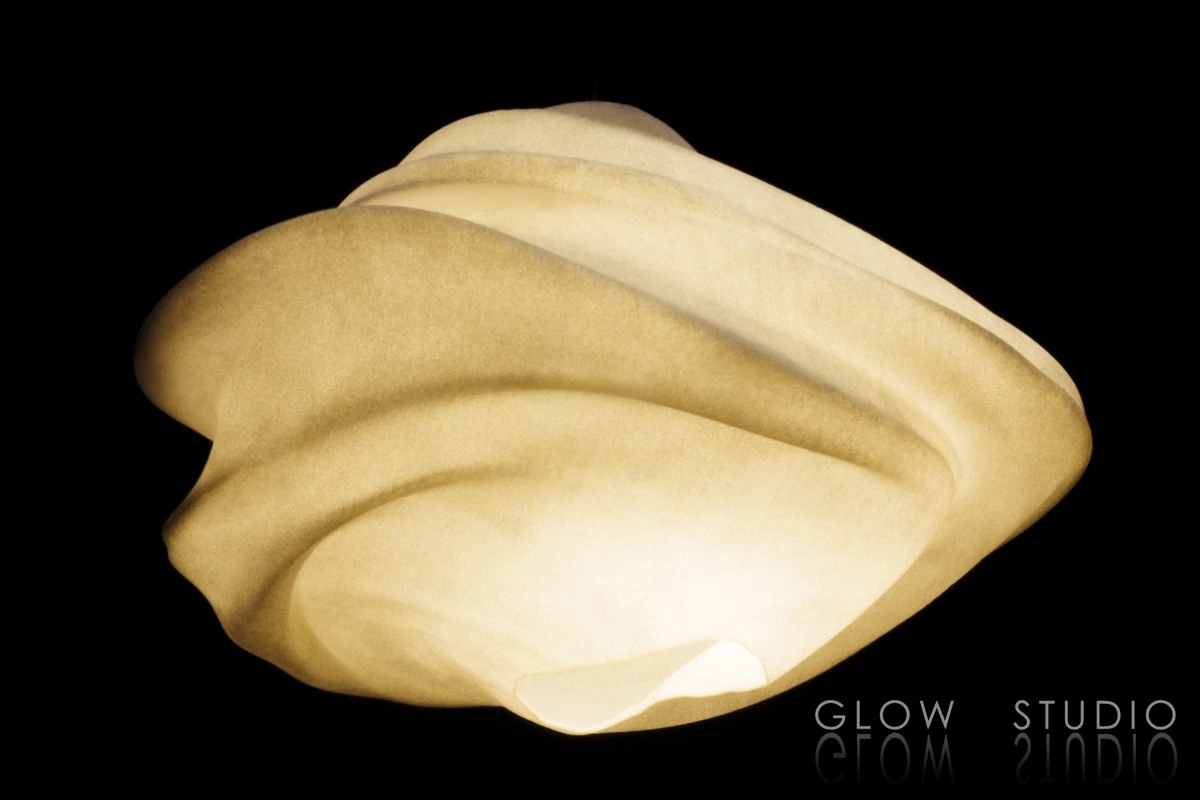
2012–2013↗
Gewu Studio / Twelve Water Lamps
Water held in form; photography reveals light, surfaces and the spaces between.
Selected works2012–2013 / Parametric design, products, 3D printing, spatial proposals
From Wave Pen, Tantan and Cornices to screens and lighting, an archive of Gewu’s early work across products and art.
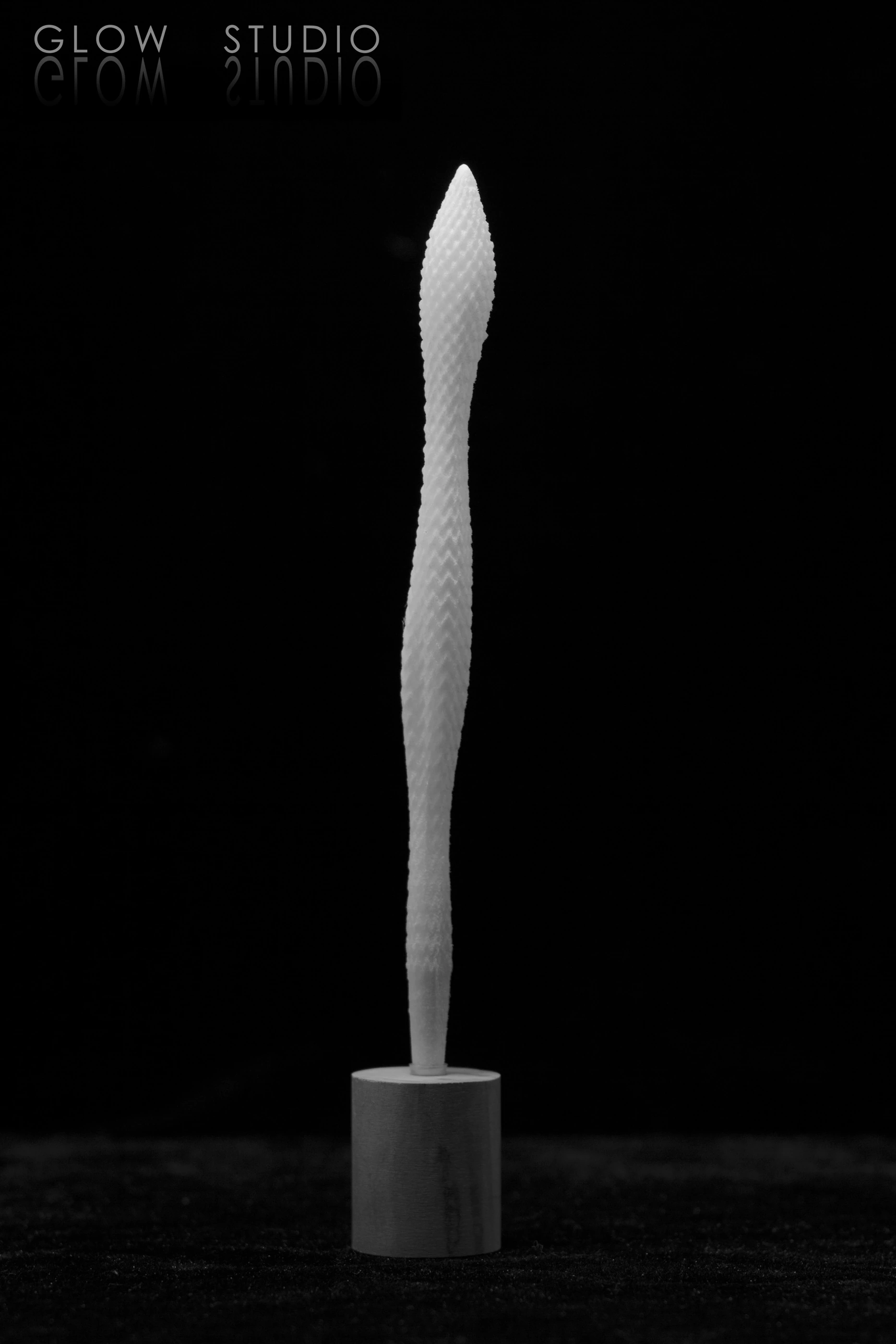
Gewu | Catalogue Record of a Wave-Shaped Writing Instrument
A pale slender wavy object stands upright on a dark cylindrical base against black. The original GLOW STUDIO watermark remains visible.
Record of a wave-shaped writing instrument from Gewu Studio’s product and spatial experiments. The original watermark is retained; this review’s evidence does not establish the individual designer, photographer, or materials.
Copyright: He Fa
Collaborative practice of Gewu Studio. See the work record for He Fa’s contributions in concept, photography, artistic direction, and other roles; not every individual object is assumed to have been independently designed by He Fa.
This archive is drawn from Gewu Studio’s half-year report. It brings together five projects: Wave Pen, Tantan, Cornices, a screen for Phoenix Island in Sanya, and lighting for Beijing’s 768 Creative Park. As co-founder and artistic director, He Fa contributed to the studio’s creative direction, conceptual development, form studies and philosophical inquiry. Individual products and commissions are presented here as a collaborative studio archive.
Wave Pen and Cornices turn continuous curves and layered structures into objects for use and wear. Tantan appears alongside them in the studio’s product series. Product photographs in the report make it possible to read these projects together with the contemporaneous Twelve Water Lamps.
The report also includes a screen designed for a Type A residence at Phoenix Island in Sanya and lighting for a venue in Beijing’s 768 Creative Park. The surviving images are design renderings. They record how curves and light were intended to enter architectural space; they do not establish completion of construction.
These products and spatial proposals are presented as records of the studio’s collaborative practice. He Fa’s work encompassed photography, conceptual development, form exploration and artistic direction. The making of the objects and authorship of their images are recorded separately.
The Qingfeng Fuping proposal designs a seascape screen for the entrance of a Type A show residence in the Phoenix Island business clubhouse, Sanya. It treats the entrance as a point where an interior view reaches the sea, connecting screen, home and seascape through looking. The proposal records an overall width of 2 m and height of 6 m, combining 55 distinct horizontal curved elements with a concealed straight framework.
The document also preserves form studies, three views of a single frame layer and a proposal for mortise-and-tenon assembly. As viewers change position, overlapping curves form different relationships. The document’s idea of “flow” refers both to the image of water and to the movement of a person.
Source documents: 清风拂屏, pp. 3, 6, 11, 14, 15, 16, 17, 20.
The studio’s Tantan naming draft develops ten homophonous or near-homophonous Chinese names: 弹弹, 忐忐, 探探, 叹叹, 昙昙, 坦坦, 檀檀, 潭潭, 谈谈 and 袒袒. Each links a disposition to a flower: 忐忐 connects shyness with begonia, while 潭潭 connects mystery with winter cherry blossom. The formal series thus also has a linguistic system built from sound, written meaning and botanical associations.
The draft documents the series’ naming concept and expressive method; it does not by itself establish production or exhibition details for all ten groups.
Source documents: 格物Tantan文案.
The studio’s initial Jinhua Award proposal brings together a ploughshare, earth, sun and a V for victory. A transformed V frames the medal; the trophy develops that outline into curves and volumes seen from different directions. The nine-page document preserves two variants, four elevation renderings and a sequence of spatial studies through 360 degrees.
The document is credited to GEWU Studio, and the medal rendering is inscribed “2013.” This date belongs to the award inscription in the image; the initial draft provides no record of selection or completed production.
Source documents: 金铧奖——方案初稿, pp. 1, 2, 3, 4, 5, 6, 7, 8, 9.
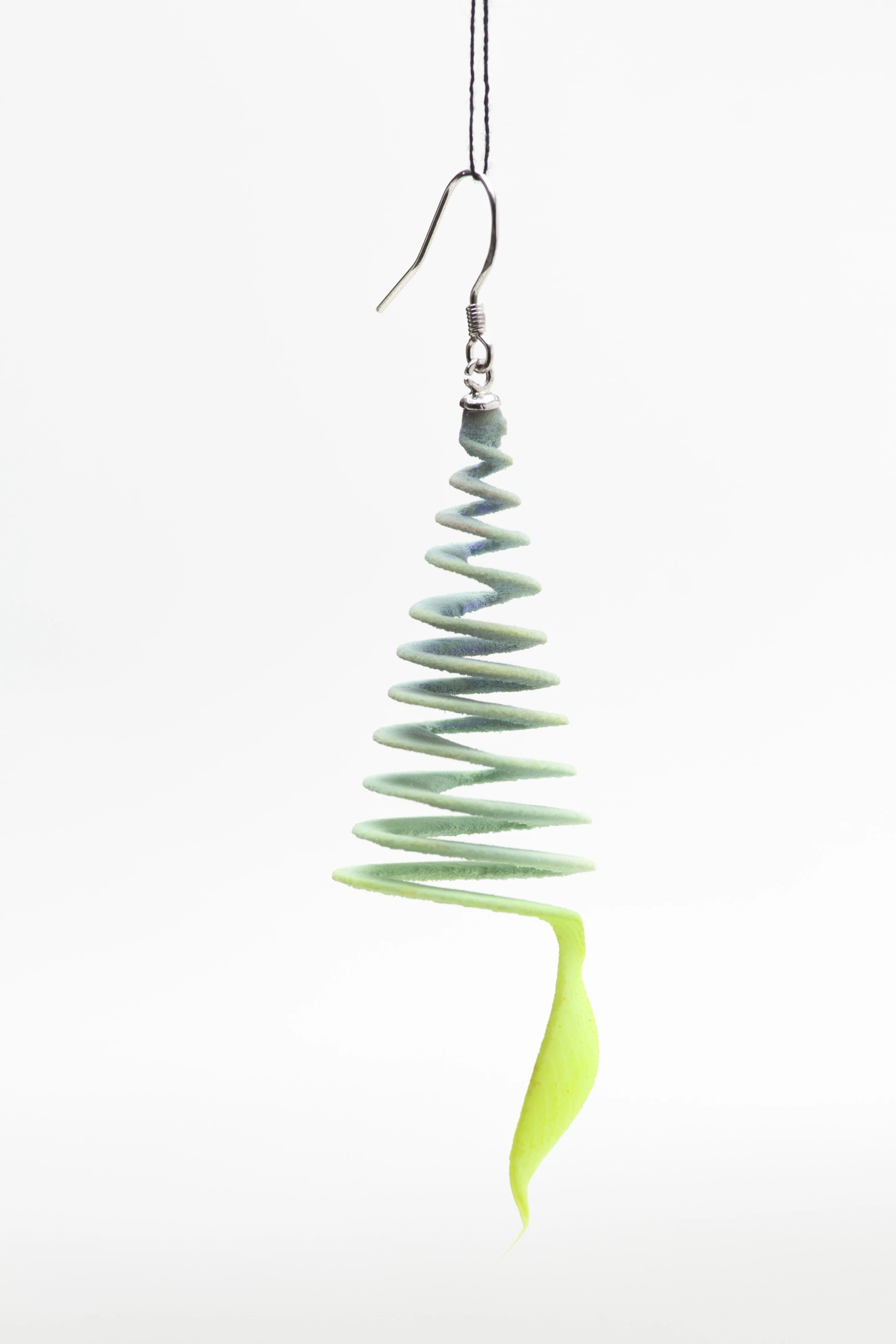
Spiral hanging object with a lime-yellow end
A slender hanging object descends from a metal hook against white, with a pale-grey spiral widening downwards before becoming a curved lime-yellow sheet at its tip. Soft background shading separates the connector, spaced coils and pointed lower end at different heights in the vertical composition.
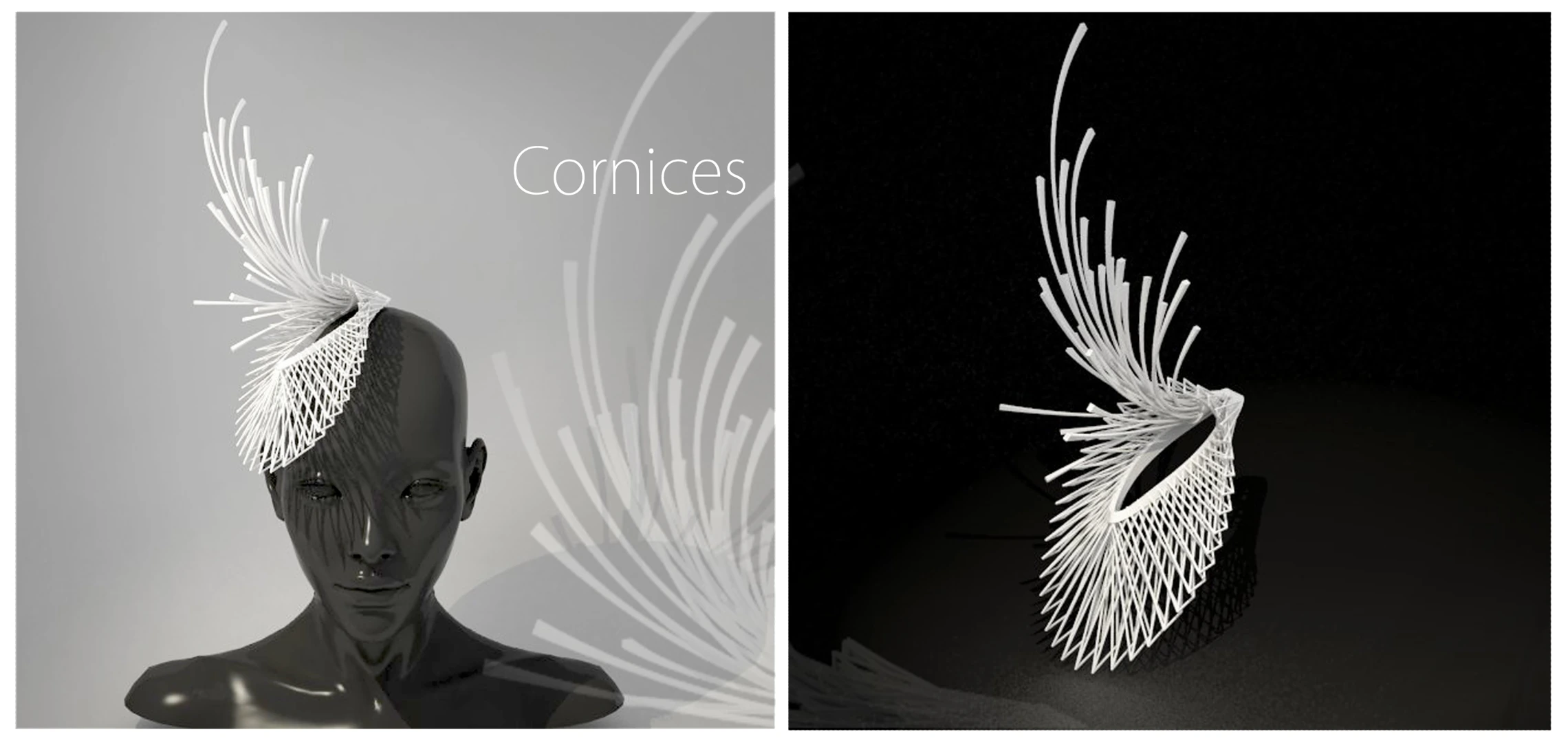
Paired renderings of a white feather-like structure
Two renderings sit side by side: a dark mannequin head wears an angled white woven structure at left, while the object appears alone on black at right. Its mesh-like lower section and unequal upward-extending rods define a curved outline beneath the visible Cornices label.
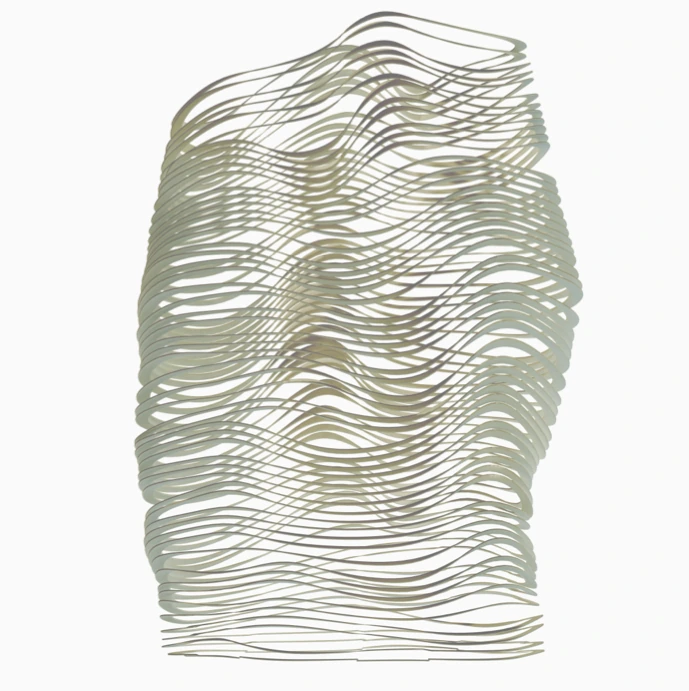
Screen proposal built from layered wavy lines
A white-background rendering stacks pale grey-green wavy lines into an upright screen form, swelling sideways around narrowed sections. Curves at different heights overlap across open white gaps, with layered lines gathering near the base and no people or surrounding room to establish physical scale.
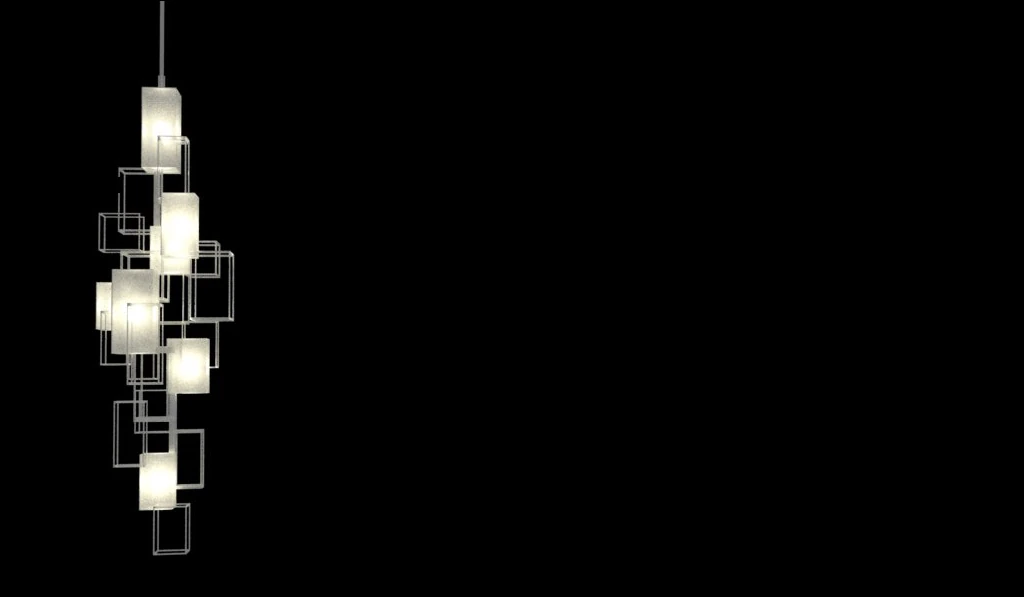
Lighting proposal with vertically staggered cubes
A long suspension line supports an elongated lighting group against black, with several bright cubes staggered vertically among grey solid blocks and transparent fine frames. Widely separated upper and lower lights, crisp glowing edges and broad dark margins emphasise the assembly's vertical extension and layered connections.
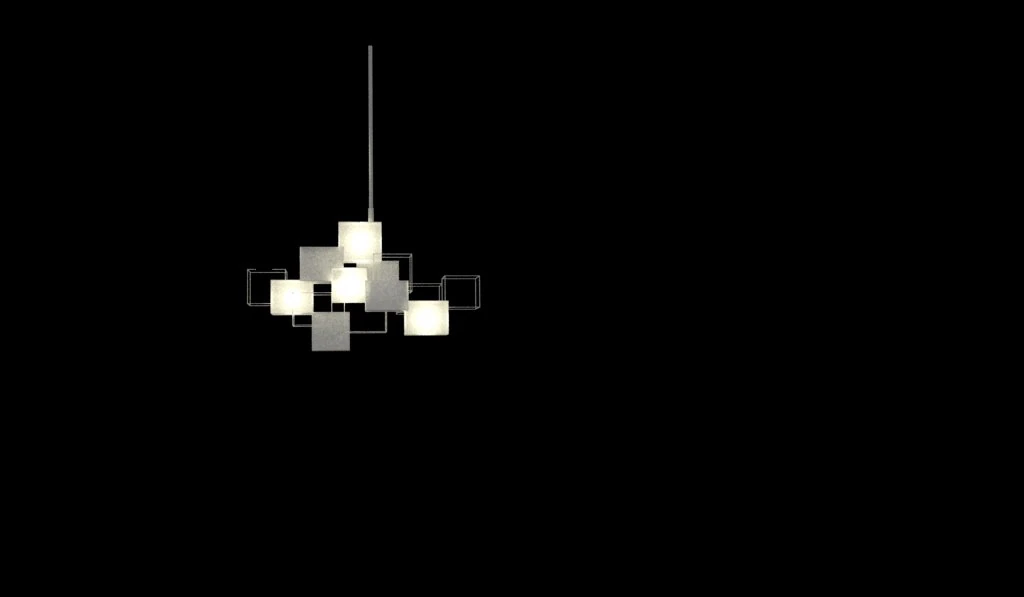
Lighting proposal with a compact cluster of cubes
A compact group of white glowing cubes gathers around a suspension line slightly left of centre within a black horizontal frame. Transparent square outlines intersect the solid central blocks and extend sideways above darker lower cubes, producing a short cross-like silhouette surrounded by generous empty space.
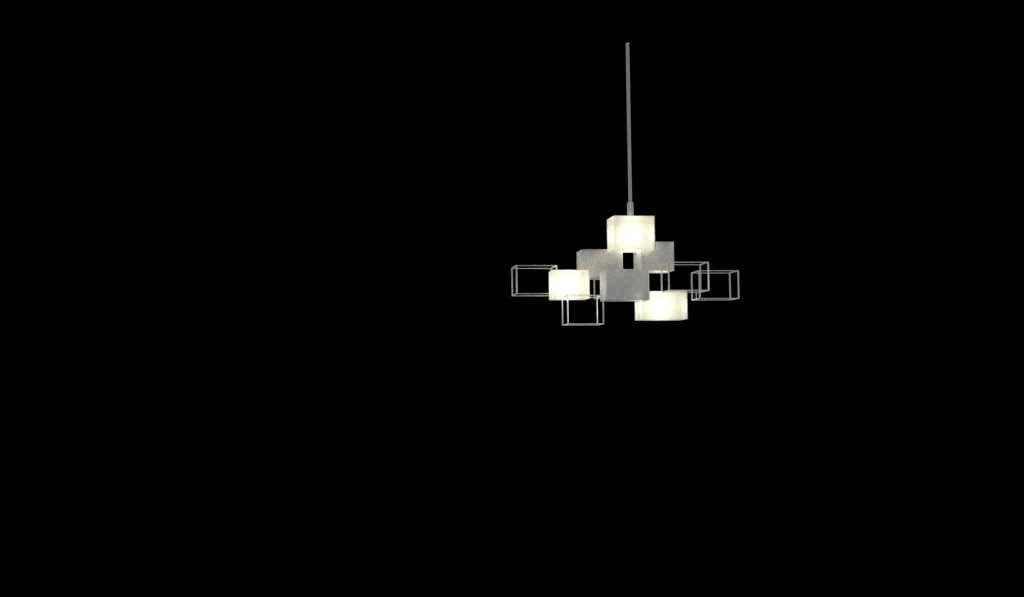
Lighting proposal with horizontally distributed cubes
A small group of glowing white cubes hangs right of centre in a broad black field from a thin vertical suspension line. The cubes step above and below the centre and extend sideways among transparent wireframe boxes and solid grey blocks, emphasising their horizontal distribution within surrounding darkness.
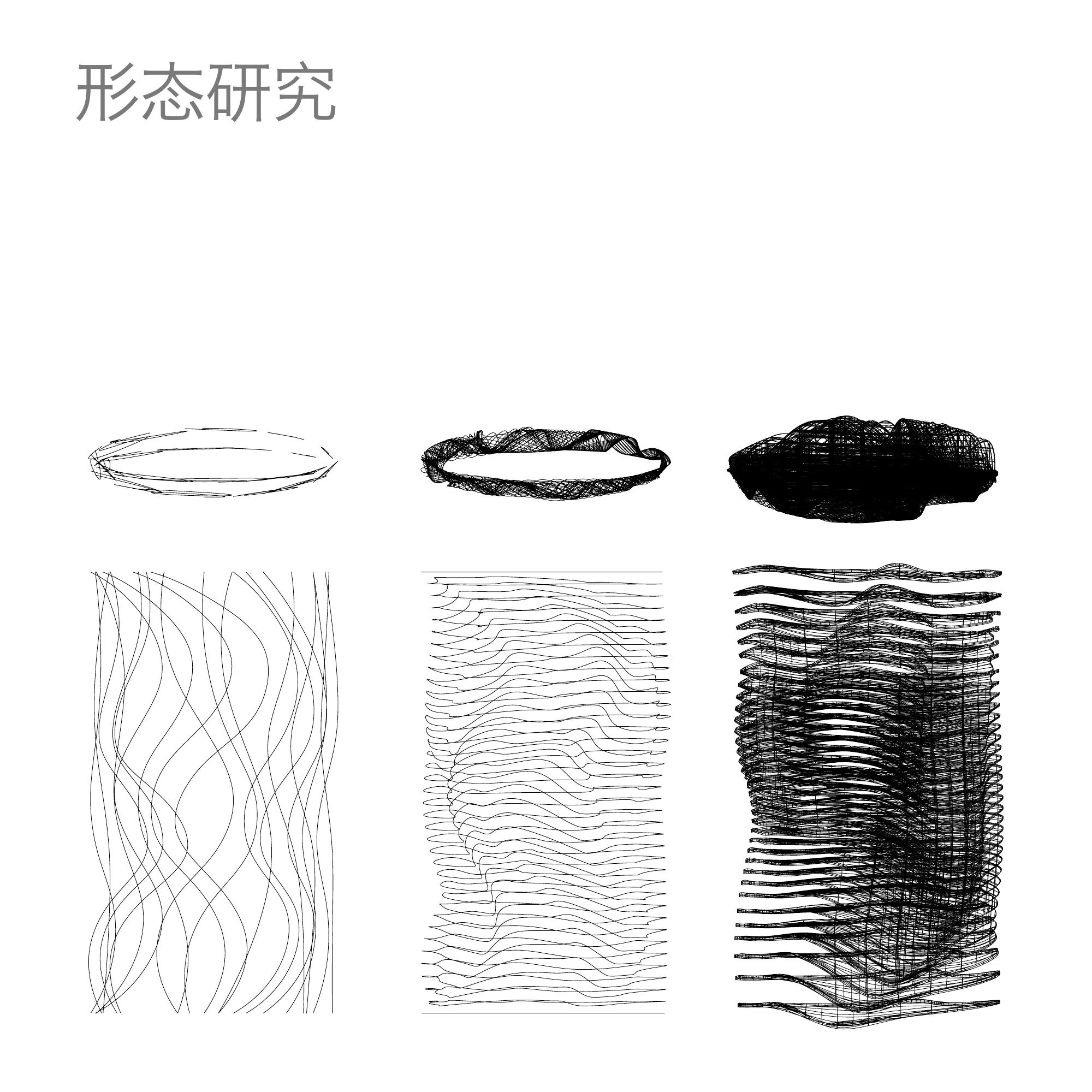
Gewu Studio / Products and Spatial Experiments | Ring sections and upright framework studies
The white design page is headed 形态研究. Three upper groups move from a simple ring outline through denser loops to a darkened section, each paired with an upright framework below. Slender crossing curves form column-like or screen-like volumes, placing sectional variation beside the overall structural arrangement.
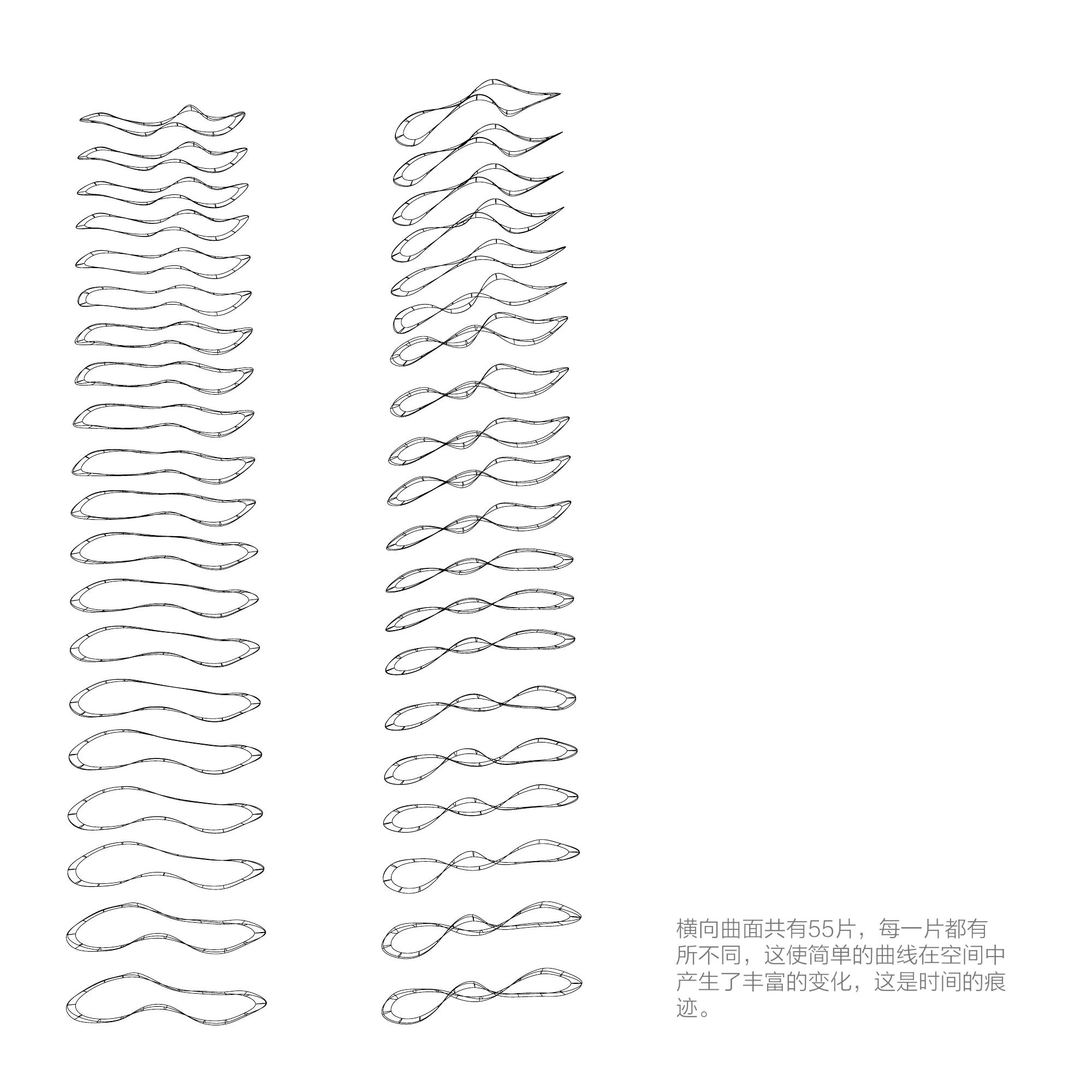
Gewu Studio / Products and Spatial Experiments | Two columns of layered curved outlines
Two columns of fine curved outlines run down a white page. The left stack changes gently while the right shows stronger crossing and twisting. A note about layered horizontal surfaces remains at the lower right. No built object or exhibition setting appears; the drawing concentrates on individual layers and the changing relations between neighboring contours.
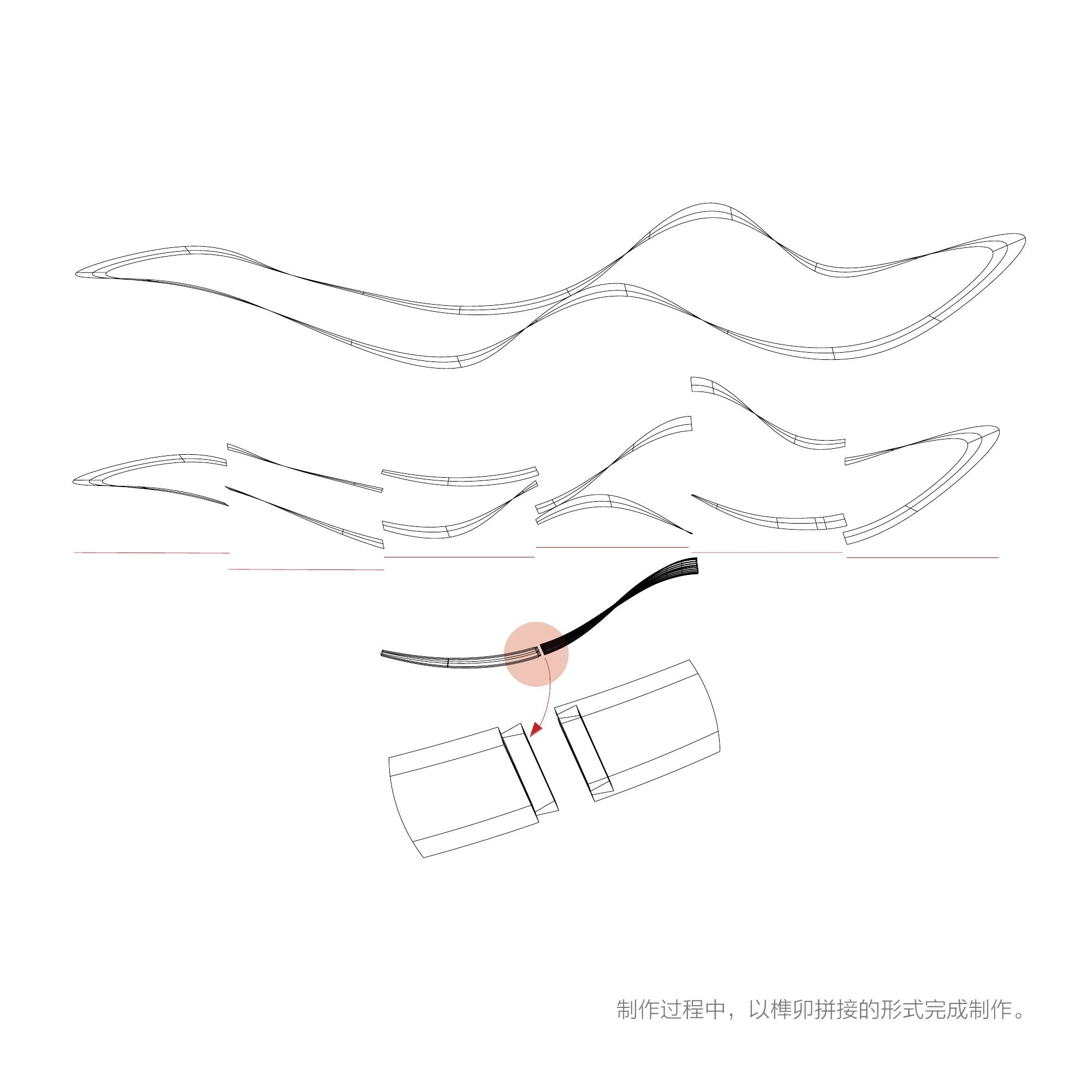
Gewu Studio / Products and Spatial Experiments | Separated curved pieces and a connection detail
The proposal sheet begins with an extended wavy wireframe. Separate curved pieces are laid out beneath it, followed by an enlarged connection highlighted with a pale red circle. Two rectangular outlines indicate adjoining directions and a short dark element bridges the joint, documenting a strategy for separating and assembling the form.
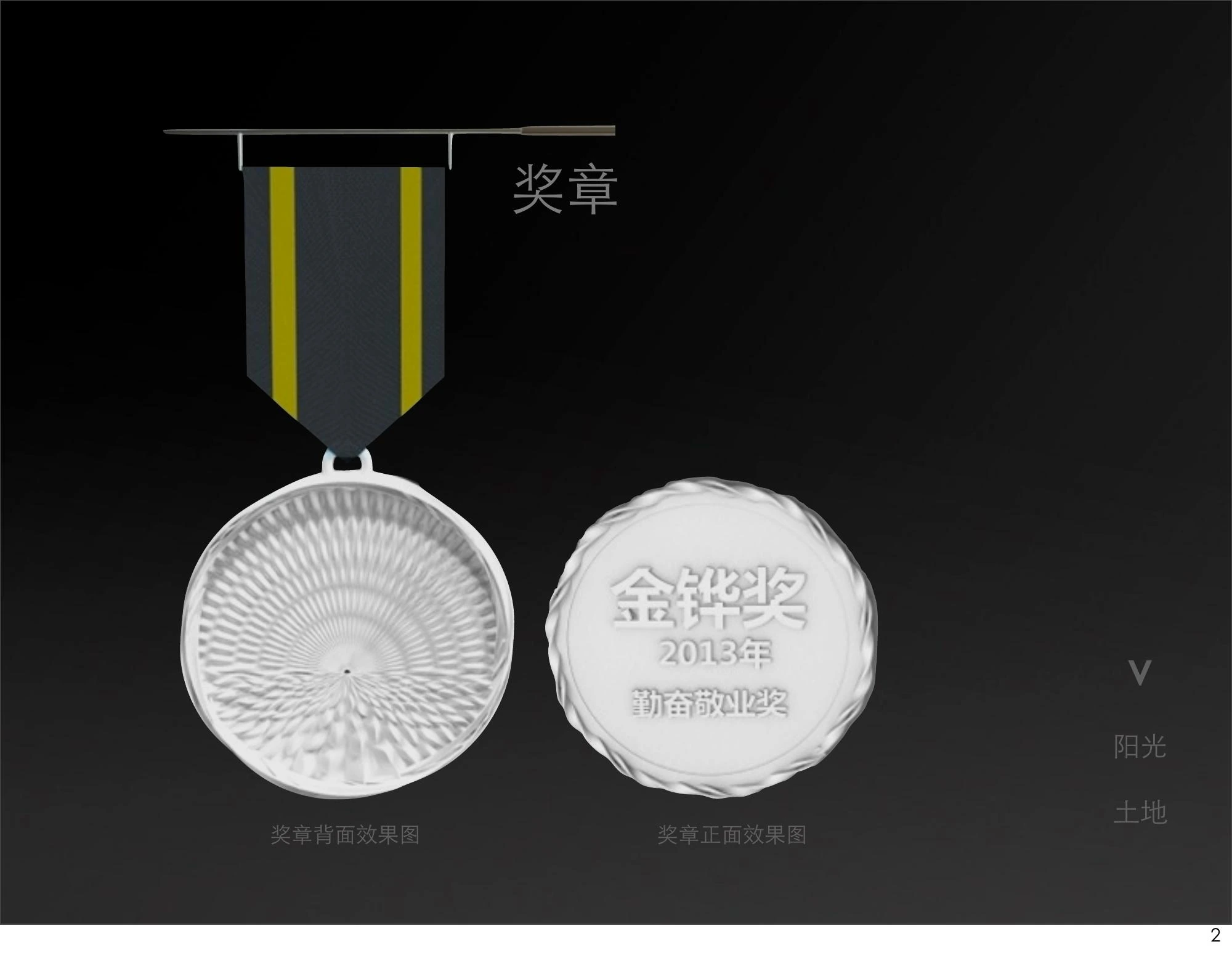
Gewu Studio / Products and Spatial Experiments | Front and reverse designs for a round medal
On a black design sheet, a black-and-yellow medal ribbon sits above two silver-white circular renderings. The left face carries a radiating spiral texture; the right includes the lettering 金桦奖 and 2013年. The heading 奖章 and page number remain at the margins, identifying the image as a medal design proposal.
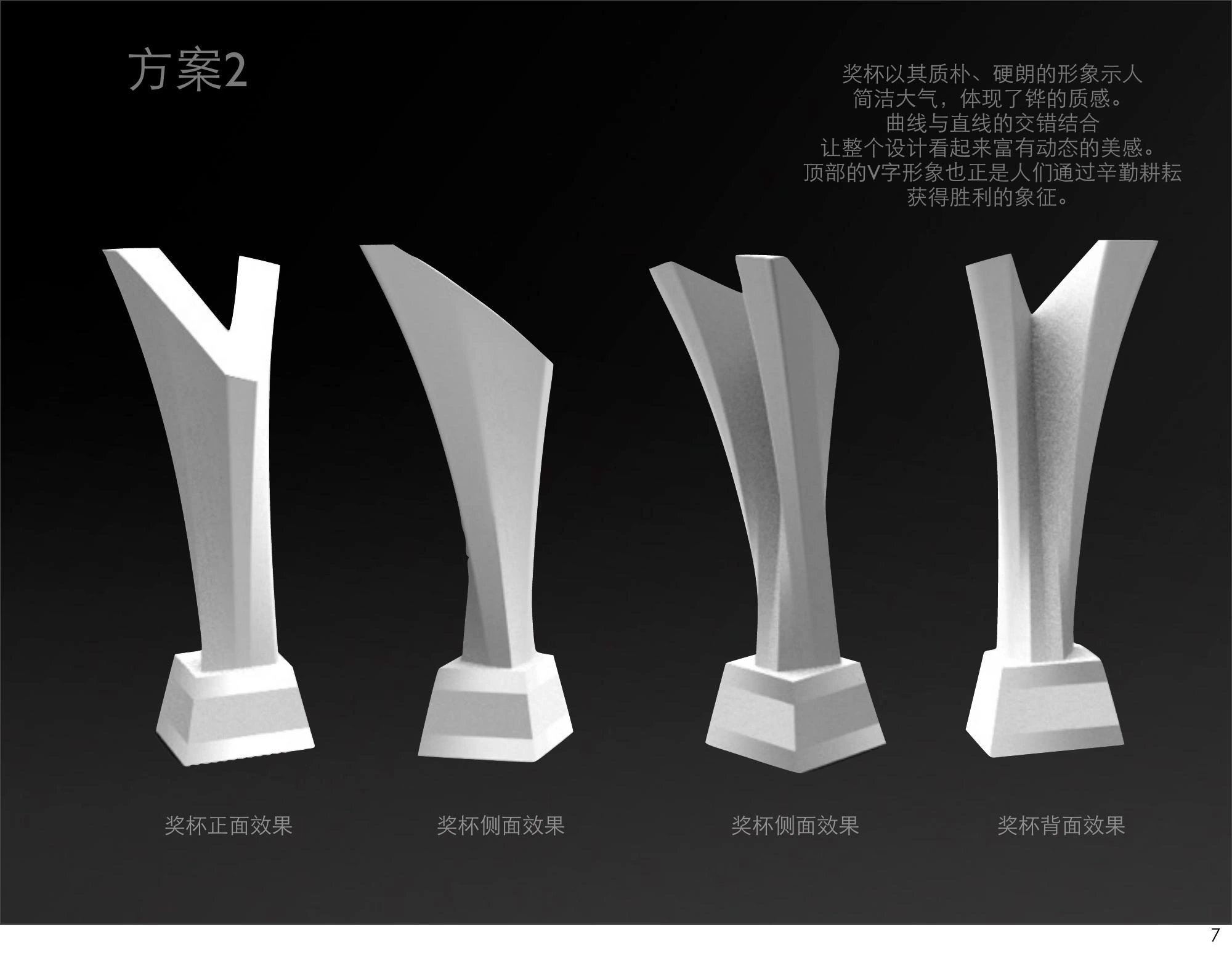
Gewu Studio / Products and Spatial Experiments | Four views of a branching trophy
Four silver-white trophy renderings stand side by side on a black proposal sheet. Square bases support slender branching Y-shaped elements. Each angle exposes different planes and openings. The heading 方案2, a short design statement above and view labels below keep the proposed object tied to its presentation format.
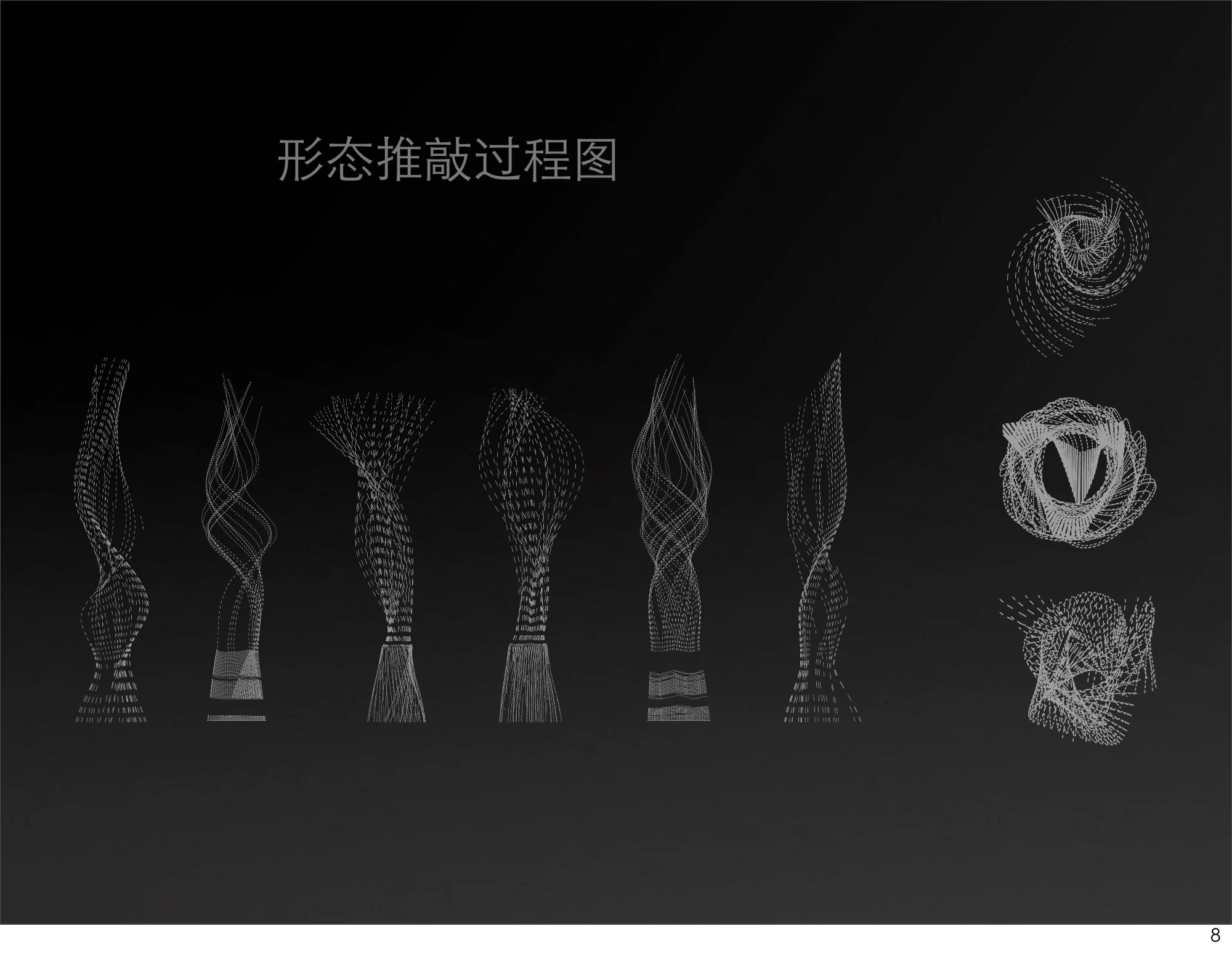
Gewu Studio / Products and Spatial Experiments | Wireframe studies of trophy form
Beneath the heading 形态推敲过程图, slender wireframe models explore different degrees of twisting, contraction and opening, each above a small base. Rounder bundles of rotating lines appear at the right. Fine strokes overlap transparently against black, documenting form studies rather than photographs of completed trophies.
Prepared from original documents retained by the artist. English text is a translation for this site.
Gewu Studio / Products and Spatial Experiments, 2012–2013. Parametric design, products, 3D printing, spatial proposals. He Fa’s role: Co-founder and artistic director.
Cite this record: Gewu Studio / Products and Spatial Experiments · 2012–2013 · Co-founder and artistic director · https://hefa.p4theater.cn/en/work/gewu-products-and-spaces
TAKE A PATH ACROSS
Spaces transformed
Gewu Studio / Products and Spatial ExperimentsShunan Bamboo Sea
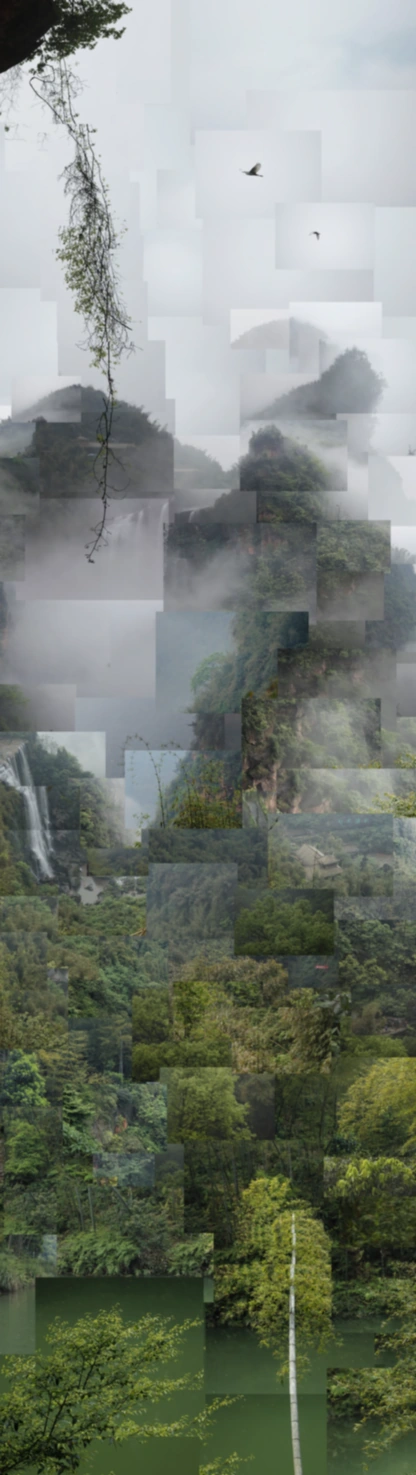
Shunan Bamboo Sea accumulates photographs vertically; the Clear Breeze Screen proposal uses fifty-five curved layers in relation to viewing position. One moves the eye; the other proposes changing relations among curves through bodily movement.
Photographic fragments accumulate along the long axis of a narrow vertical image, directing attention between its upper and lower ends.
Pages 3, 6, 11, 14–17 and 20 of the Qingfeng Screen proposal document the sea-view screen, 55 surfaces and changing viewing positions; renderings do not establish construction.
Language in transit
Gewu Studio / Products and Spatial ExperimentsCentral
Central moves a relief’s sun into photography; Gewu’s trophy proposal combines sun, ploughshare and a V shape. Both transfer motifs, but one has a documented finished work while the other remains a studio design draft.
The portfolio statement explicitly begins with a relief encountered while travelling and places the sun among mountains; this is the artist’s stated compositional decision.
Pages 1–9 of the Golden Plough Award draft combine a ploughshare, sun and V shape; the draft supplies no selection or manufacture record.
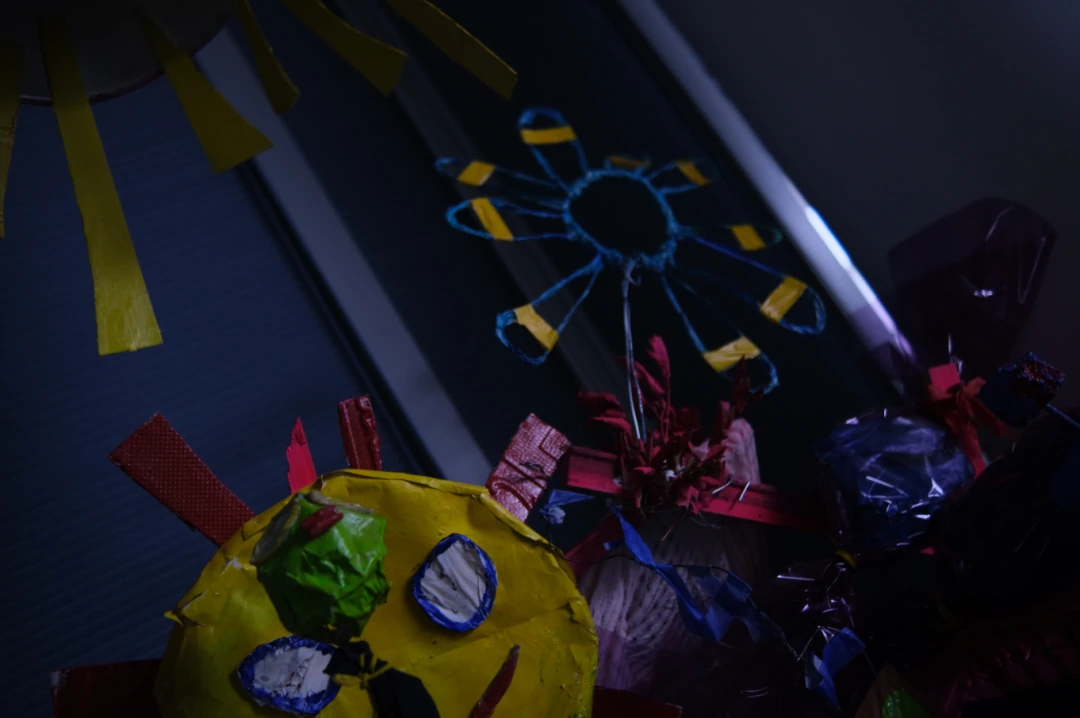
Language in transit
Gewu Studio / Products and Spatial ExperimentsHappiness Kingdom
Tantan’s naming text connects ten homophones to temperaments and flowers; Happiness Kingdom lets makers give figures personalities. Names extend objects’ meanings in both, while a series-naming proposal differs from an ongoing shared world.
Public materials from April–May 2023 describe collective puppet making, assigned personalities and role recruitment; individual roles and texts retain their own authors.
The Gewu Tantan text connects ten homophonic names with temperaments and floral images; it is a naming proposal.
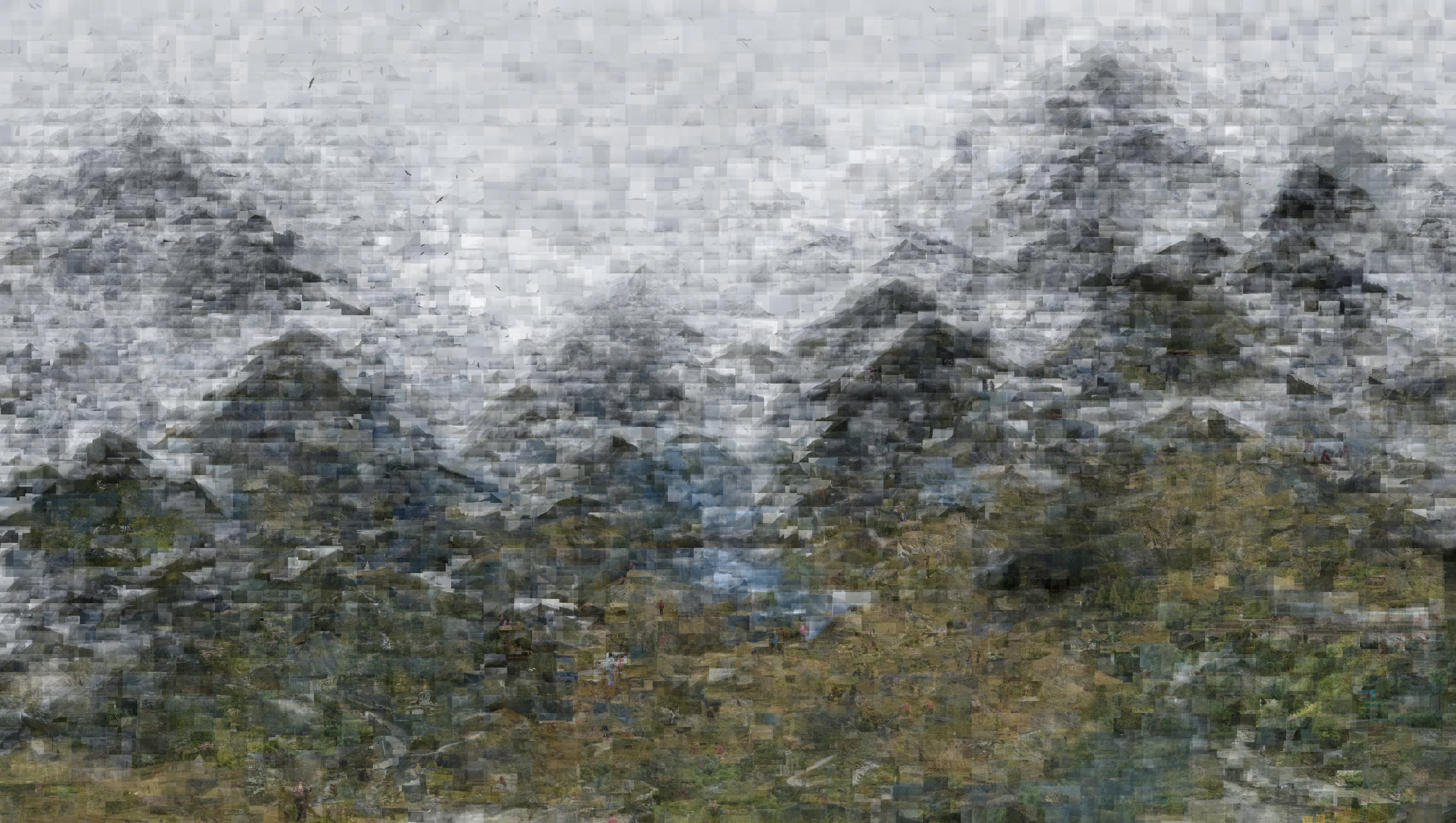
Spaces transformed
Gewu Studio / Products and Spatial ExperimentsShanshui
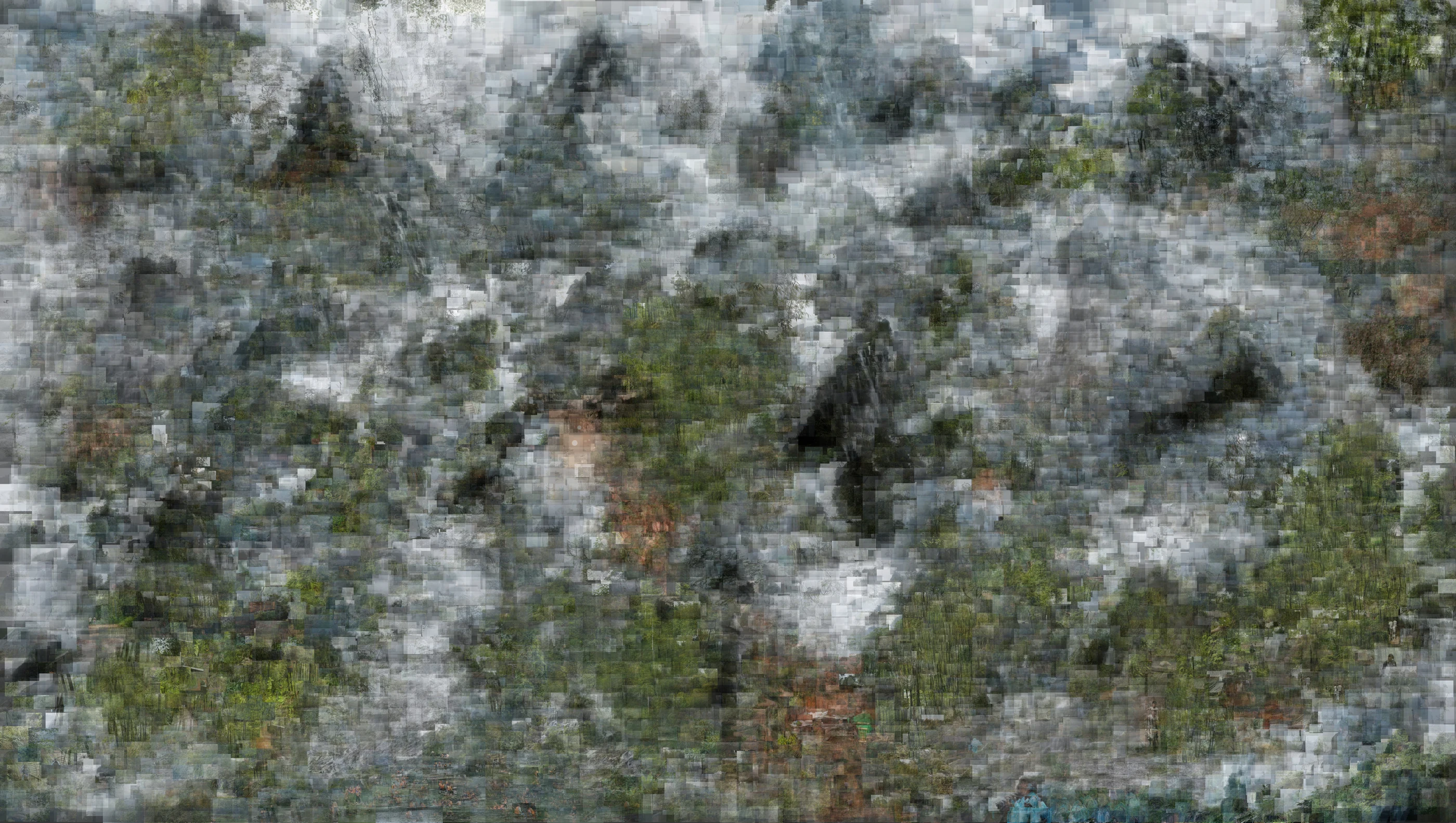
Shanshui forms a landscape from photographs, readable from near and far; the Clear Breeze Screen proposal places curved layers between a residence and a sea view. One changes an image, the other proposes changing an actual passage of sight.
The statement on defence page 7 describes an experiment with 1,025 Siguniang photographs, combining different viewpoints as traces of walking; that number is not generalized to every work.
Pages 3, 6, 11, 14–17 and 20 of the Qingfeng Screen proposal document the sea-view screen, 55 surfaces and changing viewing positions; renderings do not establish construction.
2026-10-04 / ARCHIVAL ADDITION
Studio documents distinguish project work from artistic production and discuss parametric design, 3D printing and participation. A trophy draft retains the development of V-shaped forms, horizons and curves. The documents belong to collaborative studio practice.
FROM HERE, ELSEWHERE
Gewu | Catalogue Record of a Wave-Shaped Writing Instrument — Record of a wave-shaped writing instrument from Gewu Studio’s product and spatial experiments. The original watermark is retained; this review’s evidence does not establish the individual designer, photographer, or materials.
Breeze across the Screen | Grayscale Interior Proposal Rendering — Page 12 of the Breeze across the Screen PDF: an interior proposal rendering, not a photograph of a completed space.
Breeze across the Screen | Design Dimensions and View Analysis — Page 17 of the Breeze across the Screen PDF: top, front, and side design views. Dimensions are annotations in the source proposal, not measurements of a completed construction.
Breeze across the Screen | Color Interior Proposal Rendering — Page 21 of the Breeze across the Screen PDF: an interior proposal rendering from another viewpoint. It does not establish construction, completion, or an event’s occurrence.
Stream Lines | Headpiece Design Catalogue Page — Page 21 of Product Catalogue (2012 Graduation Design Exhibition): a Stream Lines headpiece design page. The image does not establish actual wearing, materials and techniques, or completed fabrication.
All images, sources and citations for this work ↗
2026-10-27
The following preserves the earlier published wording, images and reading links. The current work information and credits remain above.
2026-10-24
Vertical product photograph of Wave Pen
2026-10-24
A slender white object stands vertically on a grey cylindrical base against black, its dense fine ribs twisting around a narrow waist beneath a pointed oval top. The base rests on a textured dark surface, with faint studio lettering above and side light separating the outline from its lower shadow.