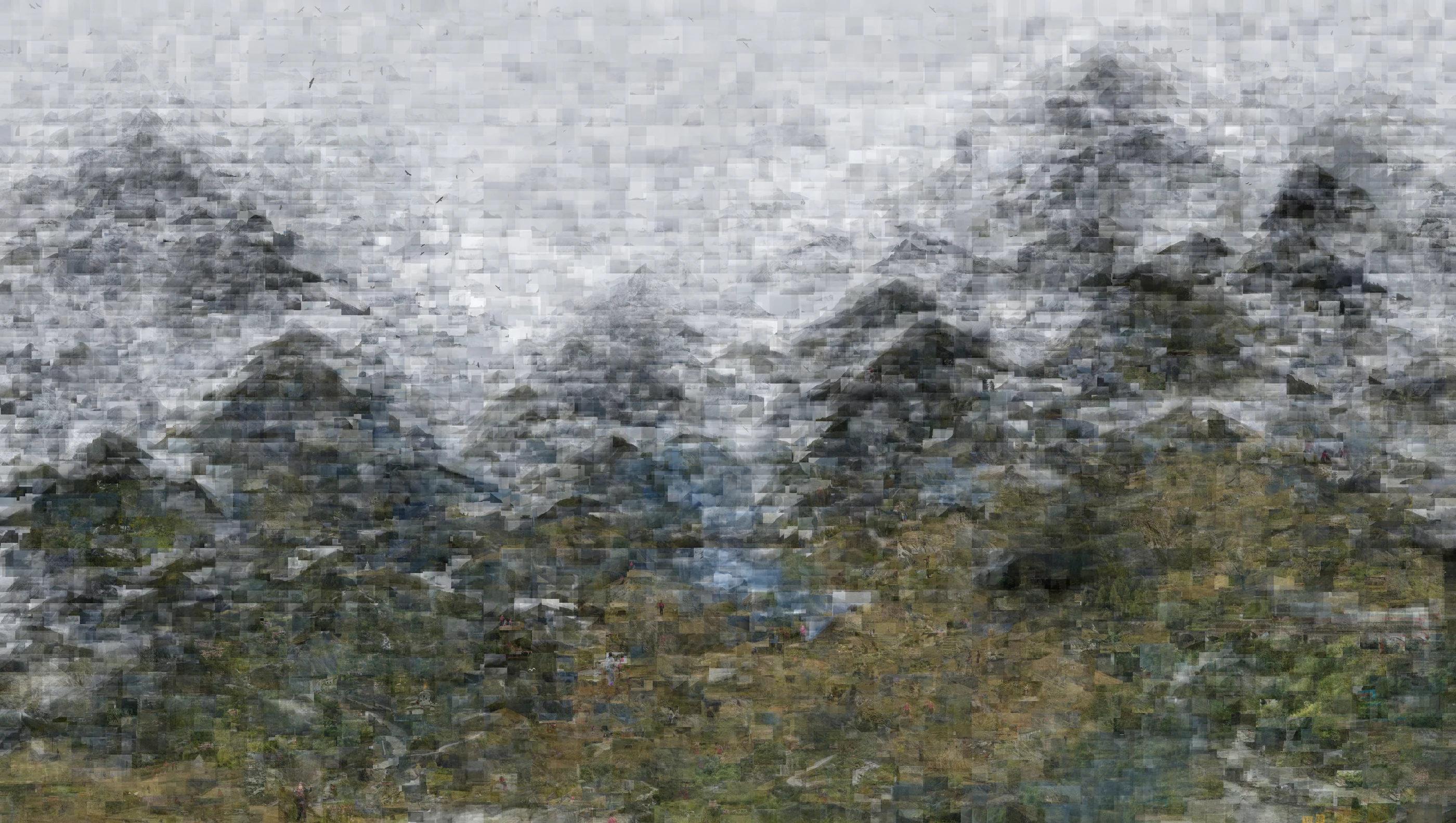
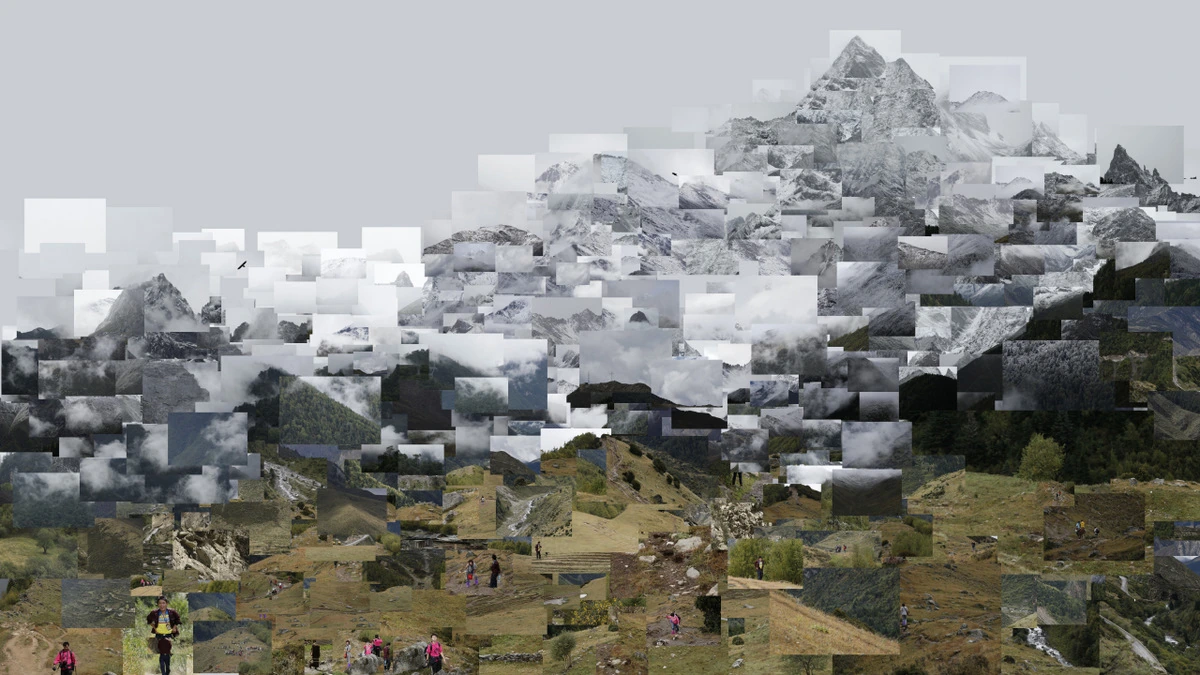
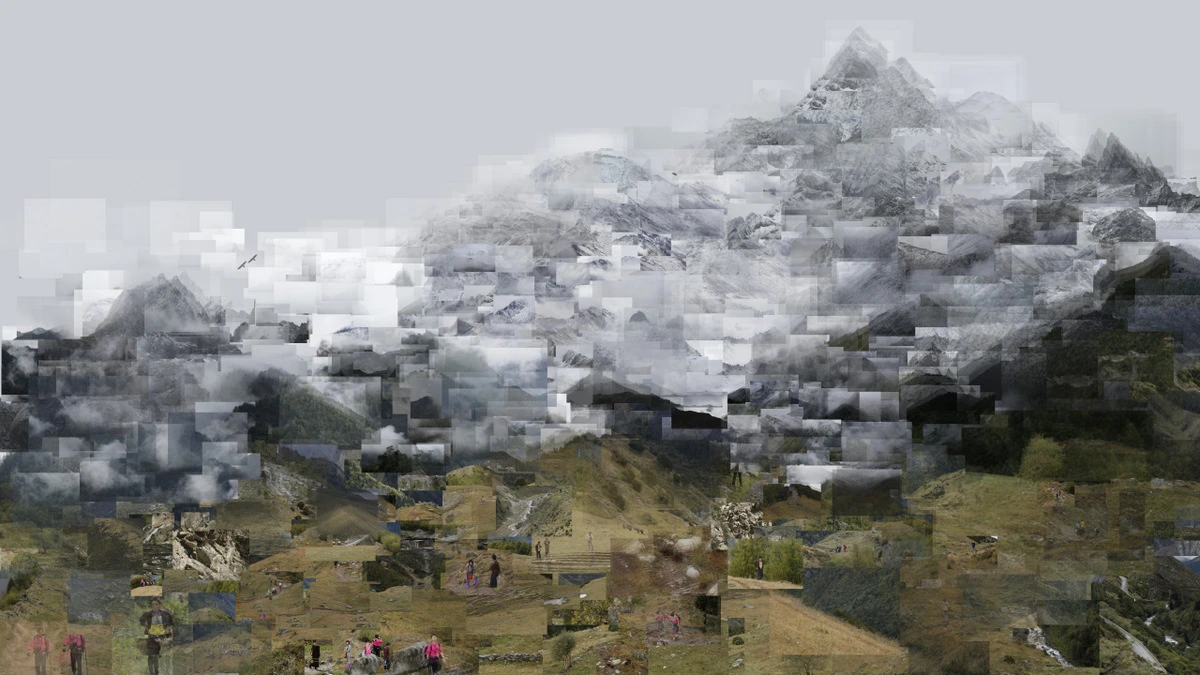
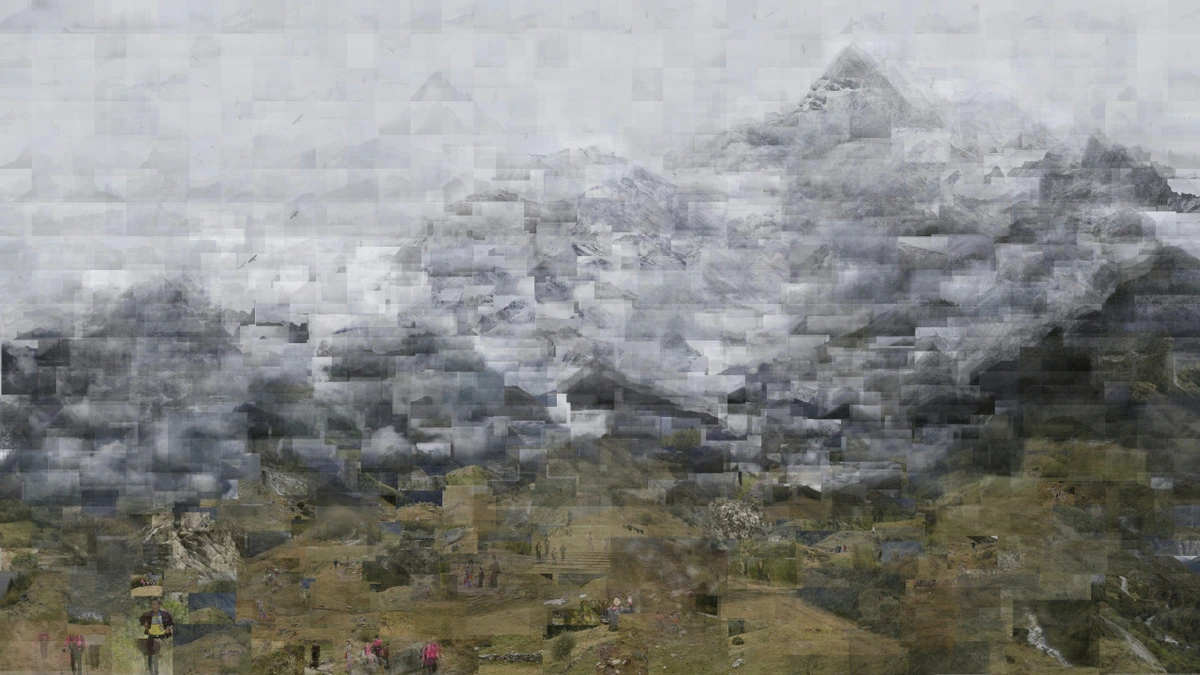
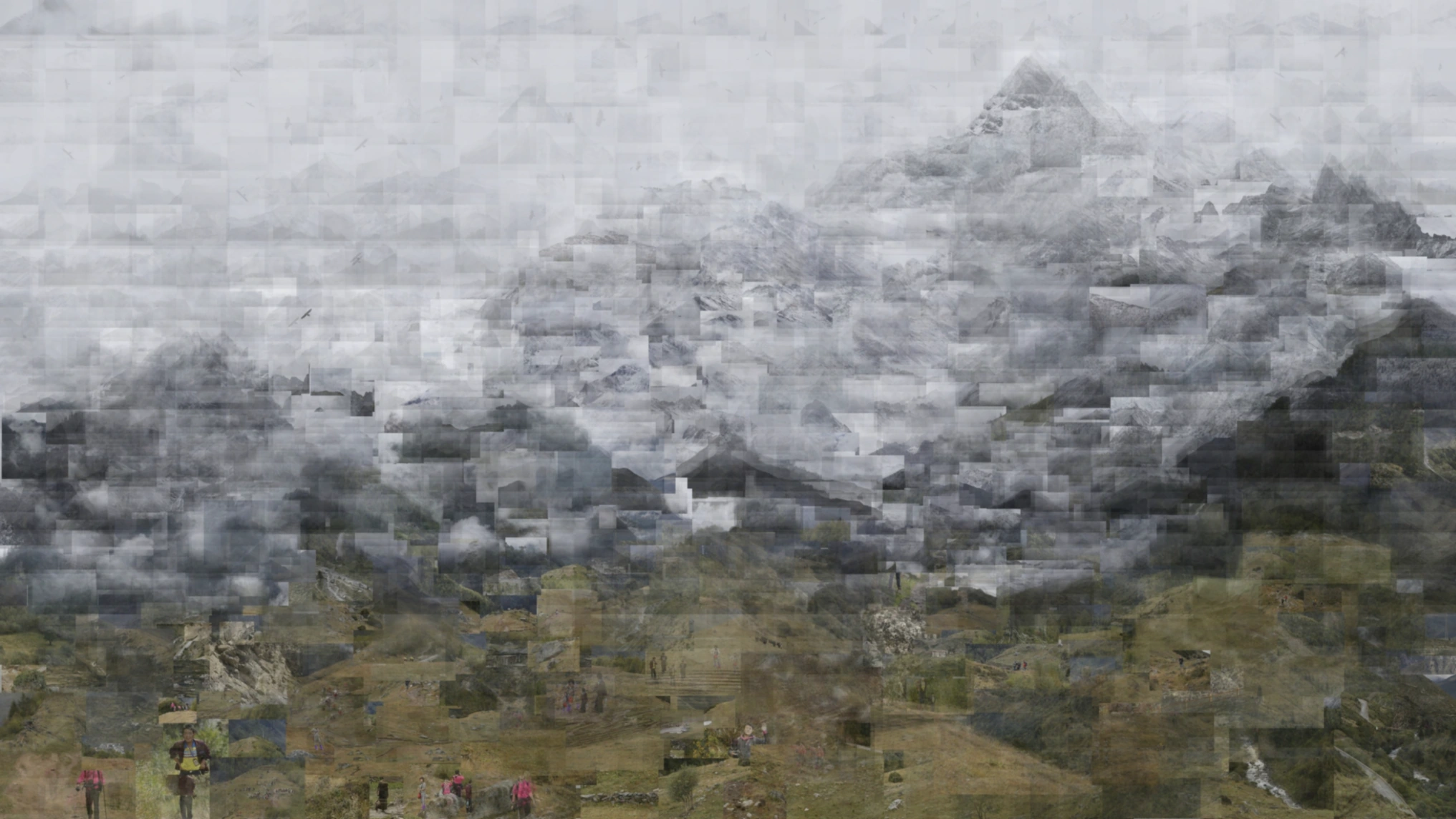
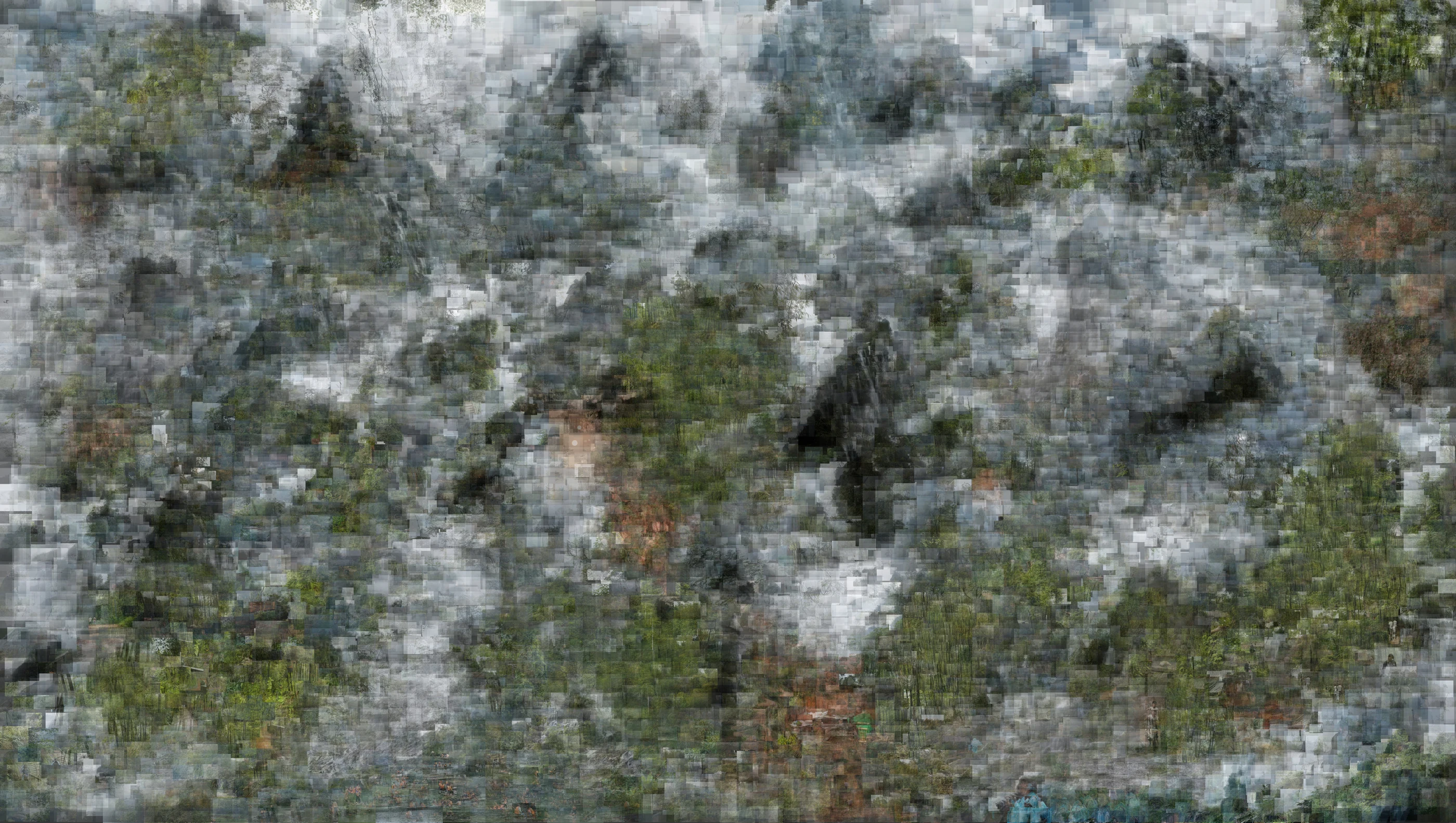
Completed in 2012, Mountain Beyond Mountains was He Fa’s graduation photography work. Photographing, dividing and recomposing organize many partial images into a landscape; it forms a whole at a distance and separates into time, viewpoint and fragment up close.
Mountain Beyond Mountains — Red and White entered the CAFA Art Museum collection. The work also established a line He Fa would return to: looking organizes space, bodies and relations.
A line through the work
If a landscape is made from countless incomplete views, do we see the mountain—or the way we look?
SCALE & COLLECTION
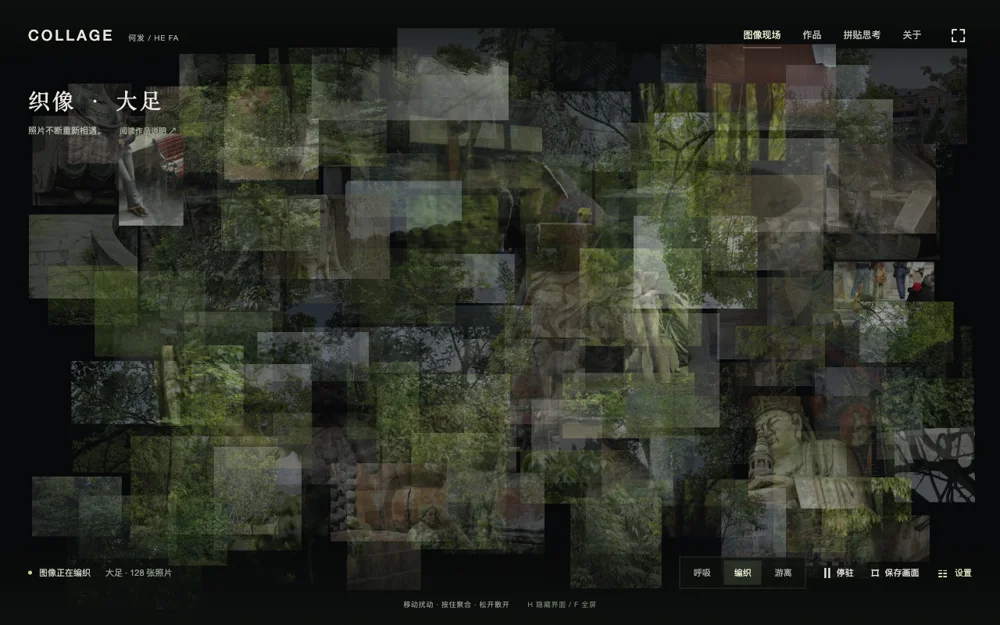
Navigate on screen; approach the physical work.
The museum record lists Red and White as C-print light-box transparencies and light boxes, each 110 × 190 cm, two works. At this scale, moving between individual photographs and the landscape becomes a bodily action. The online viewer offers another way to read closely.
ORIGINAL PROCESS ARCHIVE · AN INQUIRY INTO SHANSHUI
From photographs to brushstrokes: eight stages in the graduation defense
The original graduation defense, titled An Inquiry into Shanshui, records method studies, two approaches to arrangement and the final works. The eight illustrated stages below follow its order. Artist statements are translated from Chinese; the accompanying reading notes are editorial.
Since 2008, I have been trying to use photography to express the Chinese landscape in my mind. In the Shanshui series, I try to dissolve the photographs’ original content and information, turning them into “brushstrokes” in order to construct an ideal space.
He Fa, original graduation defense, p. 2. Translated from Chinese.
PROCESS 01 / 08
Movement through image shifts
Shifting the images brings changes in movement.
Artist statement · defense p. 4 · translated from Chinese
The initial experiment concerns the sense of movement in an image. The photograph ceases to act as a fixed window: shifts disturb its edges and details, changing the movement of the composition.
An Inquiry into Shanshui, graduation defense, p. 4. Full composition of the embedded image retained.
PROCESS 02 / 08
Scaling and displacement
Repeated scaling and displacement of the images produce an illusion between form and formlessness.
Artist statement · defense p. 5 · translated from Chinese
Scaling changes the relative size of the photographs; displacement lets a scene recur in different positions. The artist describes the resulting state as an illusion between form and formlessness: the landscape remains perceptible, but no single camera position accounts for it.
An Inquiry into Shanshui, graduation defense, p. 5. Full composition of the embedded image retained.
PROCESS 03 / 08
1,025 photographs and the trace of walking
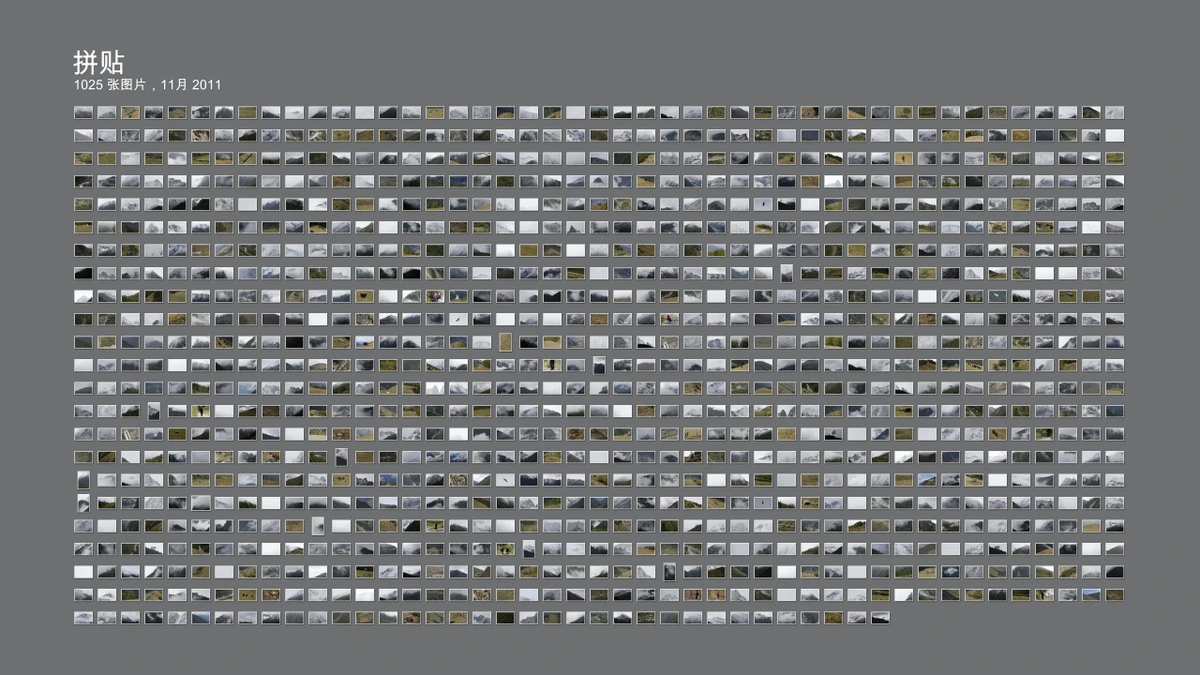
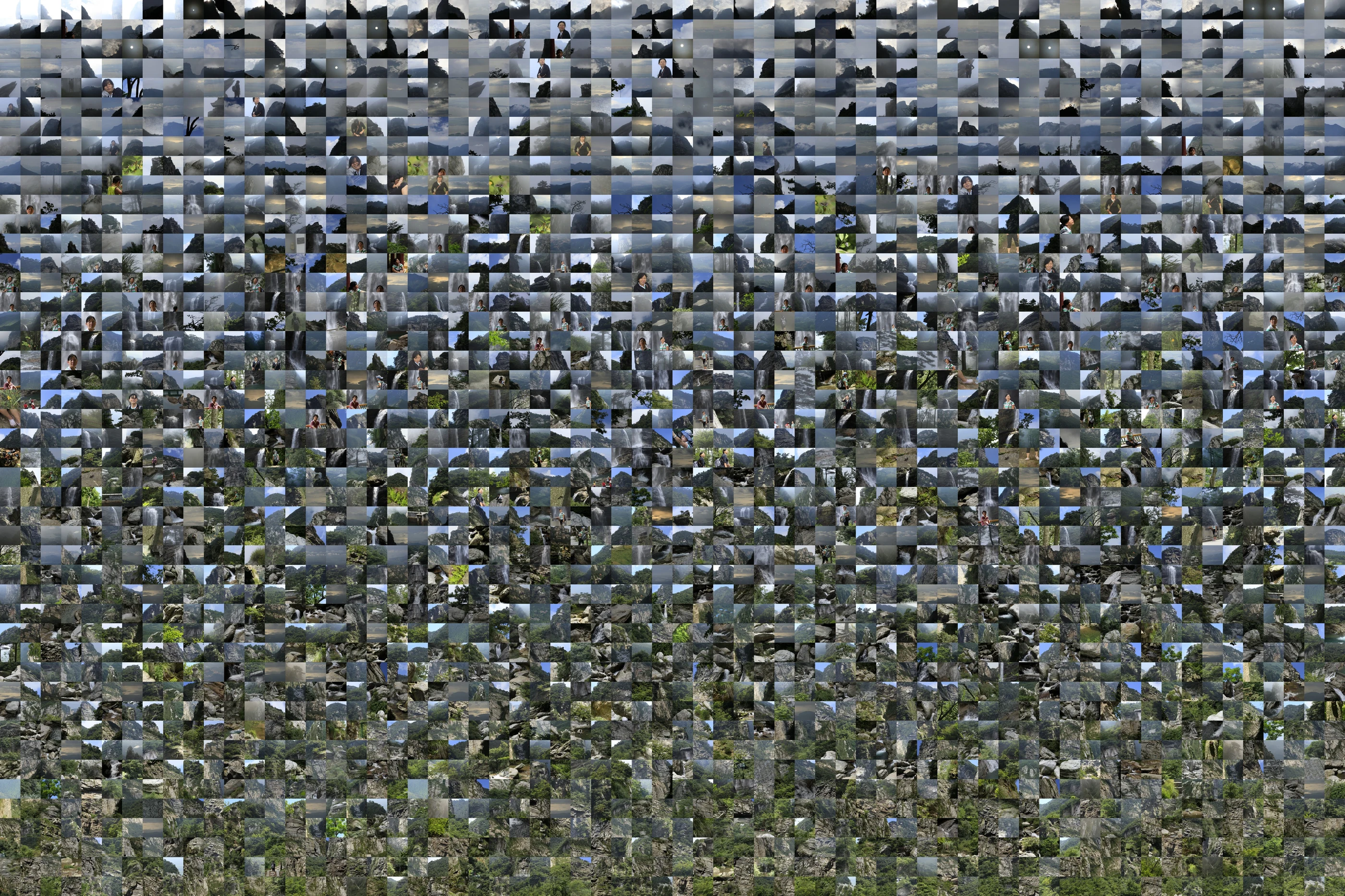
I used 1,025 landscape photographs taken at Siguniang Mountain in Sichuan as material for experiments in forms of combination.
Because they were taken from different locations, each photograph has a different perspective. Combined, they move from the single-point perspective of conventional photography to a thoroughly dispersed perspective. This composition records the trace of my walking and my memory of the whole mountain.
Artist statement · defense p. 7 · translated from Chinese
The defense presentation specifies the number of source photographs and their location for this experiment. The figure 1,025 refers to this group from Siguniang Mountain; it does not establish the photograph count of every work in the series. The differences between camera positions matter: the route of looking becomes part of the composition.
An Inquiry into Shanshui, graduation defense, p. 7. Full composition of the embedded image retained.
PROCESS 04 / 08
First arrangement: a grid organized by color
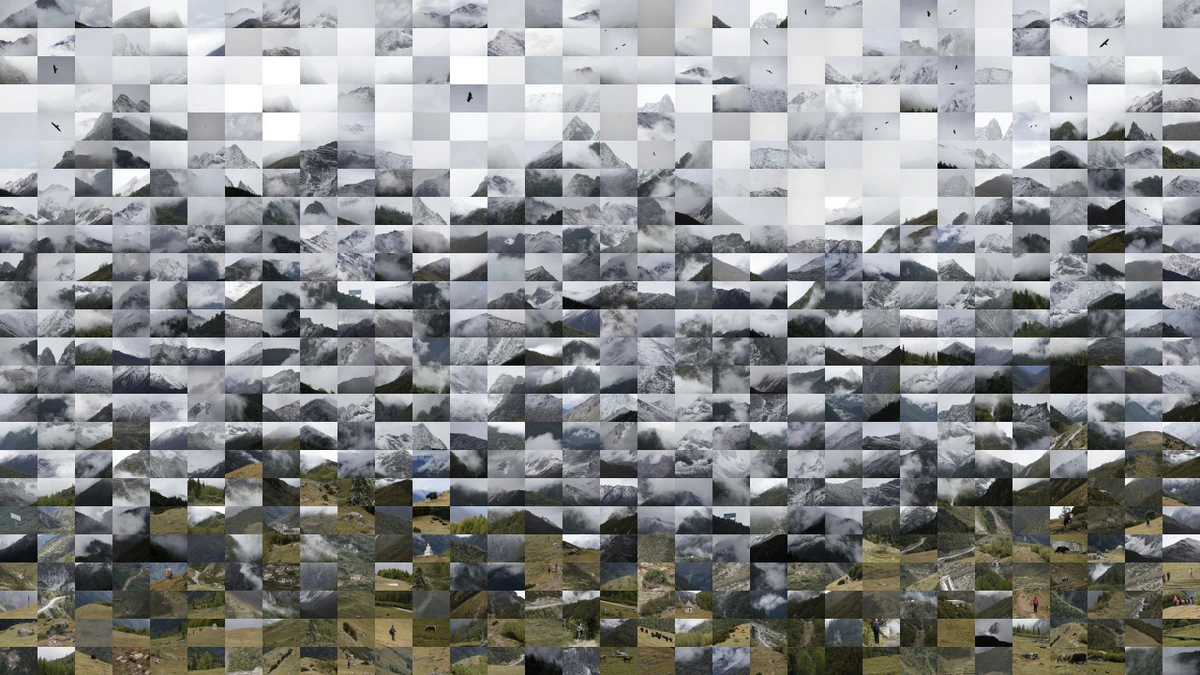
The first method is an uncontrolled grid arrangement. I place the source photographs in the grid according to their color relationships, seeking only a faint distinction between ground, mountains and sky.
Artist statement · defense p. 8 · translated from Chinese
The grid first provides a framework for holding photographs. Color relationships then form broad spatial areas. A local image does not need to describe an identifiable place; the relation of ground, mountains and sky only needs to emerge faintly.
An Inquiry into Shanshui, graduation defense, p. 8. Full composition of the embedded image retained.
PROCESS 05 / 08
Working the grid: layers, shifts and opacity
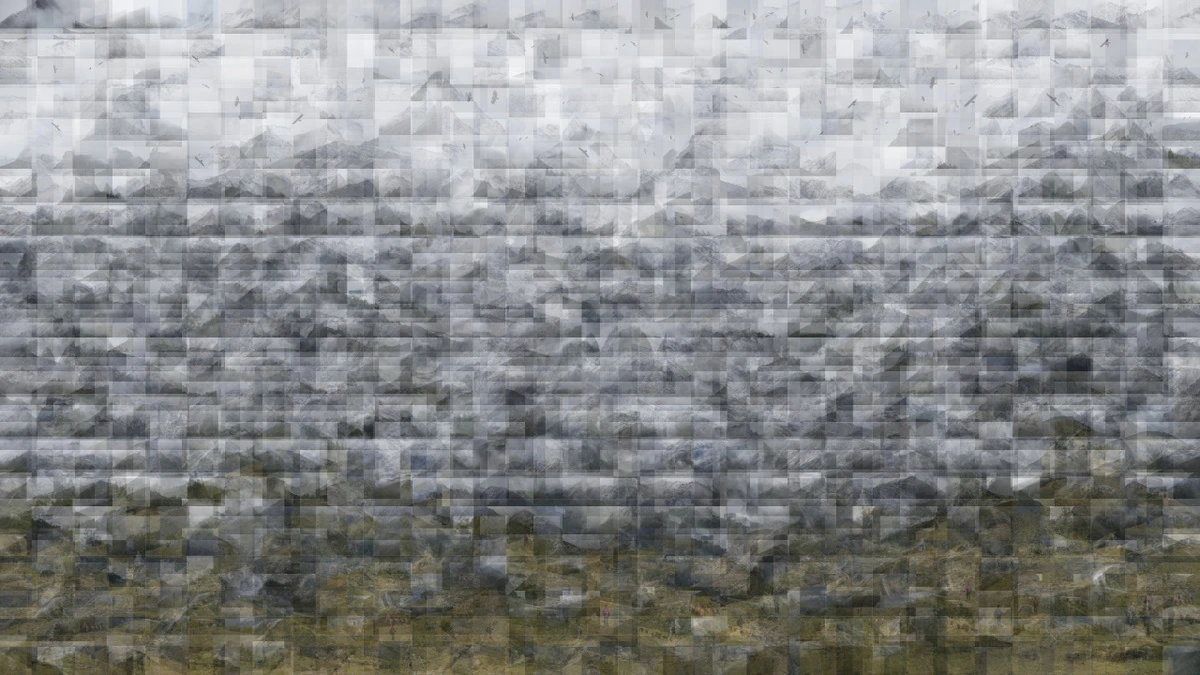
I overlay and displace the photographs within each grid cell and change their opacity, allowing their content to recede. We seem to see ground, mountains and sky, yet also seem to see nothing.
Perhaps it is by dissolving representational forms in this way that the viewer’s inner feelings can be awakened.
Artist statement · defense p. 9 · translated from Chinese
At this stage, the recognizability of each photograph changes. Layering and opacity let specific scenes recede while the larger mountain form remains intermittent. The original statement tentatively links this dissolution to the viewer’s feelings.
An Inquiry into Shanshui, graduation defense, p. 9. Full composition of the embedded image retained.
PROCESS 06 / 08
Second arrangement: composing space subjectively
The second method is a freer arrangement under subjective control. It can better express my understanding of space.
Artist statement · defense p. 10 · translated from Chinese
A second route gives the artist more direct control over the positions and relationships of the photographs. The presentation places it alongside the grid method: one builds an overall field through cells; the other seeks space through subjective arrangement.
An Inquiry into Shanshui, graduation defense, p. 10. Full composition of the embedded image retained.
PROCESS 07 / 08
Reworking photographs into a shared atmosphere
I then rework each photograph again, seeking an atmosphere in which they permeate one another.
Artist statement · defense p. 11 · translated from Chinese
After arranging the images, the artist continues to work on them individually so that different views, scales and levels of transparency act together. Arrangement is an intermediate stage; the way images permeate one another is also part of the making.
An Inquiry into Shanshui, graduation defense, p. 11. Full composition of the embedded image retained.
PROCESS 08 / 08
Combining both arrangements
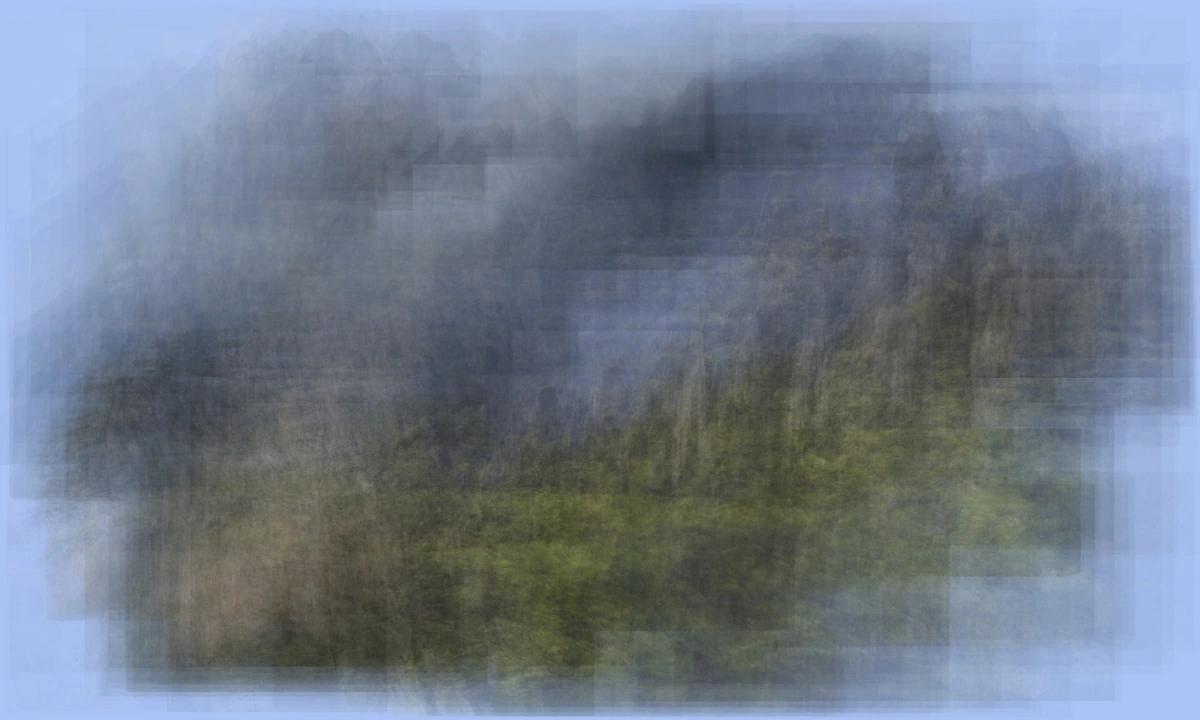
Finally, I tried overlaying the results of the two methods, creating a state of seeing mountains as mountains, then not as mountains, then as mountains again. Although the forms in each individual photograph are dissolved, the mountain’s form becomes more pronounced. This form is my experience in the mountains, my understanding and interpretation of them.
Artist statement · defense p. 12 · translated from Chinese
The final step overlays the results of both routes. Forms within individual photographs recede, while the mountain as a whole becomes more pronounced. The artist identifies this composite with experience, memory and interpretation in the mountains, rather than the reproduction of a fixed viewpoint.
An Inquiry into Shanshui, graduation defense, p. 12. Full composition of the embedded image retained.
VERSIONS AND COLLECTION RECORDS
Dimensions remain attached to their documented versions
The defense concludes with Shanshui—Red, Shanshui—White and Shanshui—Green (pp. 14–16). Its account of the making belongs alongside the later portfolio descriptions and institutional collection record.
On pp. 3–5, He Fa Portfolio 3 records Green, White and Red as works from 2012, each measuring 300 × 170 cm, made with backlit photographic film and a lightbox. These dimensions describe the versions listed in the artist’s portfolio.
The CAFA Art Museum’s 2012 graduate-work collection list records Shanshui—Red and Shanshui—White as C-print backlit film and lightboxes. It gives the dimensions as “(110 × 190) × 2” and a quantity of two: Red and White together comprise two works, each 110 × 190 cm. This is the collection version.
Both sets of dimensions are preserved in their source contexts. The available documents do not explain the precise production, resizing or reprinting relationship between these versions.
Chapter sources
He Fa, original graduation defense, An Inquiry into Shanshui, pp. 2, 4–12 and 14–16; He Fa Portfolio 3, pp. 3–5; CAFA Art Museum, 2012 graduate-work collection list. Process images use the full embedded images from the presentation, without cropping. English statements were translated from Chinese for this archive.
Another early portfolio record
This early portfolio presents Shanshui through a horizontal landscape. Distant mountains, nearer trees and sky are joined from many photographs. Differences in brightness and scale are not completely smoothed away. The image retains both the broad shape of a landscape and traces of its construction; peaks, foliage and blocks of colour become visible at different distances.
In a preserved statement, the artist begins with the act of sorting photographs. He describes assembling more than a thousand photographs from a trip to Huangshan and relating this process to a moving viewpoint in landscape painting. The portfolios record different dimensions and media for Shanshui. Those differences are retained here as distinct records, rather than treated as a single exhibition specification.
Pages 14–15 of the 38-page portfolio record a 2400 × 1250 mm light box. Page 12 of the 13-page portfolio records 520 × 520 mm and mixed media. Both give January 2012. These are version records for Shanshui, not evidence of separate works.
Shanshui: Early Portfolio Record, 2012. Portfolio image 1 of 1.
The 2012 thesis: from modes of looking to photographic brushstrokes
Read alongside the graduation presentation’s process images, the 2012 thesis Exploring Shanshui Photography places the work between three modes of looking: shifting viewpoints in Chinese landscape painting, mobile viewpoints in David Hockney’s photocollages, and Cézanne’s late construction of a whole through patches of colour. He Fa translates these readings into his own method, treating photographs taken along a walk as elements of differing texture, light, darkness and colour.
Chapter Five again records an experiment using 1,025 photographs taken at Siguniang Mountain in Sichuan, superimposing gridded and subjective arrangements. The intended viewing moves between the whole and the detail: “The viewer experiences what I experienced, and feels what I felt.”
Beginning with photographs of Huangshan
In two early statements, He Fa recalls reassembling more than a thousand photographs taken during a visit to Huangshan while sorting his pictures. He noticed a resemblance between photographic assembly and a view that changes as one moves through a landscape. Finding that an imitation of this form was insufficient, he returned to nature and brought the experience of walking back into his work.
This recollection records an early experiment with Huangshan photographs. The graduation presentation separately documents an assembly experiment using 1,025 photographs of Mount Siguniang. The two sources retain the distinct locations and image counts associated with the initial attempt and the later methodological experiment.
Source documents: 作品自述(何发目录); 作品阐释(照片目录).
The graduation plan for three lightboxes
The undergraduate graduation guidance document names the project “An Exploration of Shanshui Photography,” records the proposal date as 26 December 2011 and lists Wang Chuan, Miao Xiaochun and Yao Lu as advisers. The plan specifies three photographs—Green, White and Red—presented as C-prints in lightboxes, each measuring 190 × 110 cm.
The guidance log records a discussion of the exhibition format on 1 March 2012 and of dimensions and proportions on 20 April. This plan for three works, the portfolio’s 300 × 170 cm version and the CAFA Art Museum’s collection of the red and white works belong to distinct records and stages.
Source documents: 本科生毕业设计指导书——何发.
From sketches to exhibition
The graduation plan divides the work into sorting existing landscape photographs, reading about painting, drawing and revising sketches, producing the green, white and red works, and then adjusting the images and making lightboxes. February through April are assigned to the three images, May to revisions and lightbox production, and June to exhibition. This planned rhythm shows image experiments, physical presentation and thesis discussion developing together.
Source documents: 本科生毕业设计指导书——何发.
Taking one photograph apart
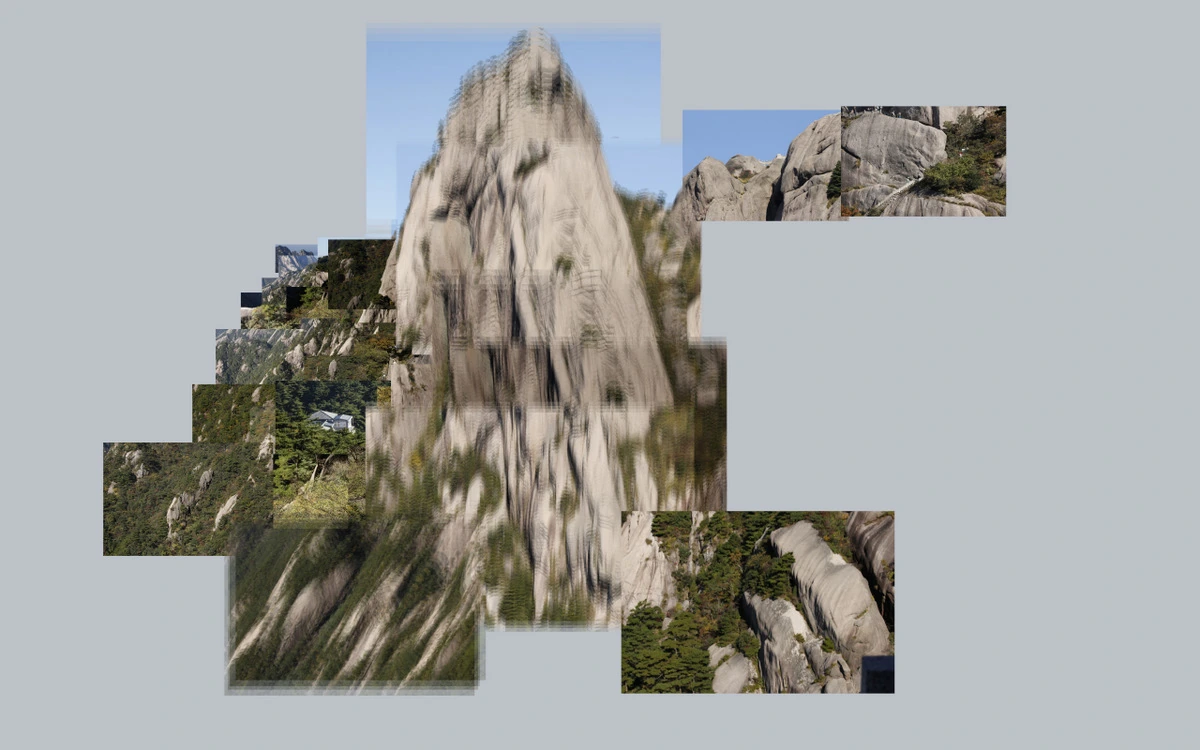
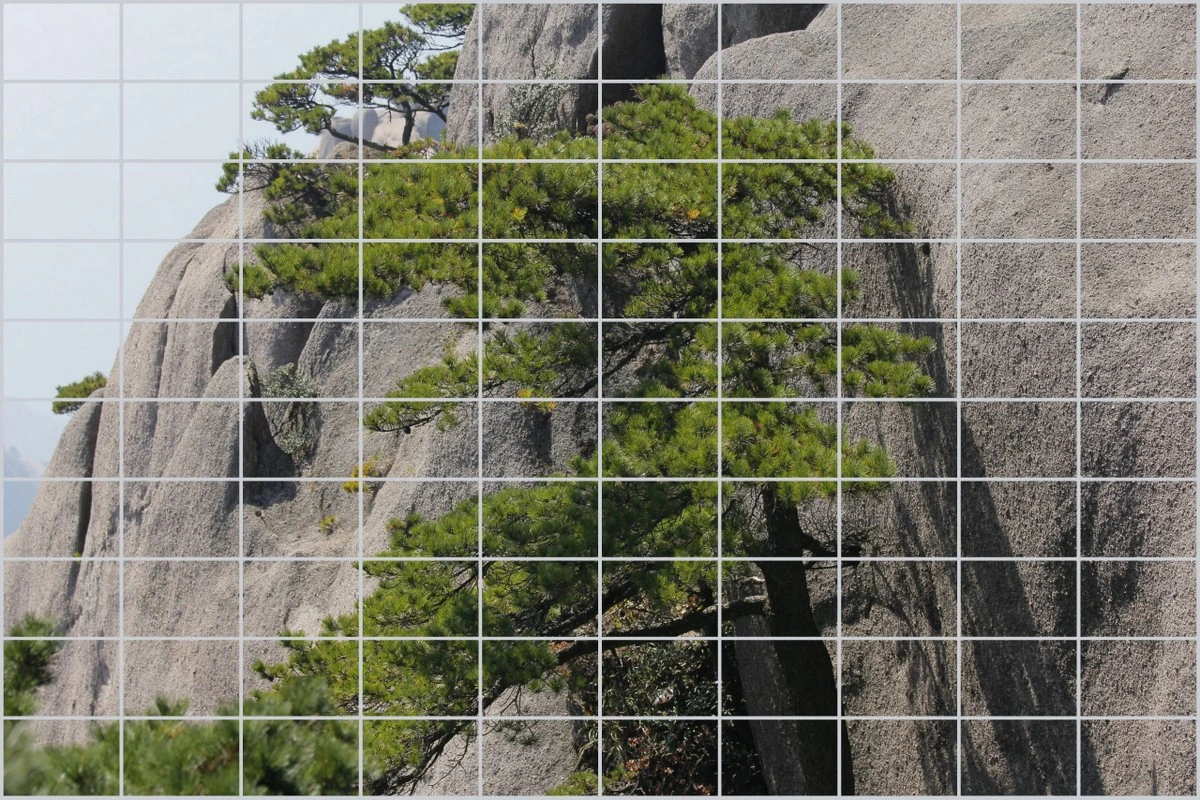
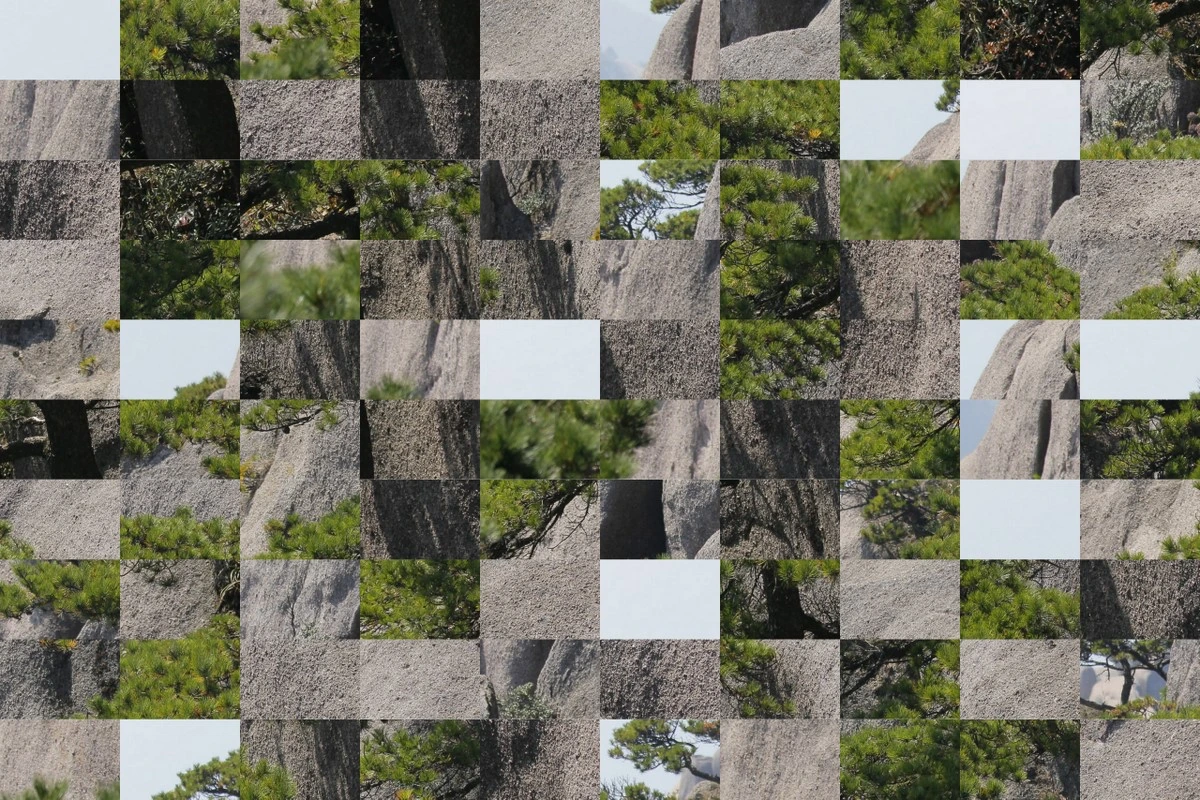
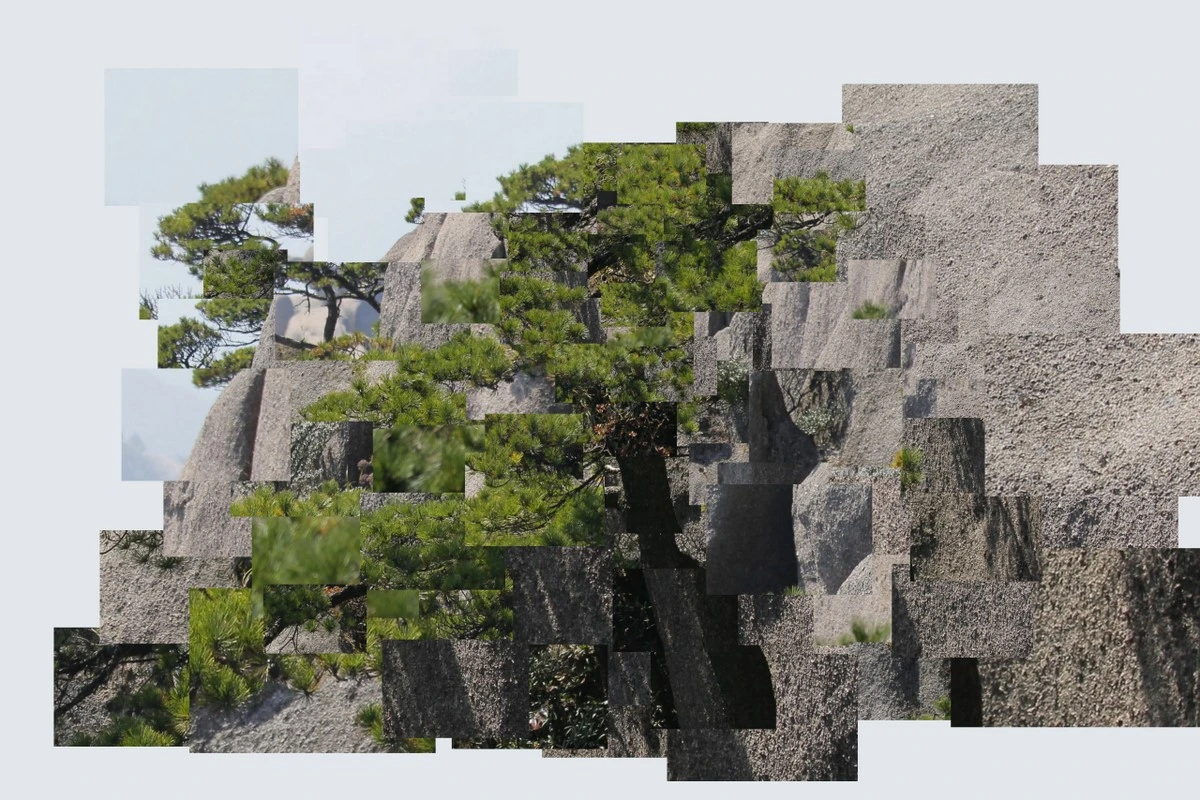
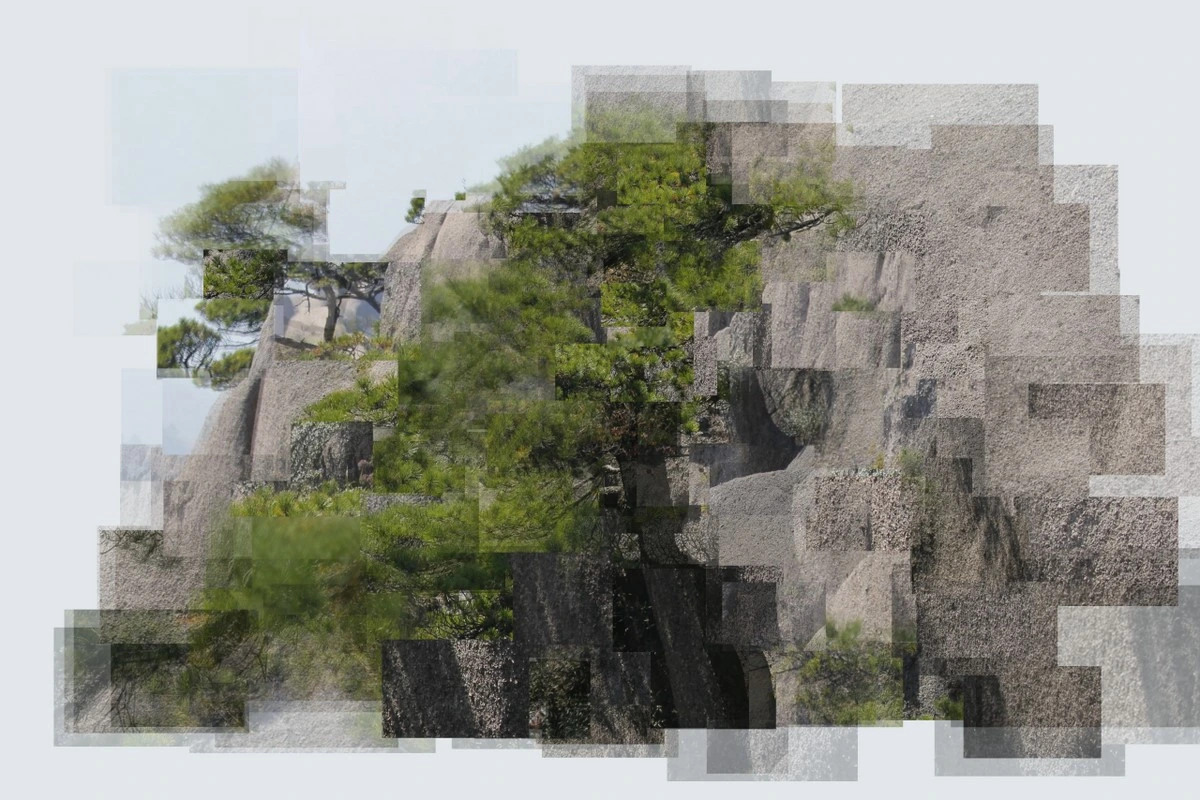
The midterm presentation begins with a photograph of rocks and trees. It divides the image, shuffles the parts and turns recognizable scenery into elements of different light, colour and texture. A subjective, painterly arrangement reassembles them; layering and displacement then change their boundaries. Vertical and horizontal shaking and changes of scale follow, before the experiment expands to a mountain assembled from 1,025 photographs.
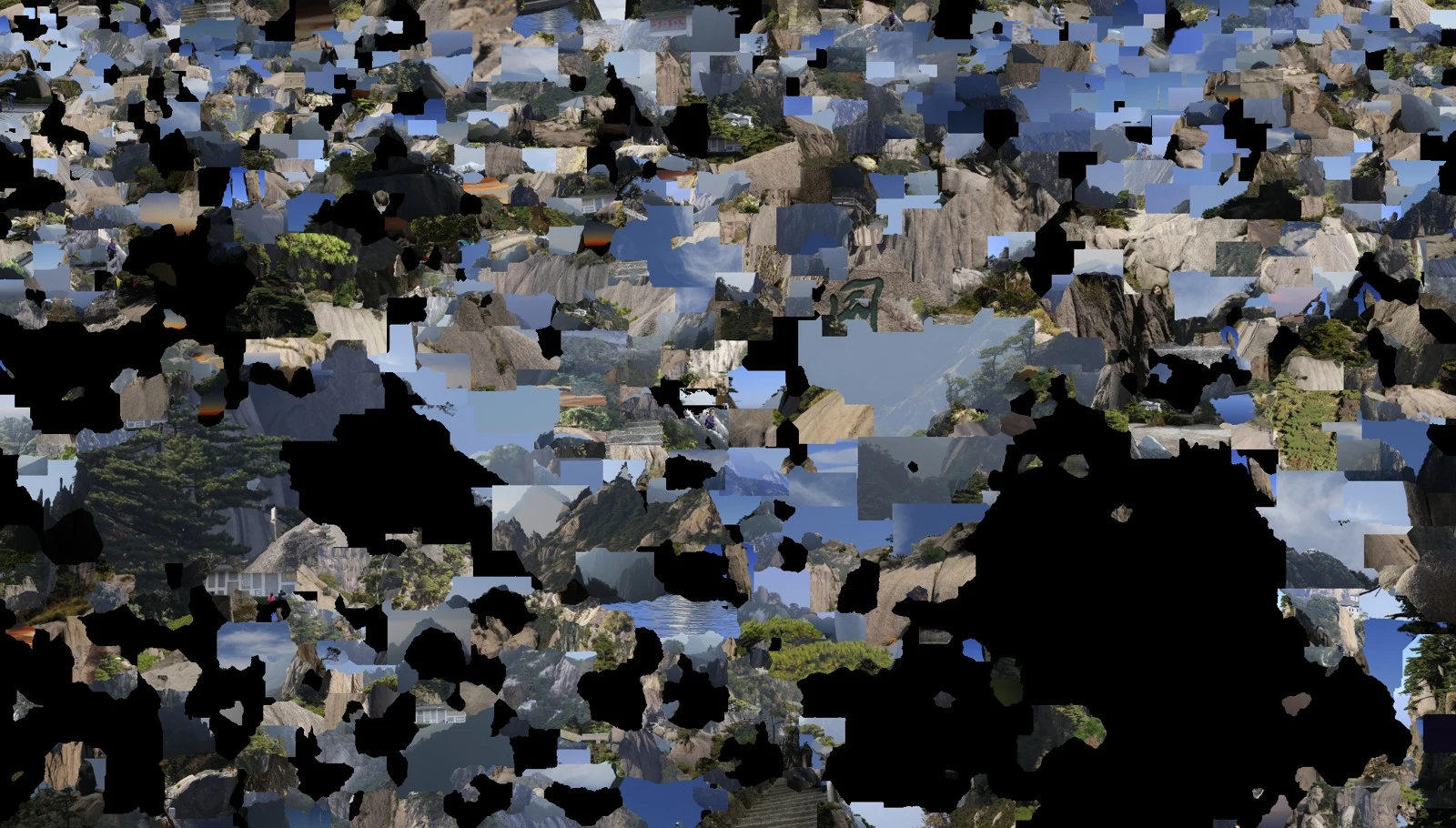
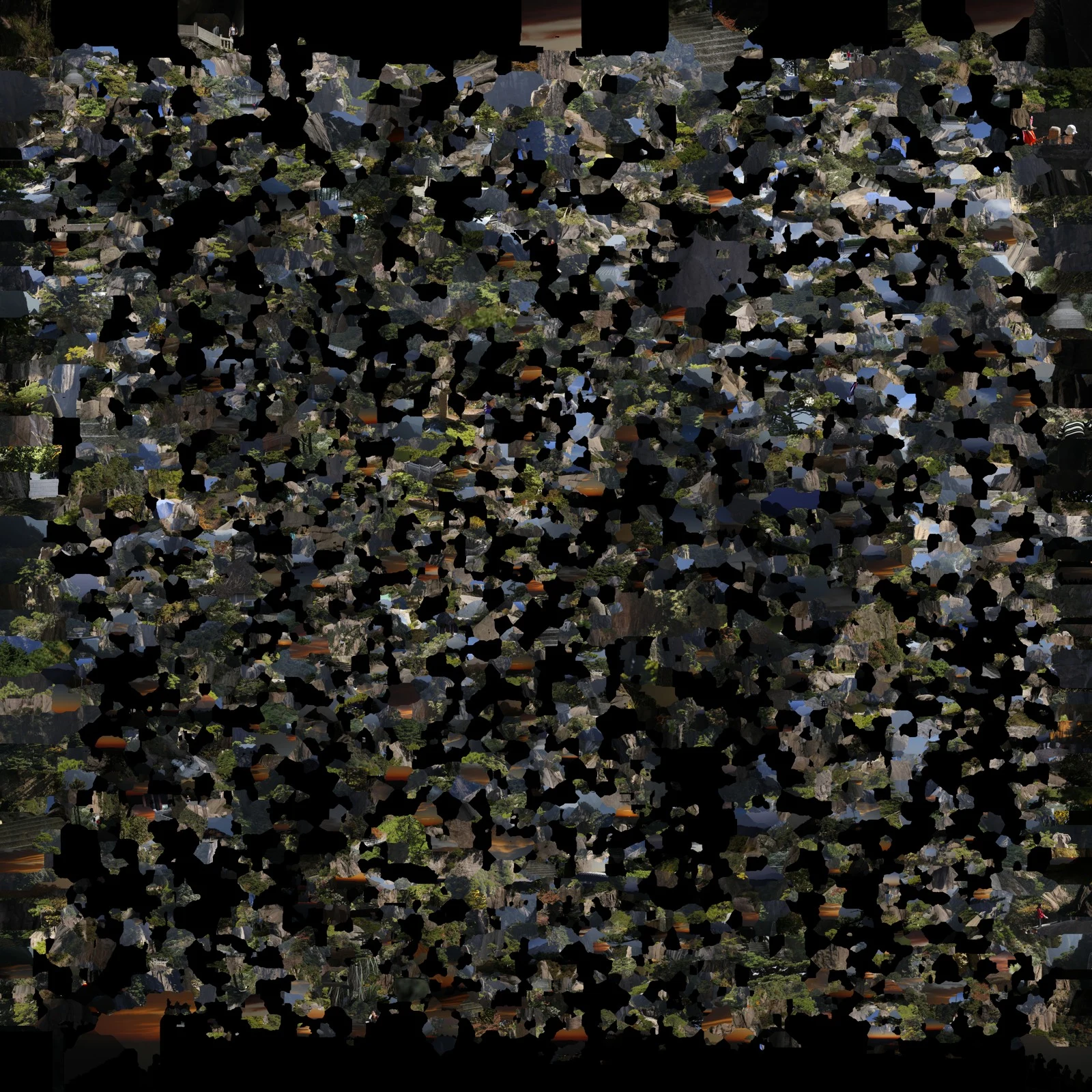
Two TIFF working files in the Shanshui directory gather rocks, trees, sky, visitors and architecture at different densities. The horizontal image measures 2074 × 1179 pixels and the square image 5120 × 5120. Black gaps and repeated fragments remain in the source files. These studies show photographic fragments overlapping, leaving openings or interrupting continuous space before they form an overall landscape.
The group also includes Photoshop Large Document files. The headers of “huangshan3.psb” and “最终.psb” both record 30118 × 16942 pixels, while their byte sizes and sampled fingerprints differ. The archive retains them as separate working files. The two process images shown here are likewise kept distinct from formally exhibited versions.
Source documents: Screen Shot 2014-10-06 at 10.36.49 AM M01 Mosaic.tiff; 拼贴139 M01 Mosaic.tiff; huangshan3.psb; 最终.psb.
Three ways of organizing attention
Green organizes depth through flanking mountains and a pale valley. In White, tree trunks and a path into the snow establish direction. Red sets ochre peaks against a blue-grey sky. Rectangular fragments repeatedly cross these spatial boundaries: just as the eye reads an inhabitable landscape, blocks of colour and seams return it to the image surface. The three works offer different rhythms of looking, beyond variations in palette.
Archive reading, 30 September 2026 · Site editorial interpretation, not an artist’s statement. Sources: the artist’s retained He Fa Portfolio (PDF), pp. 3–5; An Exploration of Landscape Photography, pp. 11–14. English is an editorial translation; document titles are translated where needed.
Shanshui method experiment: dividing the source image. Midterm presentation, p. 4; the original composition is retained.Shanshui method experiment: shuffling the parts. Midterm presentation, p. 5; the original composition is retained.Shanshui method experiment: reassembly. Midterm presentation, p. 6; the original composition is retained.Shanshui method experiment: layering and displacement. Midterm presentation, p. 7; the original composition is retained.Horizontal assembly study from the Shanshui working directory, “Screen Shot 2014-10-06 at 10.36.49 AM M01 Mosaic.tiff”; the exact production date is unestablished.Square assembly study, “拼贴139 M01 Mosaic.tiff”, 5120 × 5120 pixels; the full composition is retained.
At a distance a mountain takes shape; nearby it breaks into separate acts of framing. The viewer’s movement is therefore more than an optional way to appreciate scale. It is a temporal mechanism: stepping back compresses differences into an image, while moving closer releases them again. Each photograph records something it once faced, but no individual photograph witnessed the final mountain. The whole is made and should not be mistaken for panoramic proof of a particular site.
The important issue is not an abundance of information but its redistribution through a medium. Climbing involves direction, resistance and duration; the image makes these available on one surface. Montage compensates for the single viewpoint while introducing a different loss. A presentation should therefore let viewers see the complete work, inspect details and return to the whole. An automatic tour can suggest one reading, but should not prescribe its only sequence.
The limits of this reading
Image counts and output versions need separate verification. Digital viewing does not reproduce the scale or transmitted light of the original light boxes.
Sources for this reading
Based on the public work page, portfolio and early landscape-photography thesis materials. Later theatre theories are not treated as the original motivation of the 2012 work.
Reading connectionWhat Is Shixiang? looks back from 2020 at Shanshui and Central, then turns to photographic roles, the naming of I, See, You and publication choices. It proposes eight and a half encounters and imagines a museum holding a thousand people’s traces: retaining images while making room for another meeting.
Shanshui forms a landscape from photographs, readable from near and far; the Clear Breeze Screen proposal places curved layers between a residence and a sea view. One changes an image, the other proposes changing an actual passage of sight.
2012 / Photography, digital montage, light boxes 2012–2013 / Parametric design, products, 3D printing, spatial proposals
The statement on defence page 7 describes an experiment with 1,025 Siguniang photographs, combining different viewpoints as traces of walking; that number is not generalized to every work.
Pages 3, 6, 11, 14–17 and 20 of the Qingfeng Screen proposal document the sea-view screen, 55 surfaces and changing viewing positions; renderings do not establish construction.
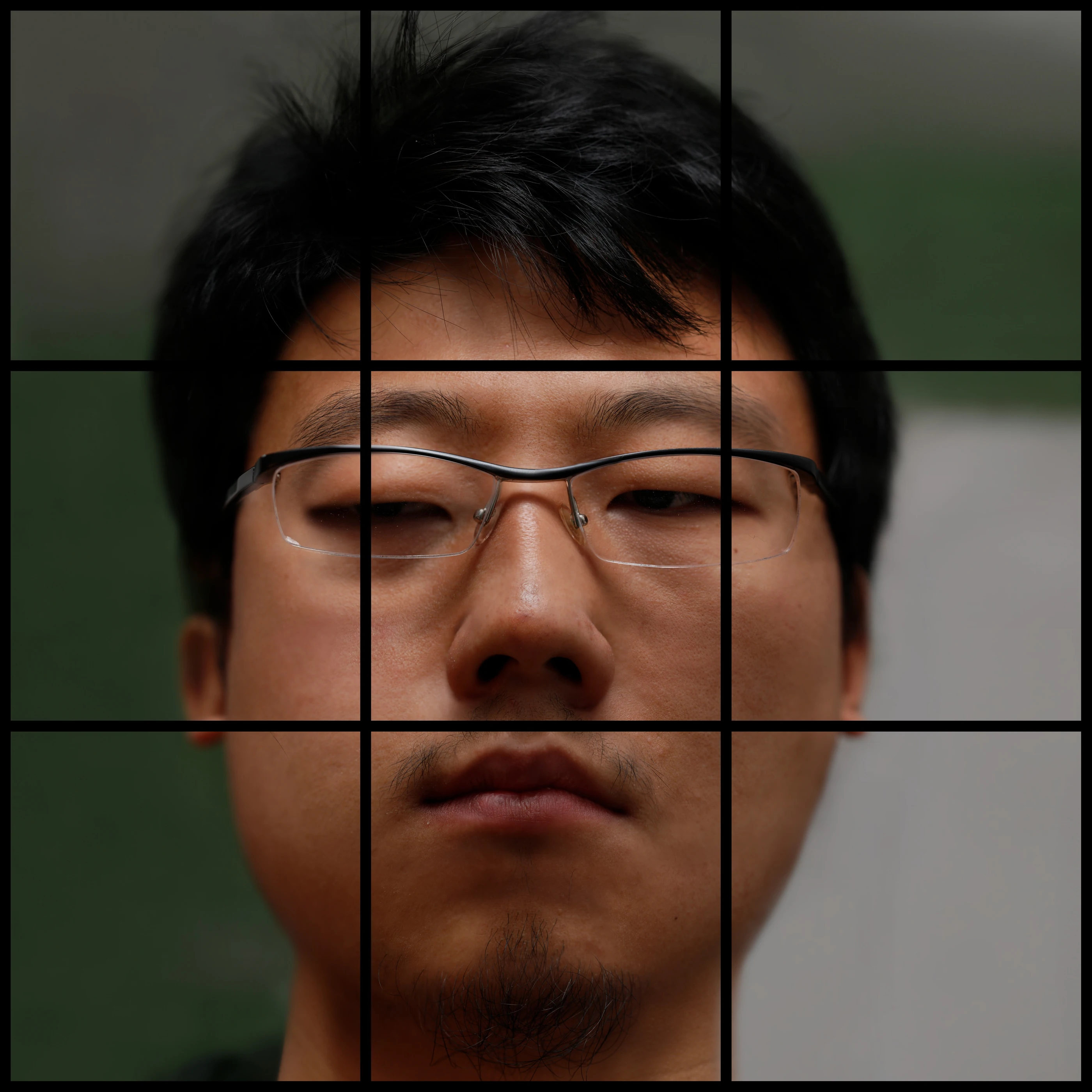
Shanshui assembles local views into a mountain; I assembles macro photographs of skin into a face. Stepping back makes each recognizable, while approaching leads into places and bodily surfaces respectively. The recognizable whole cannot retain every detail.
The statement on defence page 7 describes an experiment with 1,025 Siguniang photographs, combining different viewpoints as traces of walking; that number is not generalized to every work.
The portfolio statement describes macro observation of the self, becoming a mountain and the camera as observer, directly grounding the internal viewing relation in the self-portrait.
Shanshui reassembles views gathered through climbing; Cocktail lets JPEG file size determine adjacency. Both construct a whole from many photographs, but their arrangements refer respectively to an experience of looking and a technical value.
The statement on defence page 7 describes an experiment with 1,025 Siguniang photographs, combining different viewpoints as traces of walking; that number is not generalized to every work.
The portfolio statement explicitly makes JPEG file size the sorting criterion and describes settling and floating; numerical sorting is not equated with judgement of people.
Shanshui combines separate views into mountains; Central brings a sun from a relief into its mountainous image. Both make a whole that no single exposure witnessed. One accumulates acts of looking; the other emphasizes the decision to place an element in a particular position.
The statement on defence page 7 describes an experiment with 1,025 Siguniang photographs, combining different viewpoints as traces of walking; that number is not generalized to every work.
The portfolio statement explicitly begins with a relief encountered while travelling and places the sun among mountains; this is the artist’s stated compositional decision.
The 26 December 2011 proposal places the fixed viewpoint, photographic instant and compressed space against an experience of walking through a landscape. It questions the borders and organisation of early collage attempts. Different large-image versions provide a way to inspect those questions without treating them as the origin of all later work.
The graduation presentation records colour-based arrangement, layering, displacement and changes in opacity. Following these operations into the light-box work gives a traceable account of photographs becoming “brushstrokes”.