LINE OF INQUIRY 06 / 07
The container takes part
How does a space change a work?
Light boxes, screens, seats, a library, an office and a theatre shape how bodies stay and move. A container makes some encounters possible and others difficult.
01 / EDITORIAL ARGUMENT · 2026
Reading through this question
Understand containers through their specific constraints. A light box transmits light; a library lets readers move along printed pages; projection encounters bodies; YourTube’s cables and seats shape sightlines and movement. P4 also involves recruitment, conversion of rooms, performances and people’s lives. When a website extends these works, it should identify its own changes: playback and magnification are present-day reading devices, not scale reconstructions of historical events.
02 / THE ARTIST LOOKS BACK · ESSAY SUPPLIED IN 2026
These complete passages are from He Fa’s How Does a Hole Become a Theatre?, supplied on 16 September 2026. They are later reflections, to be read alongside records made within the works.
When we first planned P4, we had a photography studio in mind. Zhang Aoshuang proposed a theatre. Shaohua took on the conversion, and the stage, lights and curtains gradually found their places. To photograph a person, we began building a theatre.
Editorial notePreparing a photography studio, proposing a theatre and converting the room involve different people. The container’s formation already involves collaboration.
The camera was there from the start. We rehearsed, knowing the rehearsals would be kept. The person before us was watching; it was as though people in the future were watching too. That gaze, which would arrive only later, squeezed into today’s gestures ahead of time. Before anyone had left, the time when we would see them afterwards was already there.
Editorial noteThe camera brings future viewing into the live situation. The container includes the conditions of recording and later circulation as well as the room.
03 / WORKS AND PERIOD RECORDS
Return to the works and records
- Library wall, column and listening station ↗
The project asks viewers to walk, read, stop and listen in different locations. Its words alone do not represent the whole work.
- Operating conditions of the eleven screens ↗
The installation instructions retain the material dependencies of multiple screens. Web playback does not establish a reconstruction of every synchronization relationship.
- 2019–2021: photography research and the theatre’s public life ↗
Keep the dates of spatial changes and participant roles in the public record rather than compressing them into one founding event.
Works and writing
Follow works back to signed texts, with writing at the time, later reflection and participant accounts identified separately.
P4 Theater: A University in the Making, a Winding Labyrinth, a Hard Drive Inscribed with Life
Reading connectionIn 2024, He Fa revisits the studio’s conversion into a theatre, the move to a small office and cameras entering collaborative rehearsal. From Iceberg to Human Surrender, the size of a room, bodily distance and ways of filming affect one another. This retrospective returns the works to their spaces and collaborations.
Related works: P4 Theater · Iceberg · Human Surrender / Shoot Self with You
P4’s Final Chapter: The Last Rehearsal — Love, Death and Human Surrender
Reading connectionThe 2023 announcement links writings by performers, a documentarian and musicians, alongside plans to record the public event for the film. Following these links back from the film reveals how different people prepared for the same gathering. The invitation, their individual voices and the later images remain available together.
Related works: Human Surrender / Shoot Self with You
P4 Theater: Past, Present, Future, 510
Reading connectionLooking back in 2022, He Fa returns to Shadow Counterpoint and Hamlet’s Mirror, then recounts a separation between collaborators and the restart at 510. A few chairs, two desks and a small office provided conditions for work such as Iceberg to continue. Moves, collaborations and repeated beginnings connect the productions.
Related works: P4 Theater · Shadow Counterpoint · Hamlet’s Mirror · Iceberg
3P Open Call: Witnessing and Recording the Eighth P4U Project, Kill the Rose
Reading connectionThe 2021 3P call invites observers into the making of Kill the Rose. It proposes following the process, publishing during the production period and exhibiting alongside the performance, while leaving ownership for members to discuss. Looking, performing and recording alternate within these rules as observers prepare to make their judgments public.
Related works: Kill the Rose: 3P—Watching, Performing, Recording
Sixteen Days and Nights at P4: The Cocoon Performance
Reading connectionWritten before Cocoon’s 2020 performance, this account moves from scheduling into continuous rehearsal. Falls, fatigue, lateness and mutual judgments share the same days as performing, lighting, documentation and publicity. Alongside stage images, the article records how bodies bear the work of production and how many people prepare a single performance.
Related works: Cocoon
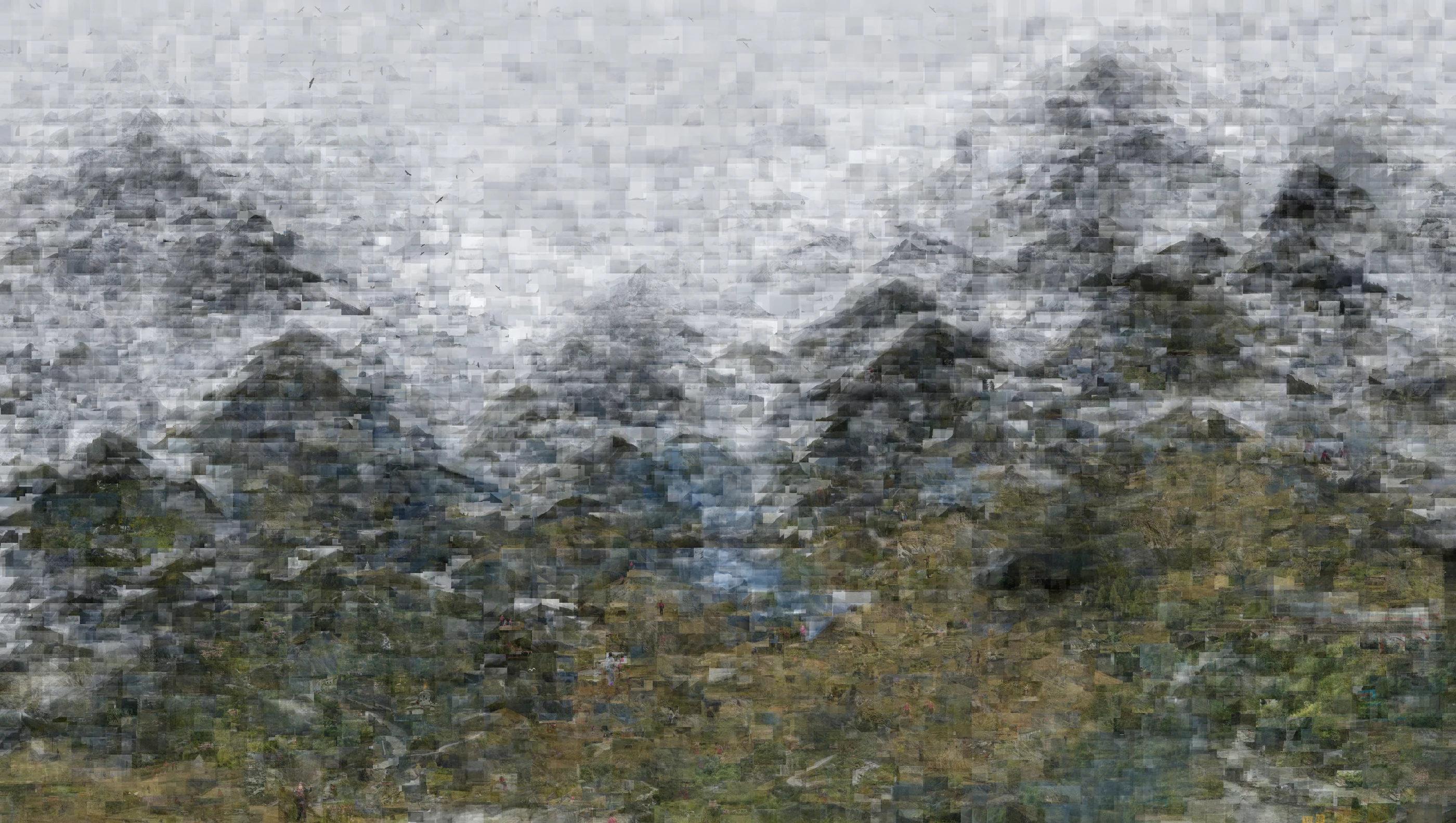
2012 · Photography, digital montage, light boxes
Shanshui ↗
WHAT CHANGES HERE
A luminous image and large-scale detail ask the body to travel between overall view and fragment.
Artist
Can a mountain hold many acts of looking at once?
At a distance a mountain takes shape; nearby it breaks into separate acts of framing. The viewer’s movement is therefore more than an optional way to appreciate scale. It is a temporal mechanism: stepping back compresses differences into an image, while moving closer releases them again. Each photograph records something it once faced, but no individual photograph witnessed the final mountain. The whole is made and should not be mistaken for panoramic proof of a particular site.
Continue the close reading ↗2015 · Moving image and performance
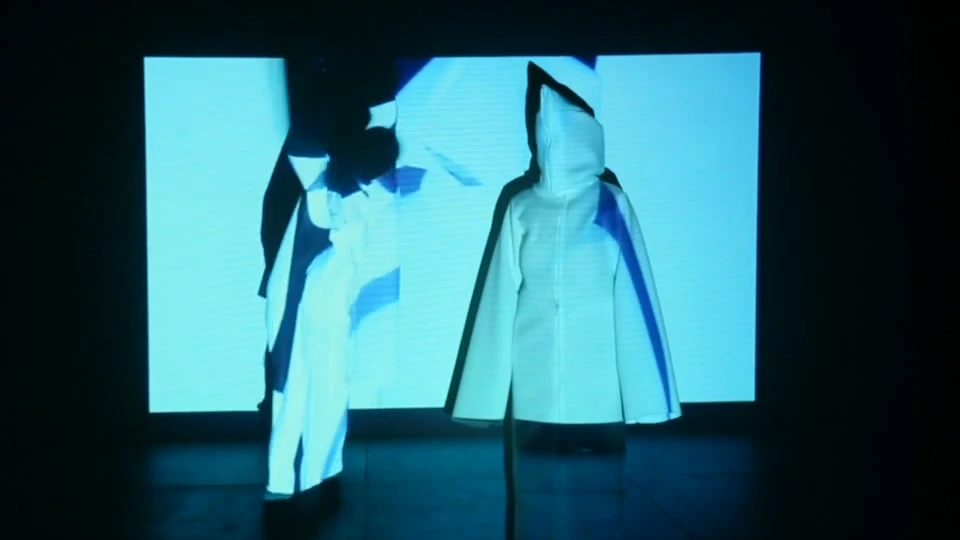
Hamlet’s Mirror ↗
WHAT CHANGES HERE
Screen, projection and the body that blocks light jointly decide where a character appears.
Co-created by He Fa and Zhang Aoshuang (FakingAosome)
When my image returns to my body, where is the character?
The figure on screen does not remain safely at a distance. When projection returns to the body, the performer carries an earlier self while present movement can block that image. Obstruction can therefore change where a scene takes place. The body is more than an instrument of emotional expression: it is a surface through which images appear, lose coherence and shift position. Viewers continually compare live action, recorded action and the location produced by projection.
Continue the close reading ↗2017 · Language, video, printed text
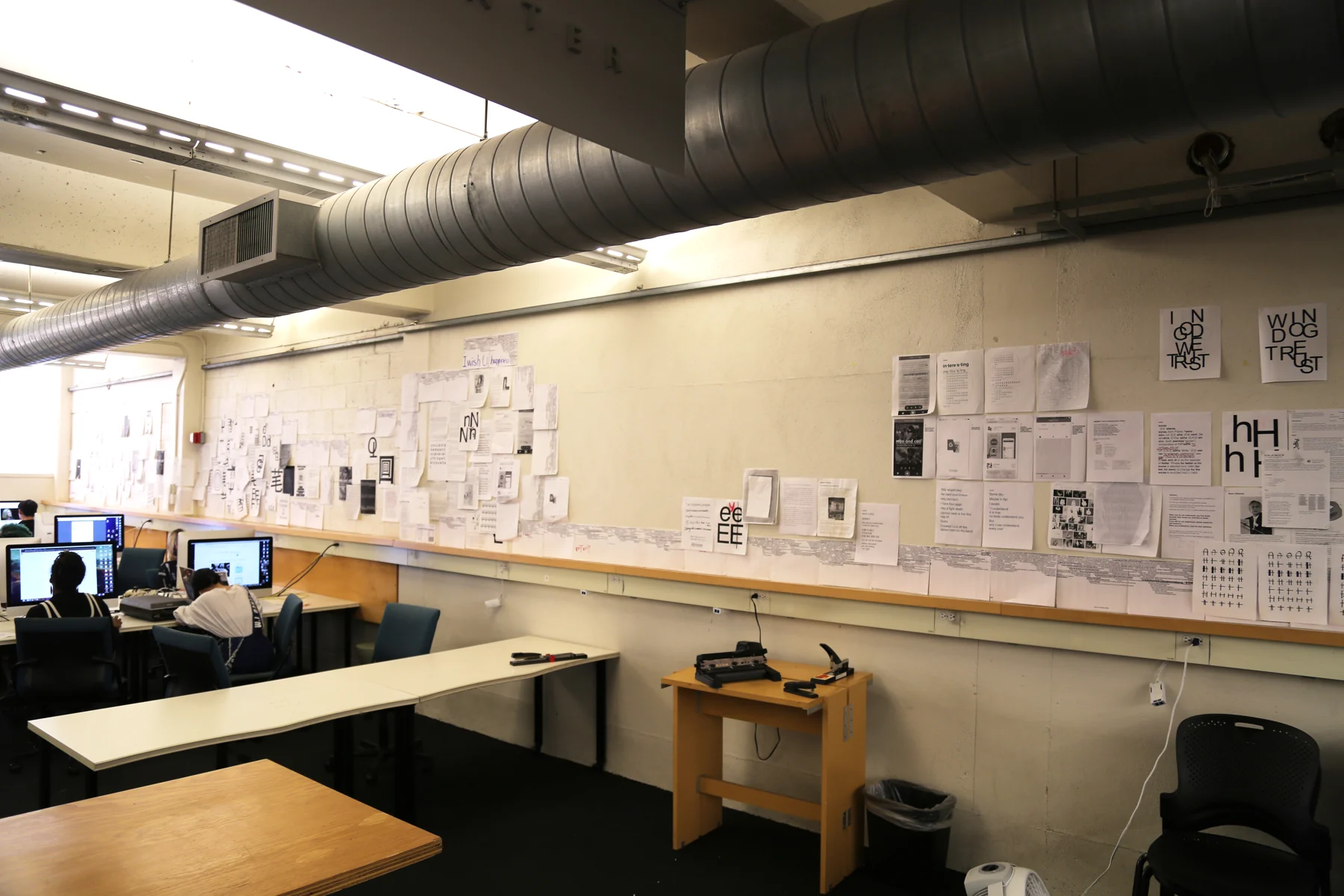
Fafalish ↗
WHAT CHANGES HERE
Text extends across walls and a column, while a listening station offers another rhythm of attention.
Artist and exhibition curator
If language cannot return intact, can communication still happen?
A deviation in one conversion becomes the material available to the next. Sound does not simply obey its source text, and written characters cannot guarantee a return to the original. Error is not a residue removed by final proofreading; it is an action that moves the work forward. Accent, guesswork, hearing and software rewrite meaning together. Looking only for what the final sentence means misses the way meaning acquires a body during its passage.
Continue the close reading ↗2018 · Multi-screen video installation
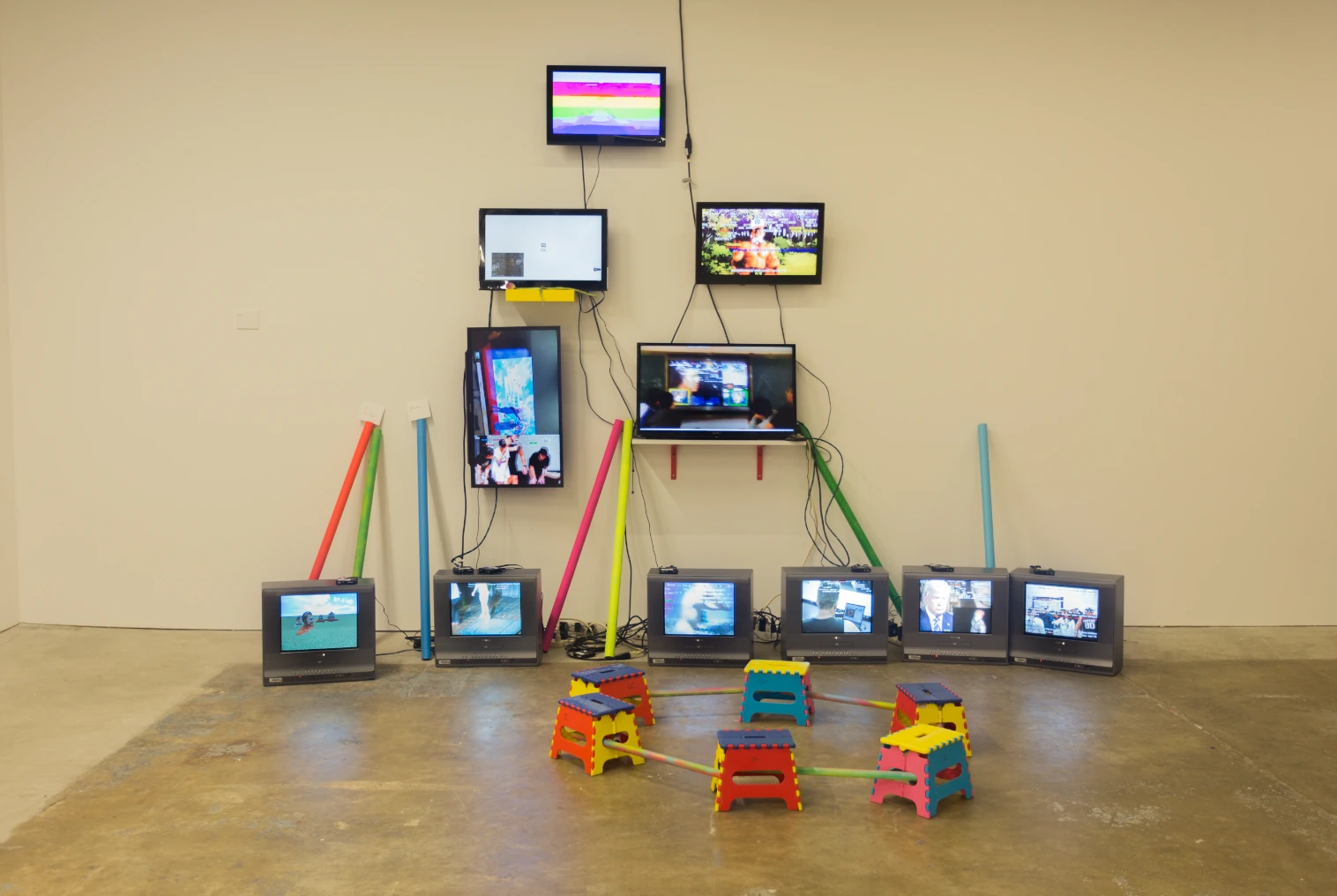
YourTube ↗
WHAT CHANGES HERE
The screens’ frontal arrangement and the seats’ circle have different centres, separating sitting together from looking in the same direction.
Artist; graduate thesis work
Do shared seats and visible comments already make a “we”?
One structure directs attention toward screens; another joins seats into a ring. Their centres differ. I can sit beside you while everyone watches a different screen, or share an image without knowing how my neighbour understands it. Exposed cables make equipment connections visible, and tubing physically joins the furniture. Those material connections cannot testify on behalf of human relations. The installation gives form to the distance between being connected and understanding one another.
Continue the close reading ↗2015–present · Long-term art practice, live work and archives
P4 Theater ↗
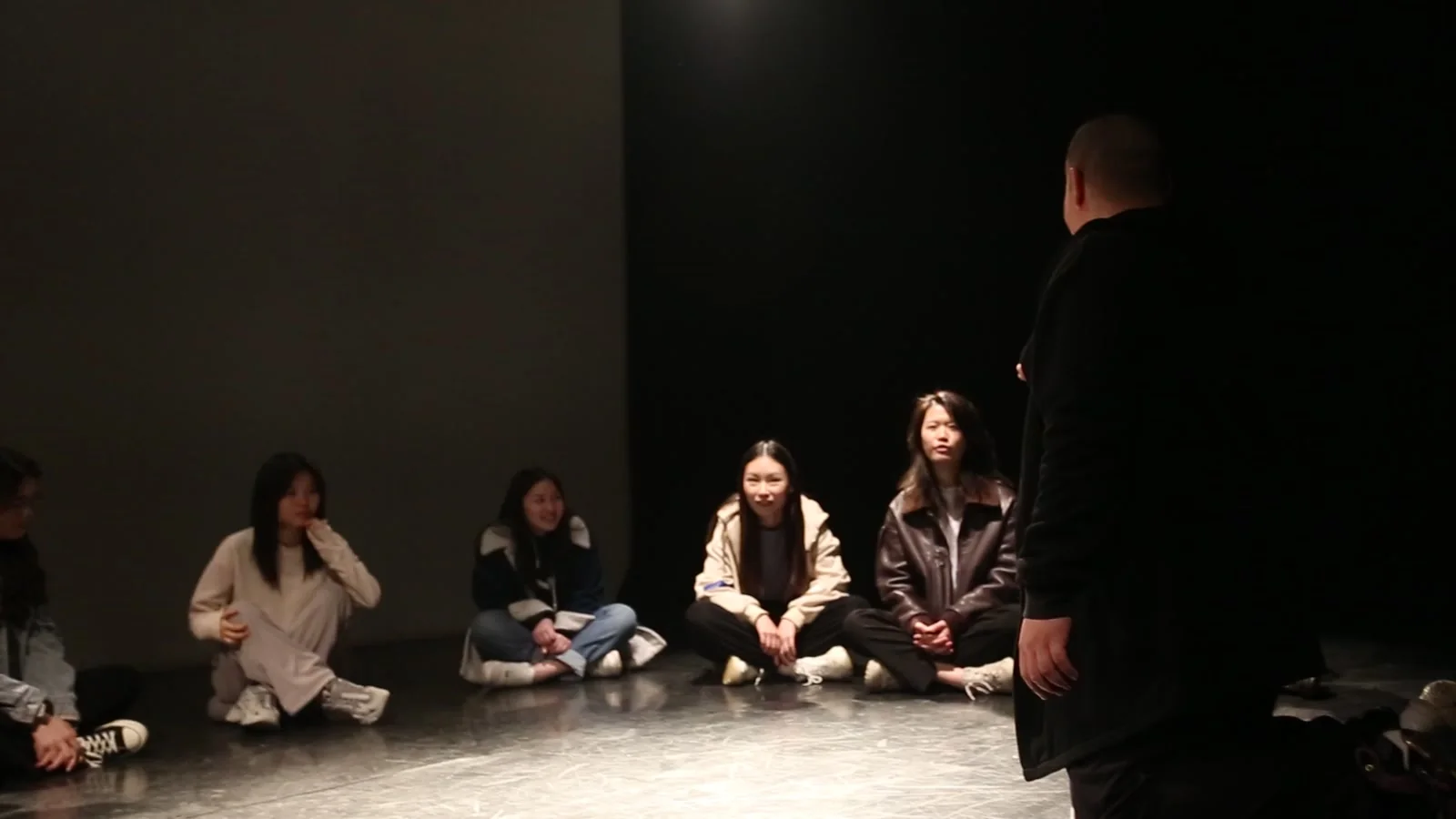
WHAT CHANGES HERE
Different venues change recruitment, rehearsal, filming and gathering; organizing space becomes part of the practice.
Co-initiated with Zhang Shaohua; long-term host and organizer
How can a container support works while letting them change it?
Calling P4 a venue misses much of its work; calling it one enormous individual artwork by He Fa claims too much. It includes renting and adapting spaces, setting project cycles, recruiting strangers, forming collaborations and making works visible. Each task creates conditions and distributes limits. How audiences enter, whether a newcomer can initiate a project, and when rehearsal must end all affect the art that appears.
Continue the close reading ↗ANOTHER QUESTION STARTS HERE