Screens arrange attention
Images occupy different heights and orientations, but together they retain a shared front. Viewers can choose where to look without being able to see every image equally clearly.
2018 / Multi-screen video installation
Screens are connected and people sit together. When does connection become participation?
HE FA’S ROLE
Artist; graduate thesis work
YOURTUBE / IN THE EXHIBITION
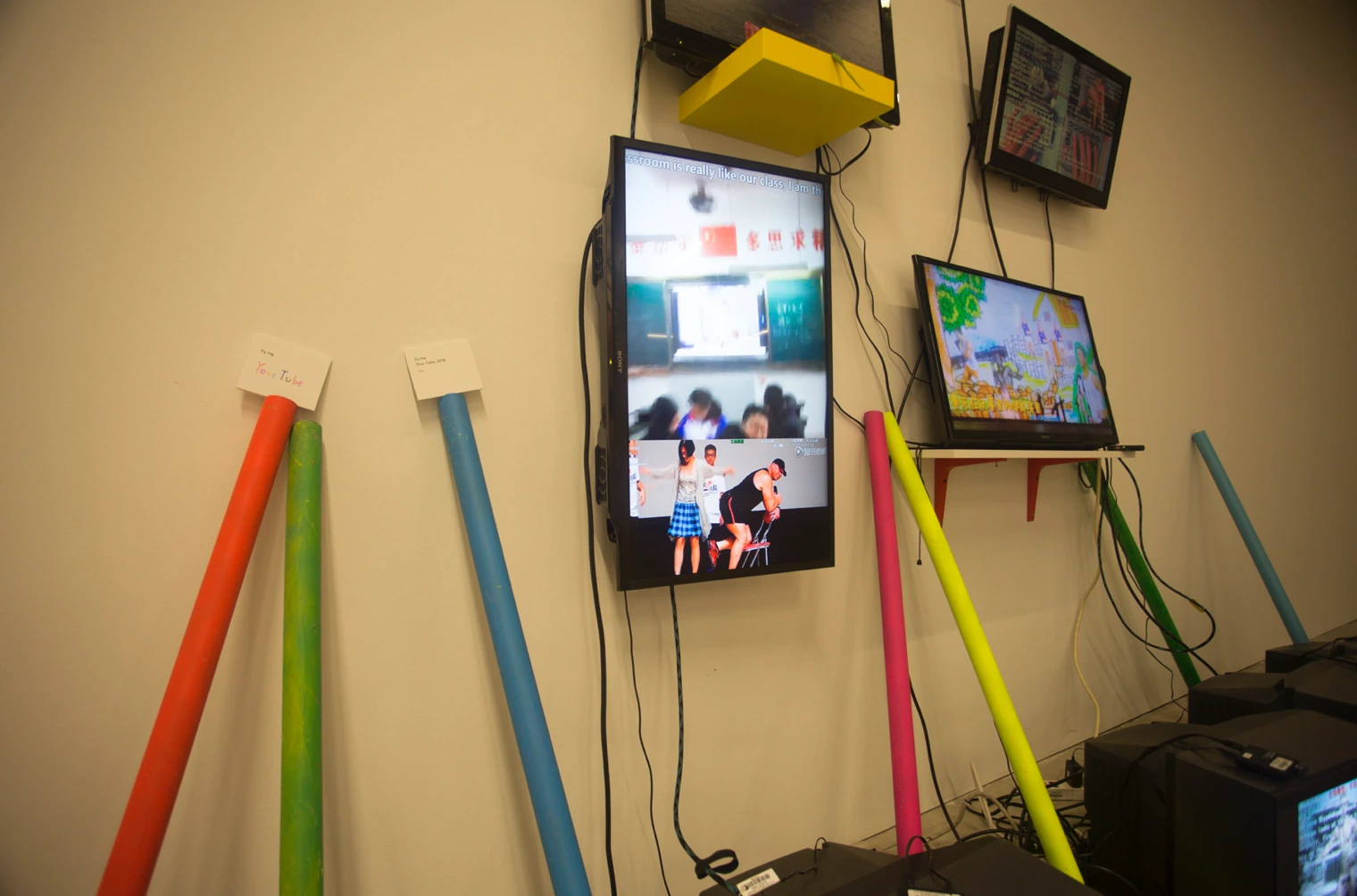
Three original documentation takes: the whole installation, an approach and a closer view. Start a video to hear its recorded sound.
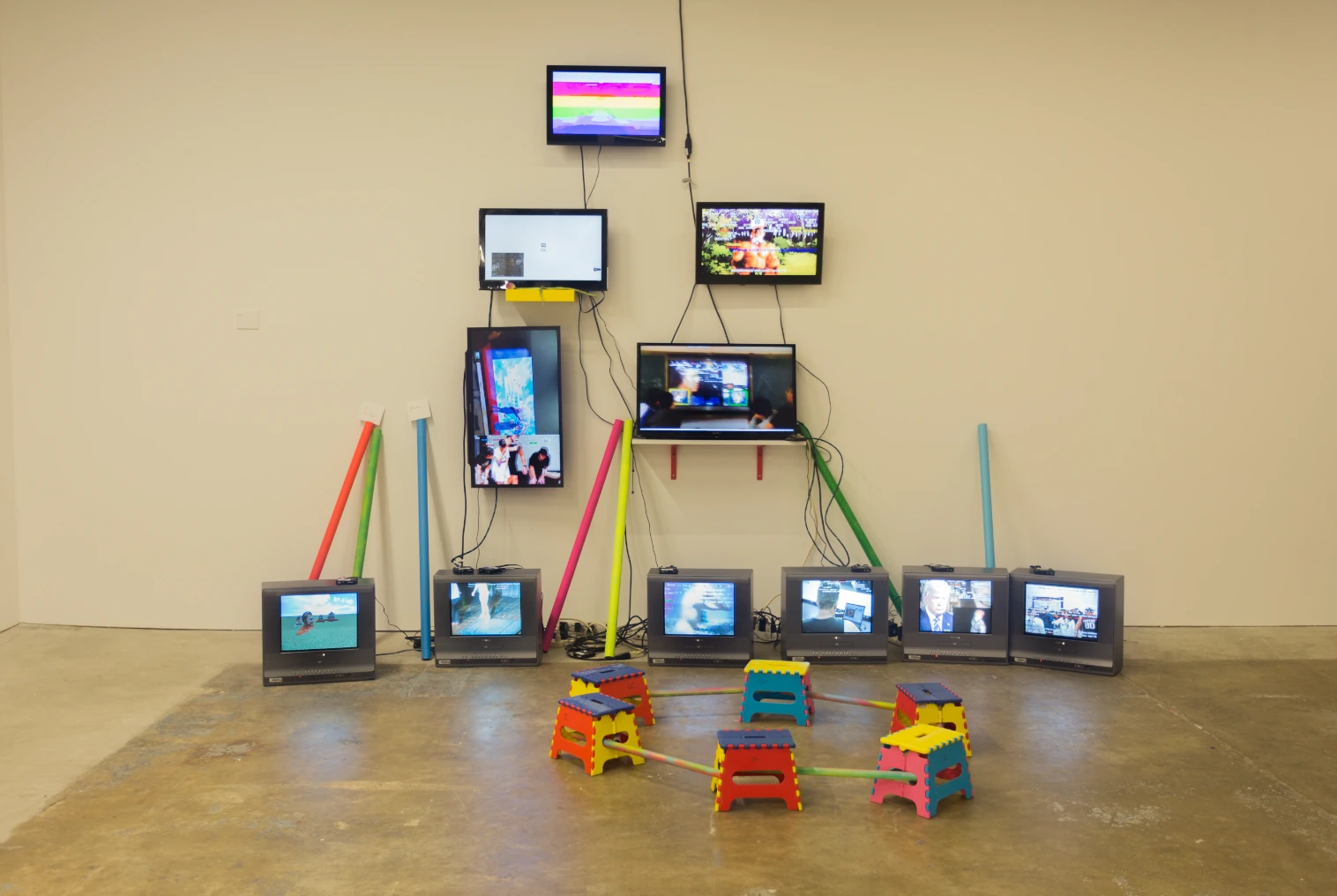
YourTube is He Fa’s 2018 MFA thesis work. It places images carrying traces of online remixing and danmaku comments within an installation of multiple screens, exposed cables, coloured tubes and connected stools. The work brings three questions together: how images direct attention, how other people’s comments shape what we see, and whether sitting together creates a relationship.
YOURTUBE / AN OVERVIEW
The equipment is connected, the seats are linked, and comments already inhabit the images. Do these connections also give viewers the ability to understand one another, speak for themselves and change the arrangement? This question guides the reading below.
Images occupy different heights and orientations, but together they retain a shared front. Viewers can choose where to look without being able to see every image equally clearly.
Six stools are joined into a ring by tubes. Neighbours have been assigned before anyone sits down. Proximity alone guarantees neither a shared direction nor mutual understanding.
Comments, jokes and interpretations are already on screen. We encounter a body together with traces of how others have watched it.
CONNECTION BEFORE RELATIONSHIP / READING THE WORK
This reading draws on interpretations supplied by He Fa and a September 2026 research draft. It begins with visible features of the installation and develops their implications. These later interpretations are distinct from reports of what audiences experienced in 2018.
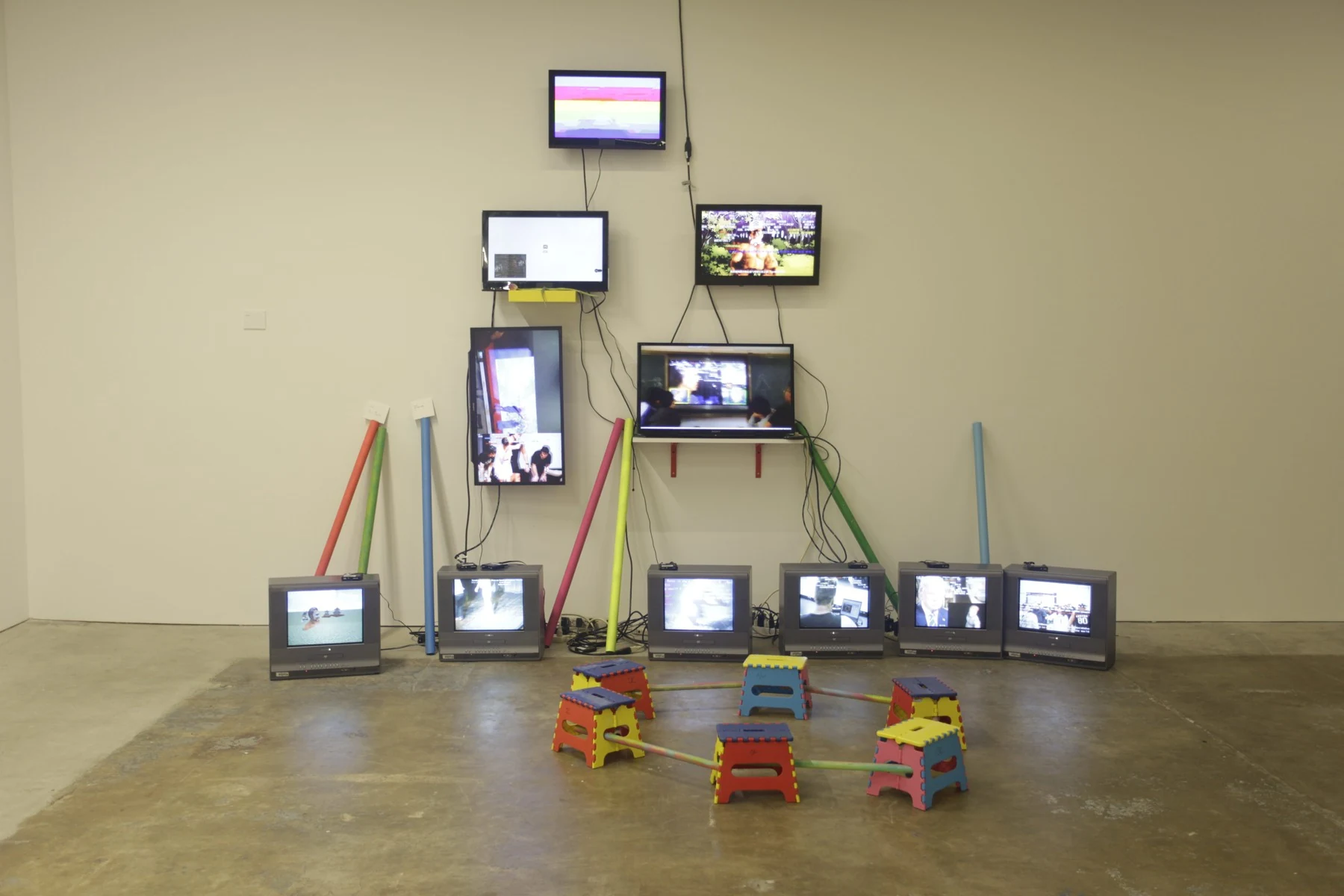
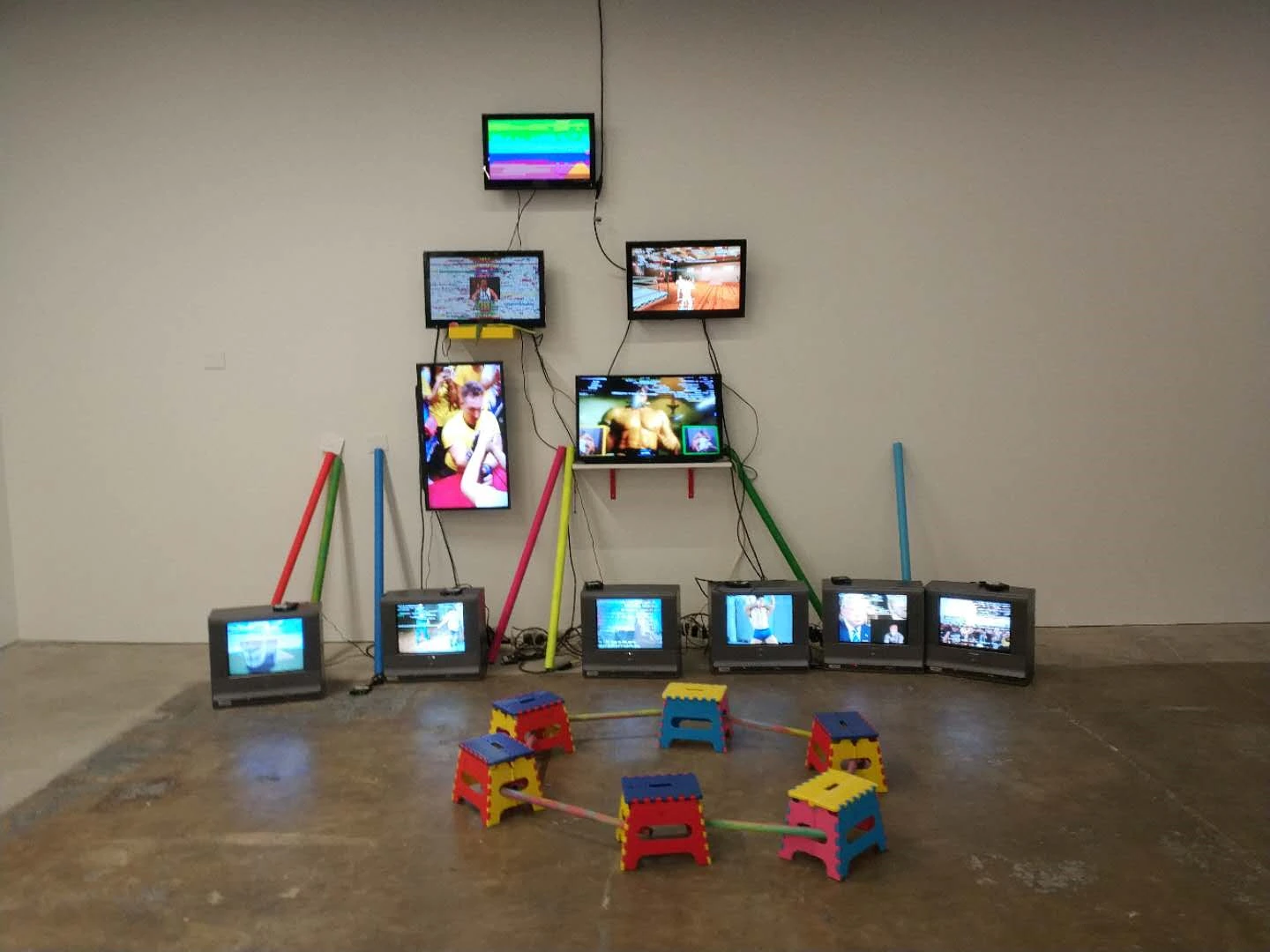
The installation photographs show six CRT televisions along the floor and five flat-panel displays extending up the wall. Frames, volume, orientation and height keep the images distinct. Looking involves adjusting between upward, level and downward lines of sight.
Although dispersed, the screens retain a shared front. They offer several objects of attention within an arrangement selected by the artist. Choosing where to look and deciding what is available to look at are different powers.
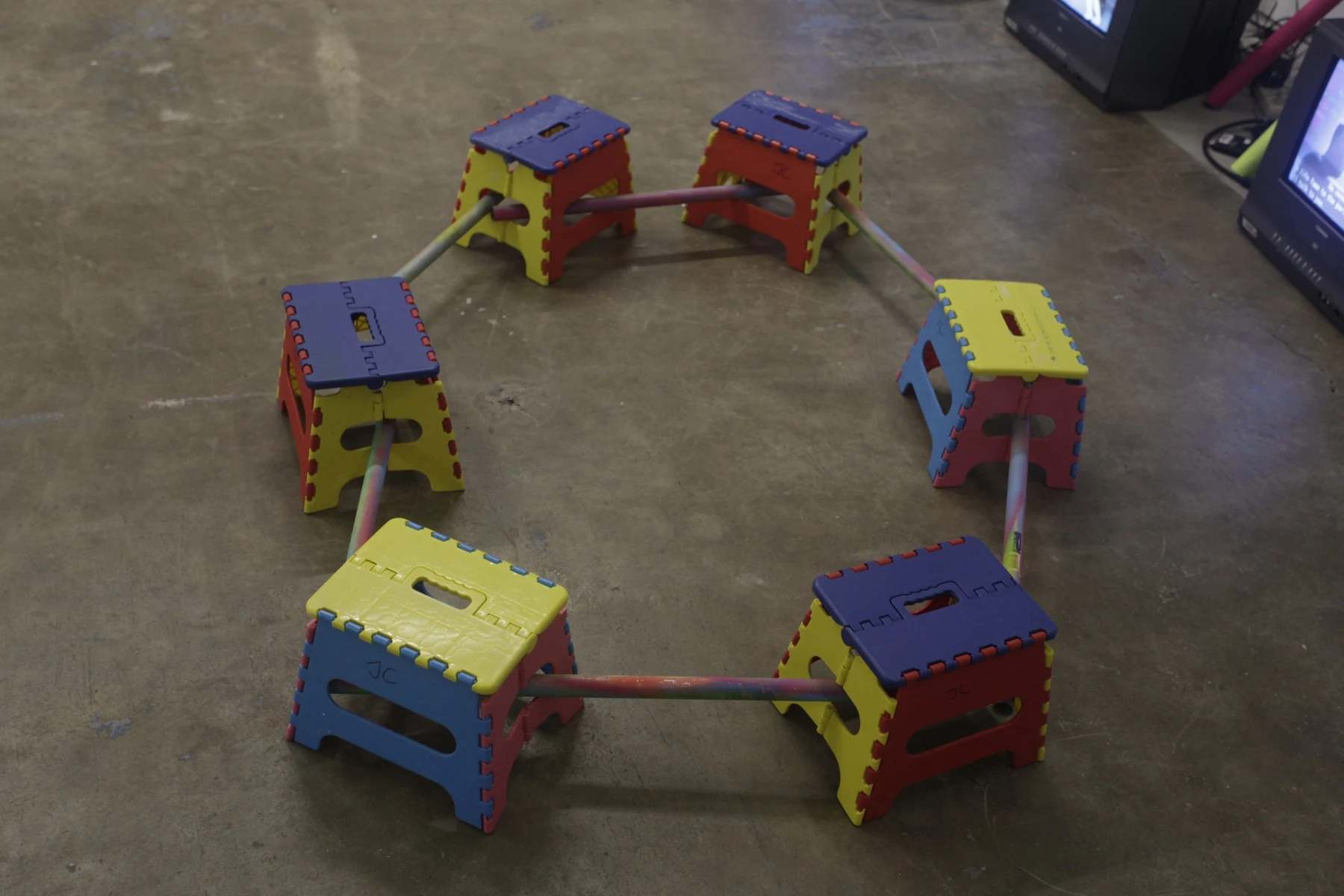
Six backless stools, joined by tubes, form a roughly circular configuration. The ring establishes who sits beside whom without prescribing a single direction for every body. Its geometric centre lies inside the ring; the screens attracting attention stand outside it. The structure gathering people and the object gathering attention do not coincide.
One structure organises where to look. Another organises whom to sit beside.
The stools are more than neighbouring objects. Tubes pass through openings in their sides, making separate everyday items parts of a connected structure. Each stool retains its own position while belonging to the larger configuration.
Before anyone sits down, proximity has already been arranged. Whether that arrangement becomes conversation, intimacy or understanding depends on how people use it. The photographs do not establish that seats could not be moved or that visitors were required to sit.
Black cables and coloured tubes should also be distinguished. The cables belong to the equipment’s wiring; the tubes shape the space and connect the seats. Visible wiring does not disclose who selected the images or who can change what is played.
Objects have been connected. Relationships between people have not thereby been completed.
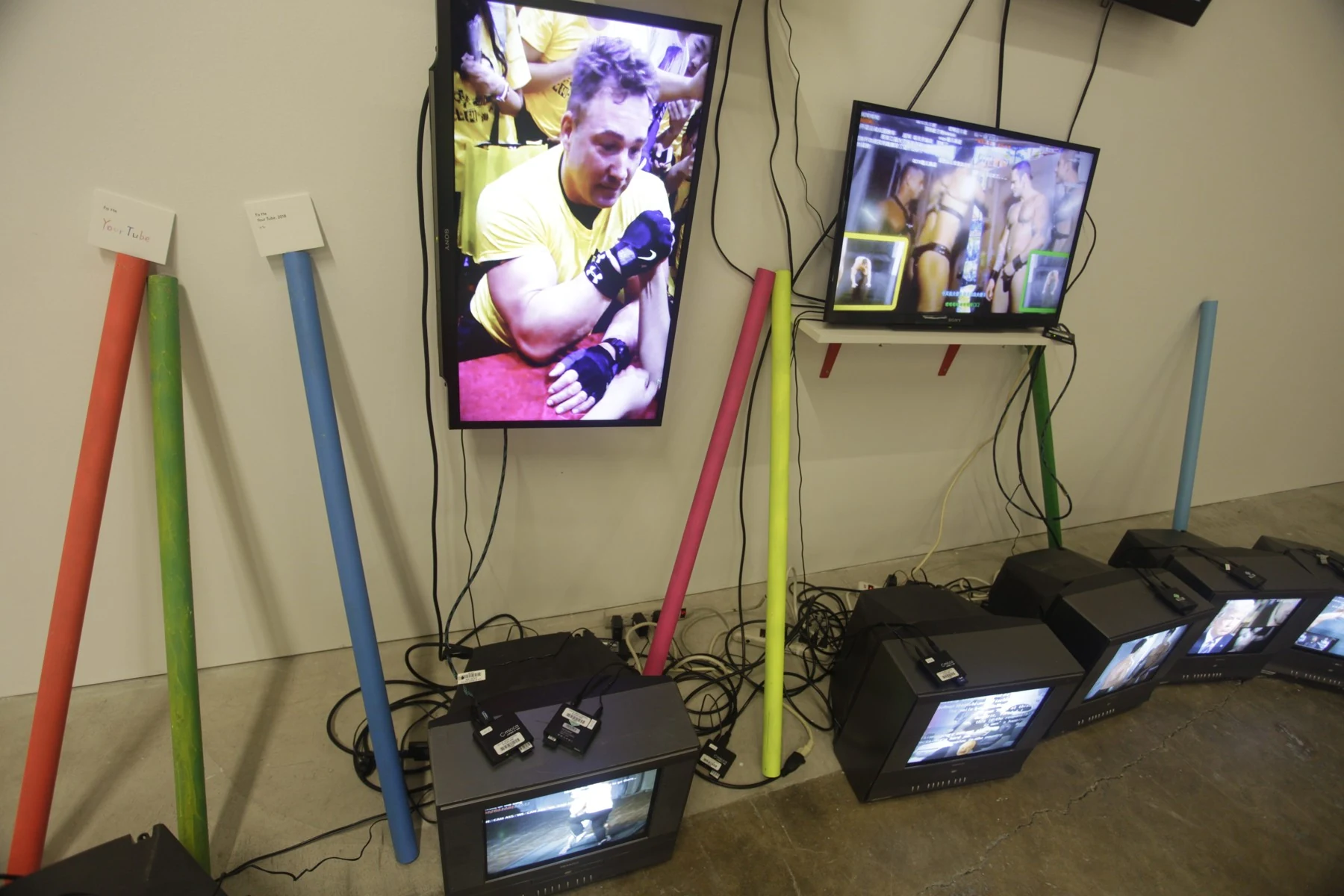
According to the account of the work’s sources recorded in the supplied materials, YourTube engages with male homoerotic imagery and its transformation in online “philosophy” culture. In this context, “philosophy” is a community label associated with remixed male-body imagery, altered sound, phonetic reinterpretation and shared jokes; it does not refer to the academic discipline.
Translation here includes more than language. Editing changes the duration of an action; phonetic reinterpretation assigns new meanings to sounds; rhythmic repetition makes fragments reusable; comments supply further social interpretations. A body’s appeal may persist while the ways of approaching and discussing it change.
This is an analytical route, not a verified history of every clip. Titles, dates, production locations, remix versions and their assignments to screens require original playback files and production records.
On relevant danmaku interfaces, comments posted on different dates can be attached to the same position in a video. A later viewer encounters them when playback reaches that point. The research draft calls this “co-presence across different times”.
Comments can direct attention, mark moments of expectation and suggest recognisable responses. The viewer encounters an image already interpreted by others. “The prior socialisation of viewing” names this condition: other ways of watching are present before one’s own judgement has formed.
This does not mean everyone accepts the same reading. A familiar joke may welcome one viewer and confuse another. Comments can be agreed with, misunderstood, rejected or reinterpreted.
Danmaku preserves reactions and makes earlier reactions conditions of later viewing.
Within the joking frame of “philosophy” culture, someone may admire a body or repeatedly watch an action while describing that attention as a meme, technical appreciation or a joke. The draft calls this “retractable expressions of desire”: a feeling can remain unnamed without immediately becoming an identity declaration.
Such ambiguity can protect exploration, but it may also become a constraint. Being free to joke differs from being accepted only while joking. The question is whether a person who expresses sincere admiration, intimacy or disagreement can still receive a serious response.
The repeated visibility of male homoerotic bodies does not automatically establish respect for the people to whom those bodies belong. An image being visible and a person being recognised in their desires and life are different conditions. Viewing choices, laughter and bodily gestures are not evidence of an individual’s sexual orientation.
The exhibition adds another relation: the viewer can also be seen watching. Desire’s public appearance becomes a question, without establishing that every visitor feels shame, repression or liberation.
A comment can be stored, replayed and exhibited. Its continued appearance does not establish that a visitor can now write a response on the same surface. Several forms of participation need to be distinguished.
| Level | What it involves | The question |
|---|---|---|
| Traces of participation | Earlier comments, edits and reactions become part of the display. | Does visible speech remain open to a reply? |
| Interaction in the space | Visitors talk, turn, approach, move together or leave. | Does proximity generate mutual understanding? |
| Power to change the arrangement | Content, comments, playback or viewing settings can be modified. | Who can make changes, and do those changes persist? |
The documentation shows text within the displayed images but does not establish whether the original installation supported live comment input, independent playback control or other response mechanisms. It therefore supports neither a confirmed claim of real-time interaction nor a blanket claim that no response was possible.
Watching together is a beginning. Changing the conditions of watching together is a further question.
One way to read the title is through the shift from “You” to “Your”: an address becomes a claim of belonging. CRT televisions and physical tubing also give “Tube” a material resonance. This is an interpretation of the title and installation, not a claim to the artist’s sole original intention.
Does being given a seat include the right to arrange it? Does choosing a screen include deciding which images receive a screen? Does recognising a comment include the ability to change the reading it establishes?
These questions include the artist. Content, equipment and seating have been selected. The displayed images may carry distinct contributions from performers, original production teams, remixers and commenters. An artistic signature should not erase those contributions.
Online circulation is also shaped by regulation, platform rules, commercial distribution and community habits. Multiple screens, low resolution and exposed wiring do not independently prove escape from these arrangements. The work’s critical potential lies in opening their conditions to discussion.
YourTube constructs a position for the viewer and leaves open whether that position can genuinely belong to them.
The Chinese research draft, Co-presence across Different Times, the Translation of Desire and the Redistribution of Participation: A Media-Anthropological Study of He Fa’s YourTube, develops these arguments with references, methodological limits and proposals for further research.
Download the Chinese research draft · DOCX ↓Draft dated September 2026. Supplied as research material, without a claim of journal publication or peer review. This page also draws on the interpretation “Connection before Relationship,” provided by He Fa.
Screens, seats, tubes and text layers are visible in the documentation. Concepts such as pre-arranged relationships and retractable desire are analytical readings. The material does not establish audience psychology, community formation or the work’s social effects.
No such equivalence can be assumed. Channel count, synchronisation, sound routing and the full running time require playback files and technical records. The three video durations on this page belong to documentation takes.
This is an archive and interpretation. Photographs and videos provide access to the work without reproducing its original spatial, sonic and social conditions. Proposed interviews and participant observation in the draft are not presented as completed research.
Move between the whole landscape and its photographic fragments, or let the view roam in fullscreen.
March 28–April 7, 2018: Part 1 of the CCA MFA Thesis Exhibition at Minnesota Street Project, San Francisco. The official roster lists Fa He; this page brings that record together with the artist’s documentation of the thesis work.
Page 34 pairs a frontal installation view with an oblique close view. The wider image preserves the relationship of differently sized screens, colored strips and small stools on the floor. In the close view, a physical label reading “Fa He / YourTube / 2018” directly connects the photograph with the work’s title and year.
The artist’s retained installation instructions add an account of how YourTube was operated: after connecting the main power, individual screens were switched on, and remotes and media players were used to select MP4 files from storage cards. The completed view in the document matches the portfolio installation bearing the label “Fa He / YourTube / 2018,” with the same configuration of six CRT televisions, five flat screens, coloured rods and six connected stools.
The instructions are retained as operating documentation for YourTube. A writing date absent from the document is not inferred, and the number of screens is not equated with the number of independent video channels.
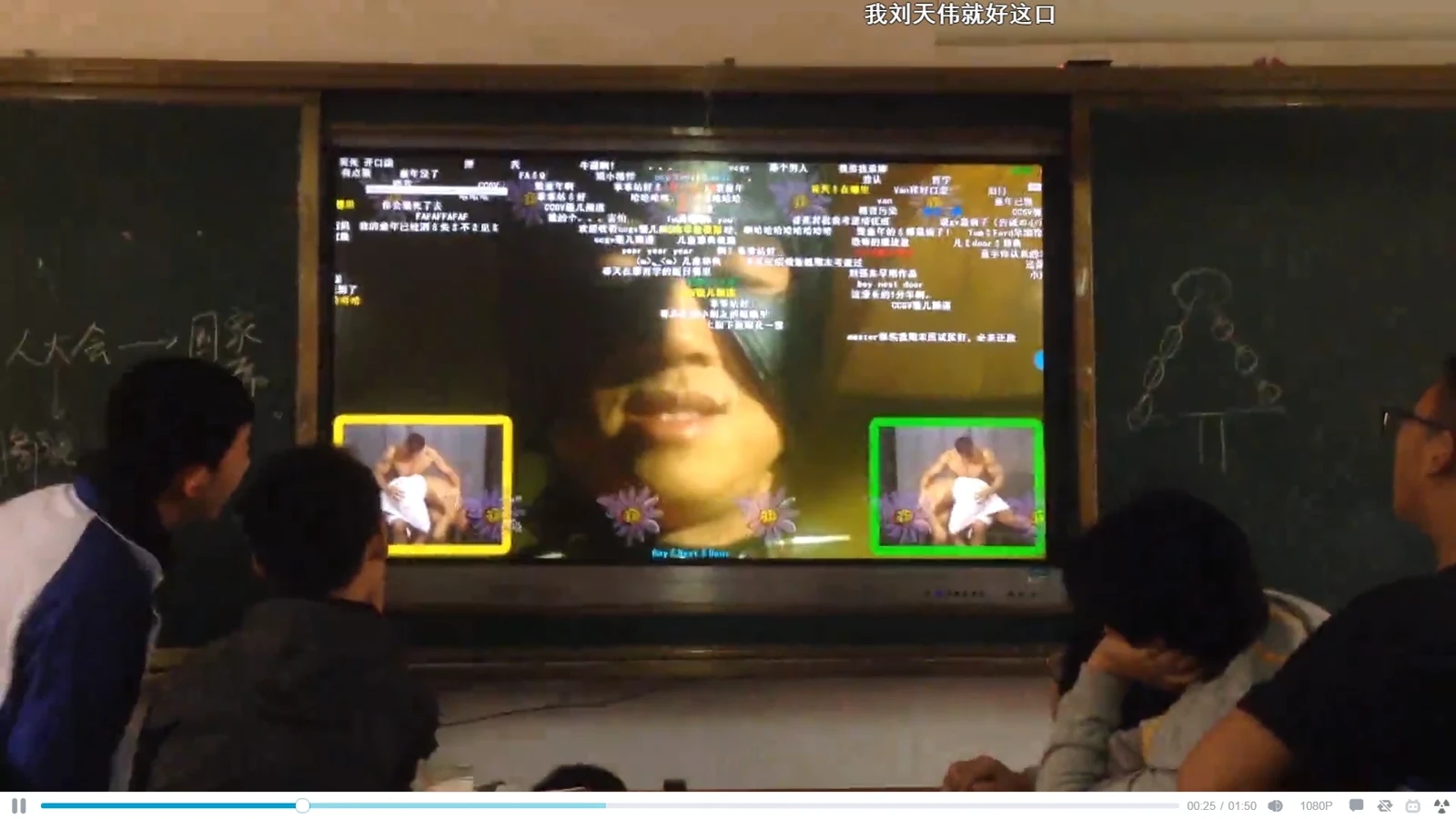
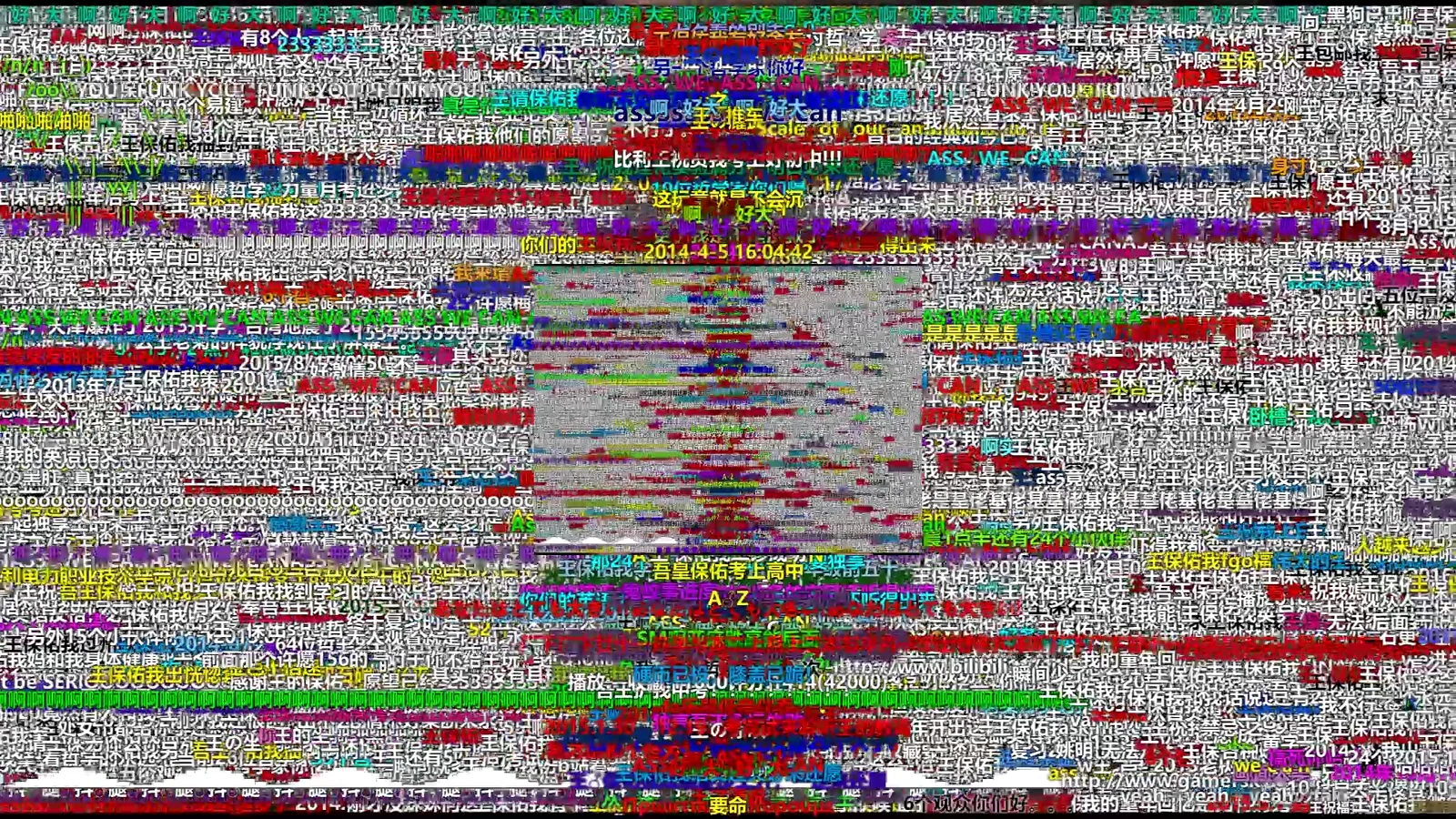
The installation instructions show a television menu listing “大右.mp4” at 83.09 MBytes. The working archive retains a file with that name and a measured size of 83,098,694 bytes: 64.36 seconds, 1920 × 1080, 25 frames per second, with stereo audio. Its comments, figure and small yellow- and green-bordered images correspond to the composition visible on the installation photograph’s large screen at the right. The filename, size and visible content connect this playback file to that display.
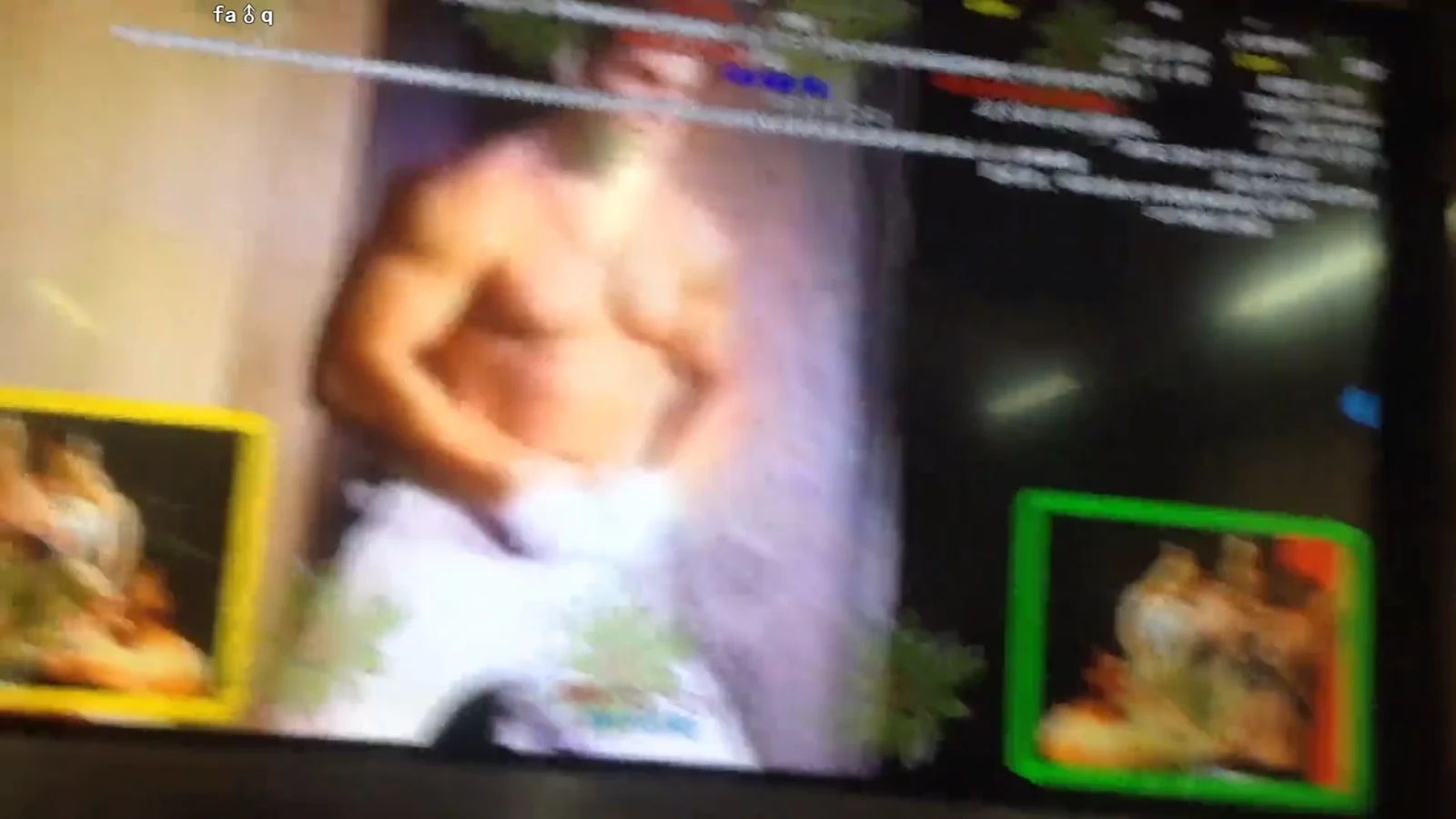
These are frames from one playback file used within the installation. They retain the inset images, on-screen text and shots of people watching a screen, making it possible to follow this footage into a particular display. The installation photographs remain necessary to understand the spatial relationships of the work as a whole.
Original media and Fa He’s installation instructions
The same working directory also retains “中左.mp4” (226.24 seconds), “大竖屏.mp4” (316.28 seconds) and “小.mp4” (108.56 seconds). Sampled frames show a portrait covered by dense text, bodies and event footage arranged for vertical viewing, and shifting bands of colour. These visual features correspond to the middle-left display, the vertical screen and the small upper monitor in the installation photograph.
Four aligned samples from “中右_3_x264.mp4” and “大竖屏.mp4” show the same sequences with different orientation and encoded dimensions. The archive preserves this distinction between playback versions. A count of files does not by itself establish the number of channels in the work.
Original media and Fa He’s installation instructions
CLOSE READING / 2026 CURATORIAL INTERPRETATION
Do shared seats and visible comments already make a “we”?
One structure directs attention toward screens; another joins seats into a ring. Their centres differ. I can sit beside you while everyone watches a different screen, or share an image without knowing how my neighbour understands it. Exposed cables make equipment connections visible, and tubing physically joins the furniture. Those material connections cannot testify on behalf of human relations. The installation gives form to the distance between being connected and understanding one another.
On-screen comments bring previous acts of watching into the present. The bodily imagery has already passed through jokes, phonetic play and shared codes. Familiarity may invite someone in while limiting which kinds of appreciation can be expressed seriously. The work should therefore not simply be praised as interactive. Seeing an earlier comment differs from being able to answer it now; selecting a screen differs from deciding which material can appear. The title’s “your” leaves a concrete question: how much of this position can you actually change?
Eleven devices do not establish eleven independent channels. Live commenting, synchronization and the complete source list remain unverified; viewers’ sexual orientation is not inferred.
Based on installation photographs, three original recordings and versioned research material on the public work page. This is a retrospective reading from 2026.
YourTube, 2018. Multi-screen video installation. He Fa’s role: Artist; graduate thesis work.
Cite this record: YourTube · 2018 · Artist; graduate thesis work · https://hefa.p4theater.cn/en/work/yourtube
TAKE A PATH ACROSS
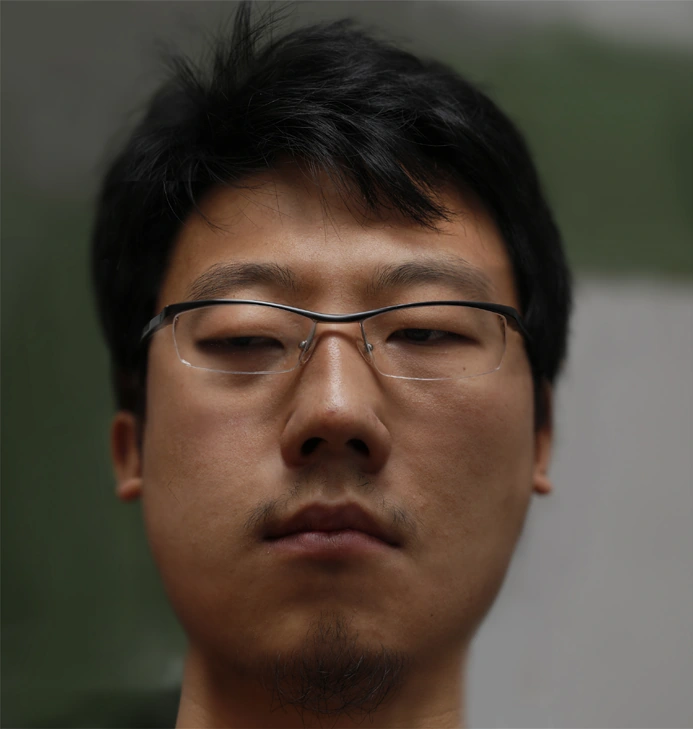
Distance and looking
YourTubeLarge Portraits / Portraits
Large Portraits presents each person through a whole image and details, while YourTube disperses imagery across screens. Both allocate attention, but a viewer cannot survey them through the same kind of sequence.
The grouping and captions of the Large Portraits PDF list four sets of full portraits and details; names follow the original captions only.
The saved installation instructions document switching on individual screens, media players and MP4 selection, and preserve the arrangement of screens, tubing and six connected stools.
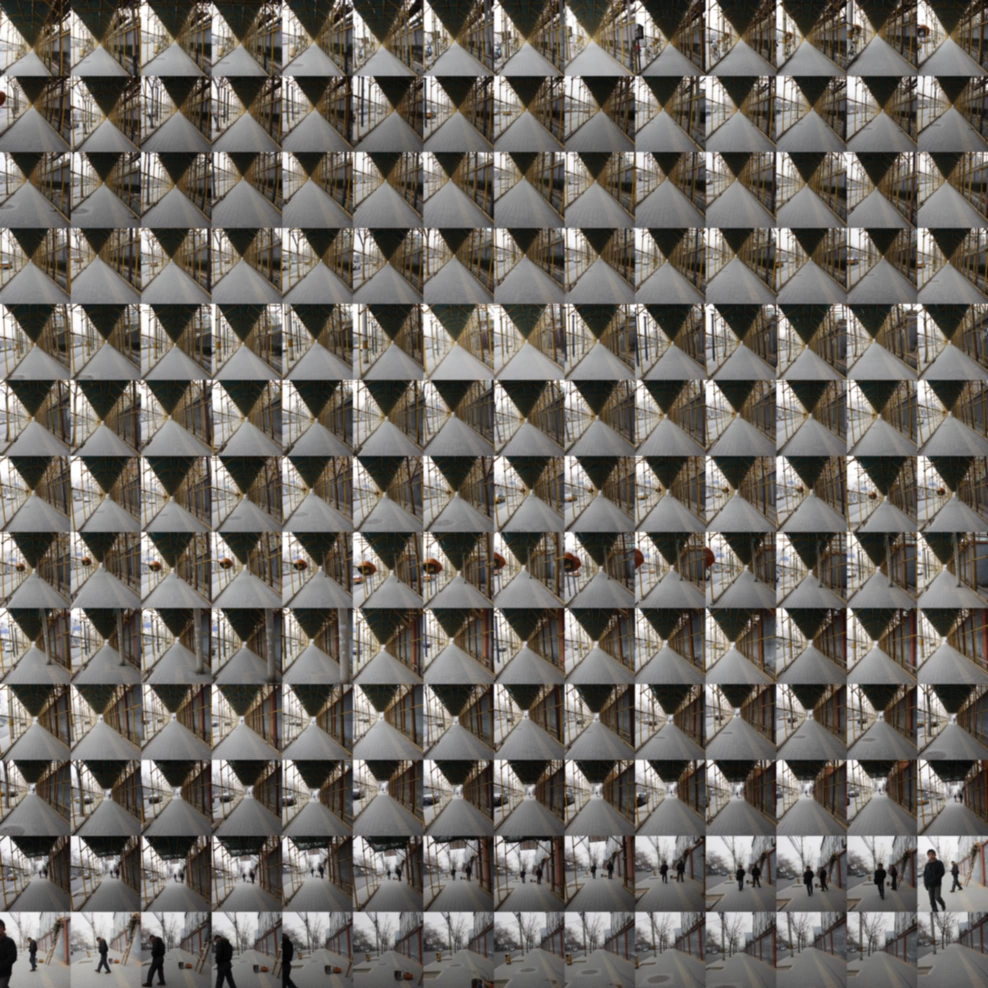
Spaces transformed
Yigui juxtaposes distinct divisions with soft overlays; YourTube retains each screen’s border. The former compares organization within images, while the latter places separate displays within a shared viewing space.
Two images sit together: one uses distinct divisions, the other soft superimposition; the portfolio does not state a developmental sequence between them.
The saved installation instructions document switching on individual screens, media players and MP4 selection, and preserve the arrangement of screens, tubing and six connected stools.
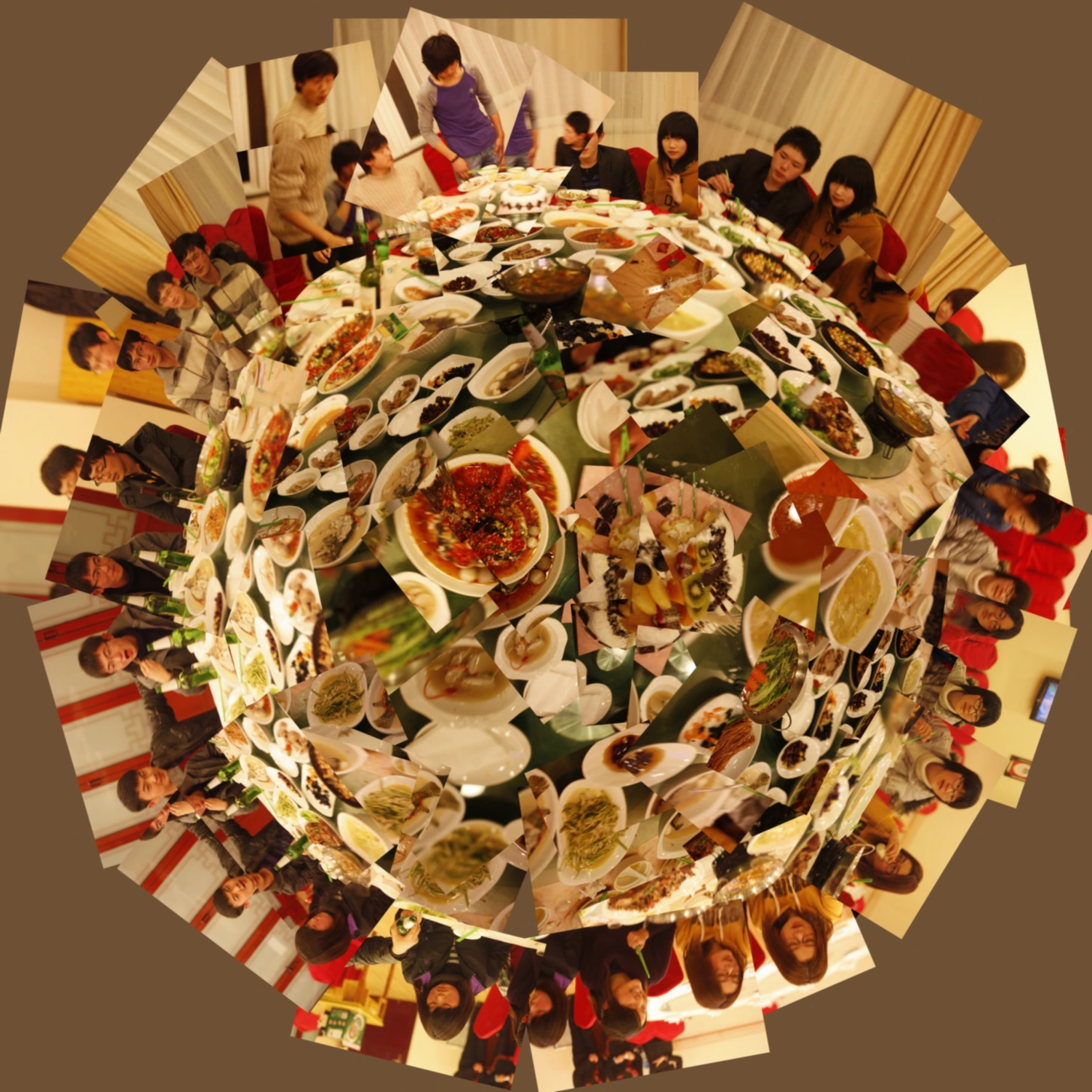
Spaces transformed
Gathering’s surrounding compositions reorient objects; YourTube joins six seats into a ring with tubing. Adjacency within an image and proximity between bodies do not guarantee that everyone looks toward the same place.
In the first image, table, food, people and room fragments form an encircling composition, with directions changed by the collage.
The saved installation instructions document switching on individual screens, media players and MP4 selection, and preserve the arrangement of screens, tubing and six connected stools.
Language in transit
Fafalish repeatedly changes text through transcription and translation; YourTube brings phonetic reinterpretation, on-screen comments and re-editing into multiple screens. Both expose material to later interpretations, but successive linguistic conversions and the juxtaposition of earlier viewing traces unfold at different rhythms.
The Dayou.mp4 shown in the installation instructions corresponds to the saved file of the same name and size; its frames retain on-screen comments and picture-in-picture.
The CCA exhibition statement supplies six transformations: Chinese poetry, literal English translation, accented reading, pinyin transcription, Chinese rewriting and machine translation into English.
FROM HERE, ELSEWHERE
Choosing which screen to watch differs from choosing what the screens show.
Editing, phonetic play and on-screen comments rename actions and sounds, reorganizing how they are watched.
The screens’ frontal arrangement and the seats’ circle have different centres, separating sitting together from looking in the same direction.
The installation instructions break operation into connecting power, switching on screens, using a media player and selecting an MP4 from a memory card. The spatial work also depends on procedures another person can carry out.