2012↗
Shanshui
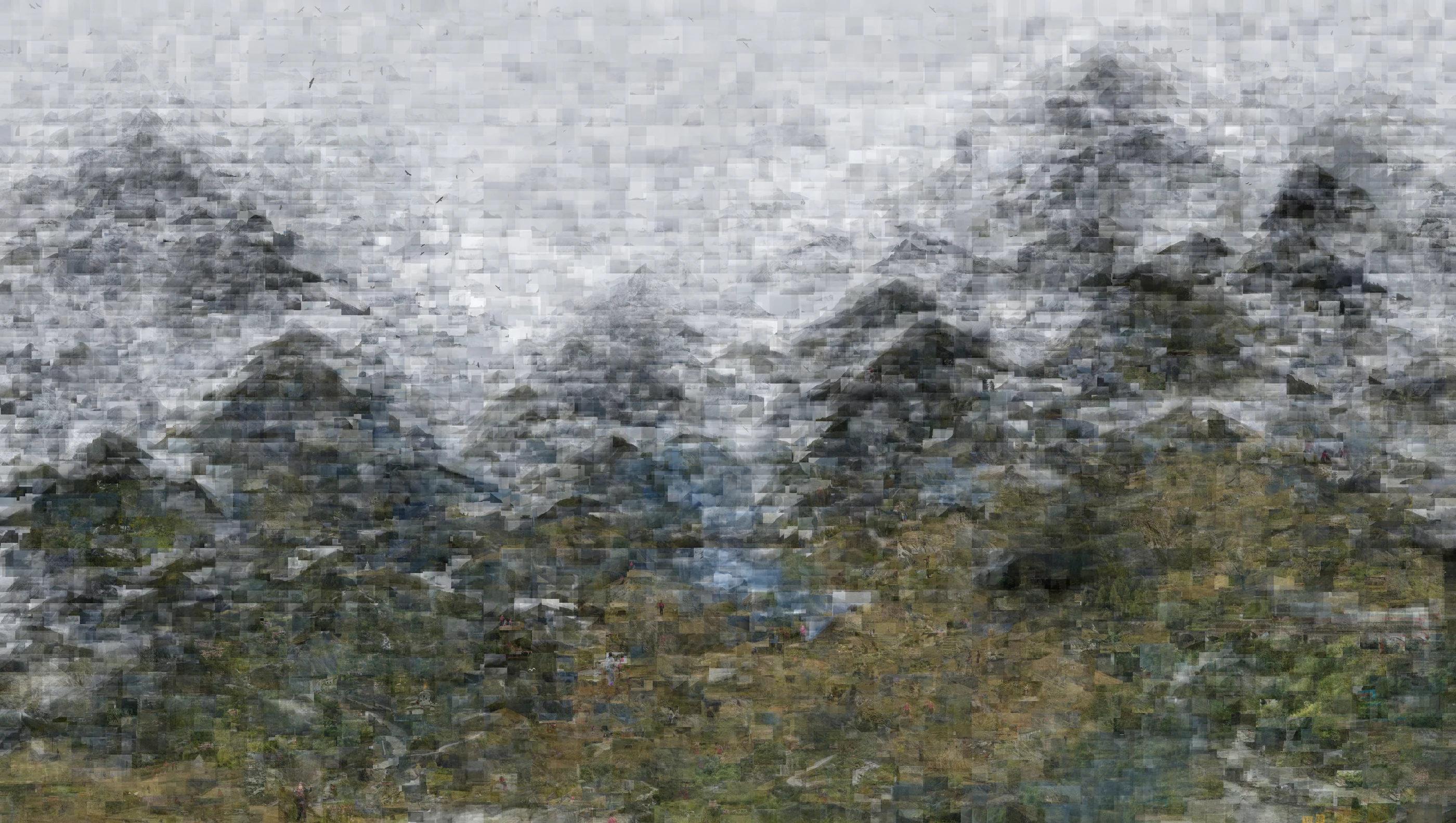
From a distance, a landscape. Up close, photographs made at different times and positions.
Selected works2012 / Archival inkjet print
A macro lens travels across the body; individual photographs assemble into an enlarged self-portrait.
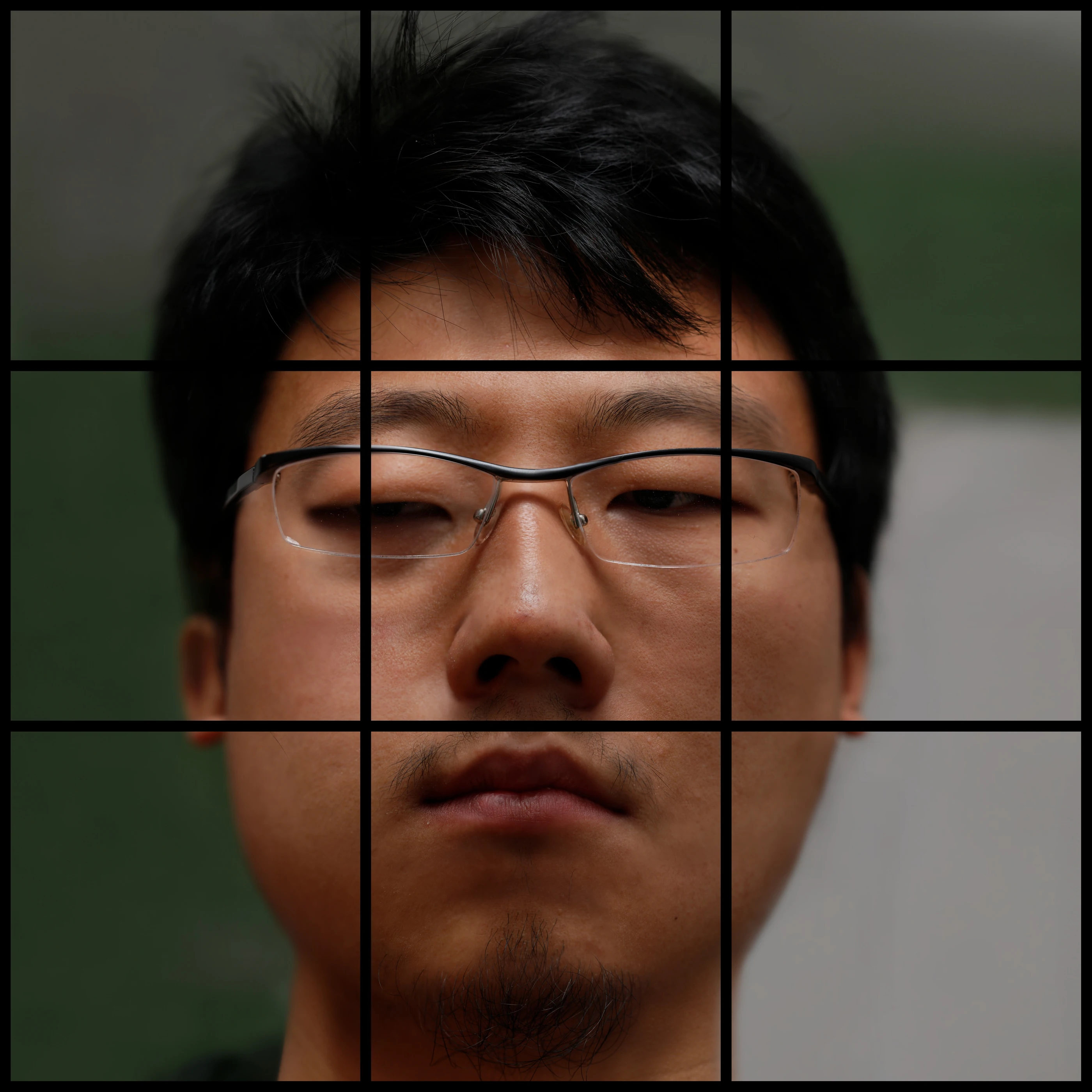
In I (2012), the photographer becomes the terrain being photographed. A macro lens attends to skin, facial features and hair, piece by piece; these close observations are assembled as a self-portrait measuring 320 × 320 cm. The grid divides a recognizable face and retains traces of its photographic construction.
From a distance, the image remains a face. At close range, it can be read as a surface composed of many details. A comparable shift occurs in the contemporaneous Shanshui works: both a landscape and a body invite repeated movement between the whole and its parts.
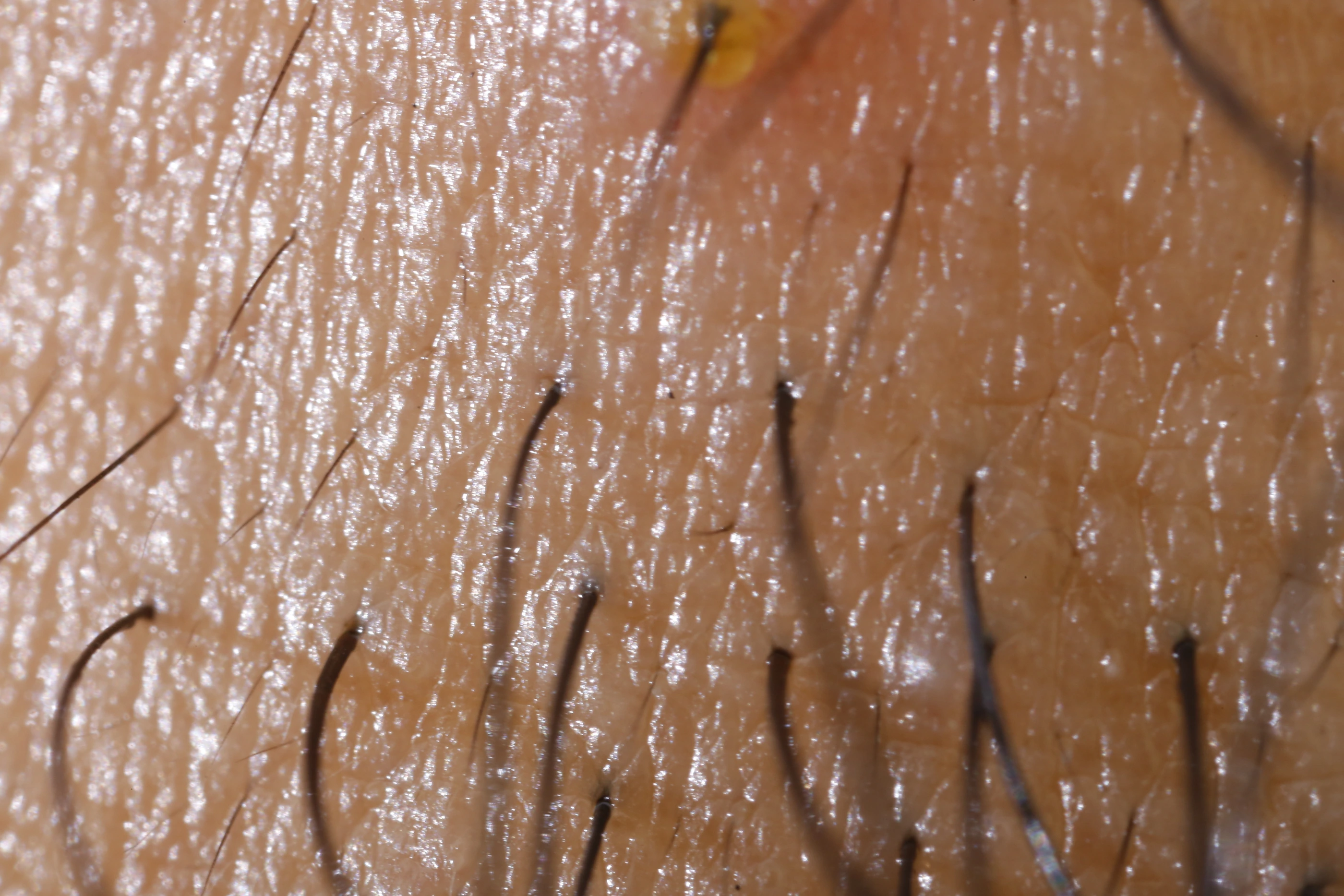
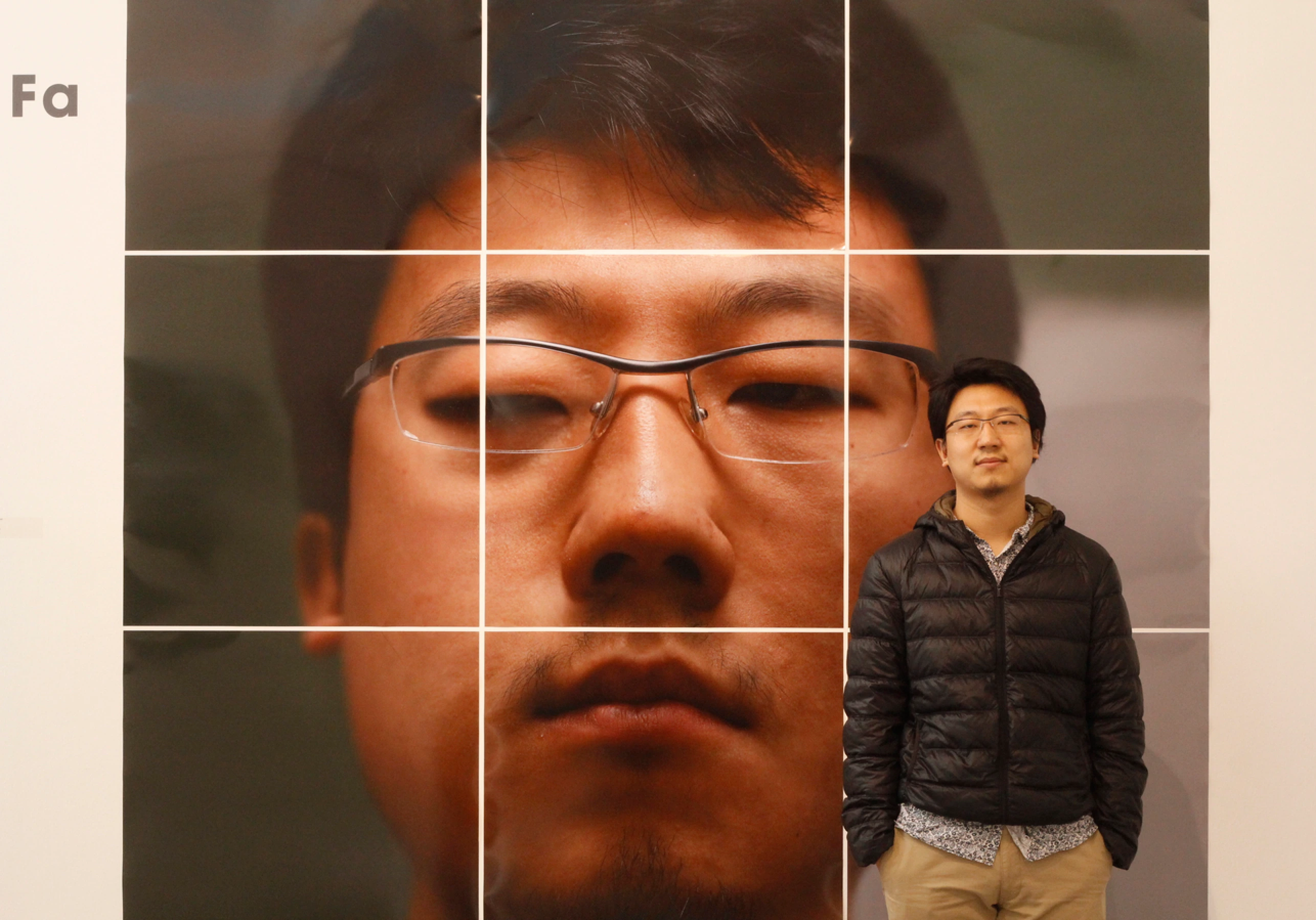
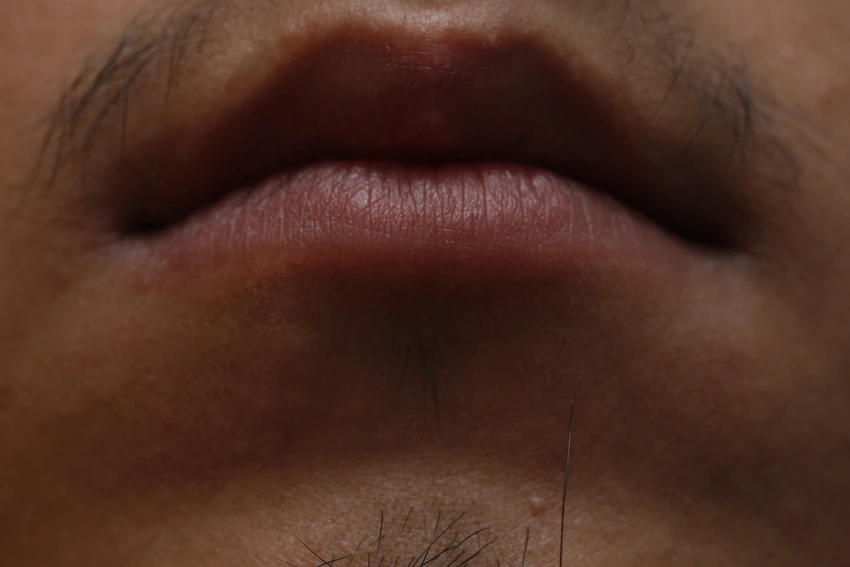
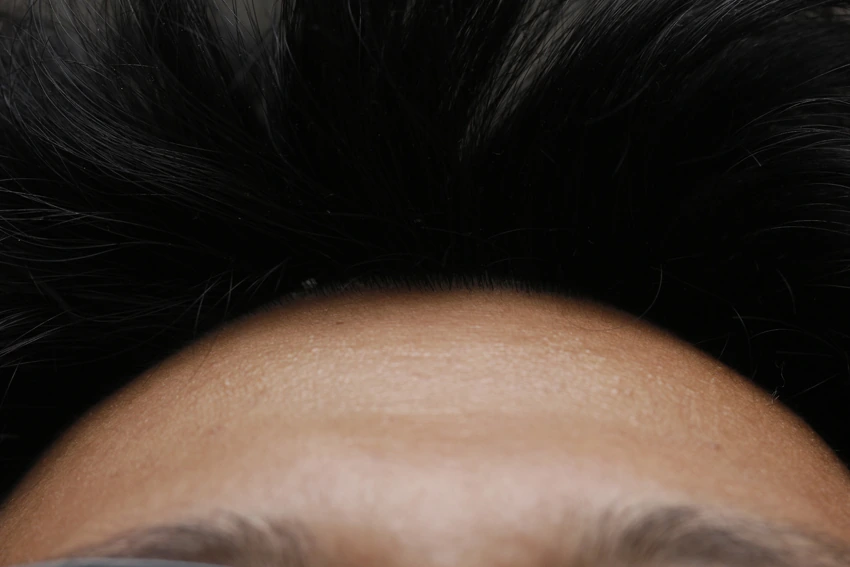
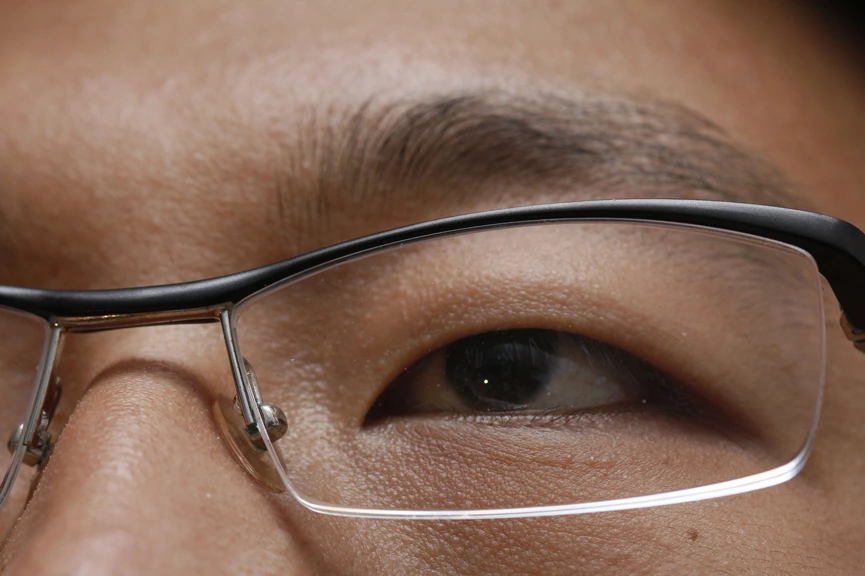
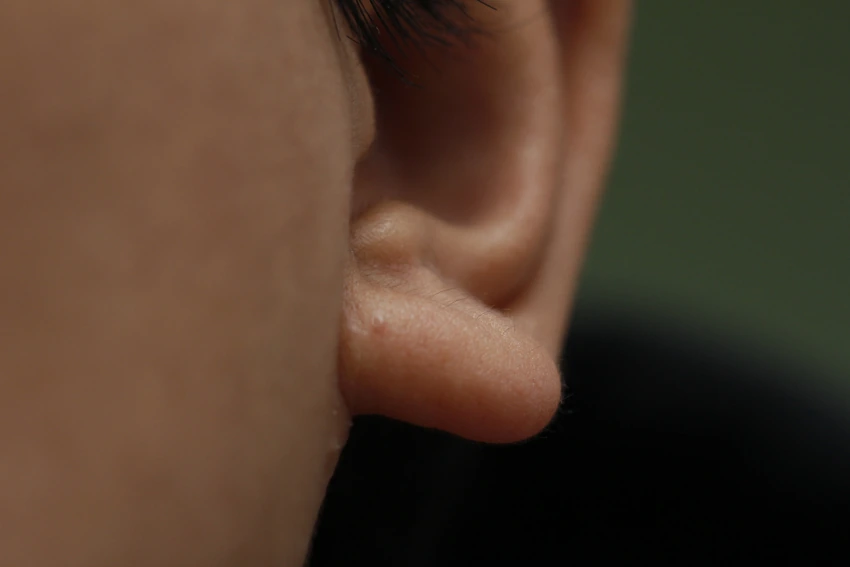
After the full image, the portfolio places a macro photograph of skin beside an installation portrait. Pores, fine hair and skin become terrain; a person standing before the work restores its scale of 320 × 320 cm. The two distances correspond to the artist’s statement that “I became the mountain.”
The same portrait also appears in the 2010 Large Portraits portfolio as Portrait — He Fa: a vertical image without a grid, recorded at 2310 × 2430 mm. In the 2012 portfolio, I has a square, gridded composition and is listed at 320 × 320 cm. Dates and dimensions are retained from their respective documents.
Page 18 of the multi-artist Tangle document presents this self-portrait as “He Fa · My Face” with a bilingual statement. He Fa’s separate 23-page About Tangle presentation begins with photographs of Mount Siguniang and its rocks, moves into close observations of mouth, forehead, eyes, nose and ear, then returns to the complete face.
Page 17 gives the full portrait as 273 × 287 cm; pages 19 and 20 show details of skin and hair labelled at original size. Alongside the 231 × 243 cm record in the 2010 portfolio and the 320 × 320 cm gridded version of I from 2012, this preserves different documented dimensions and compositions for the portrait materials.
Source documents: 纠结(多艺术家文献); 关于纠结——何发.
The heavy black grid becomes visible before the texture of the skin. It divides the face into stable regions and makes the person an object of inspection, cell by cell. At close range, pores, hair and reflected light can briefly displace recognition. Beside the ungridded portrait version, the change concerns more than scale: the frame makes the organization of looking part of the image.
Archive reading, 30 September 2026 · Site editorial interpretation, not an artist’s statement. Sources: Large Portraits — Works by He Fa, pp. 2–5; He Fa Portfolio (PDF), p. 2; the Struggle catalogue, p. 18. English is an editorial translation; document titles are translated where needed.
ARTIST’S STATEMENT / PORTFOLIO
This is a huge photograph. I observed myself through a macro lens, from a mosquito’s point of view. The idea came to me while climbing a mountain: I became the mountain, and the camera became the me observing me.
Translated from the artist’s Chinese portfolio statement.
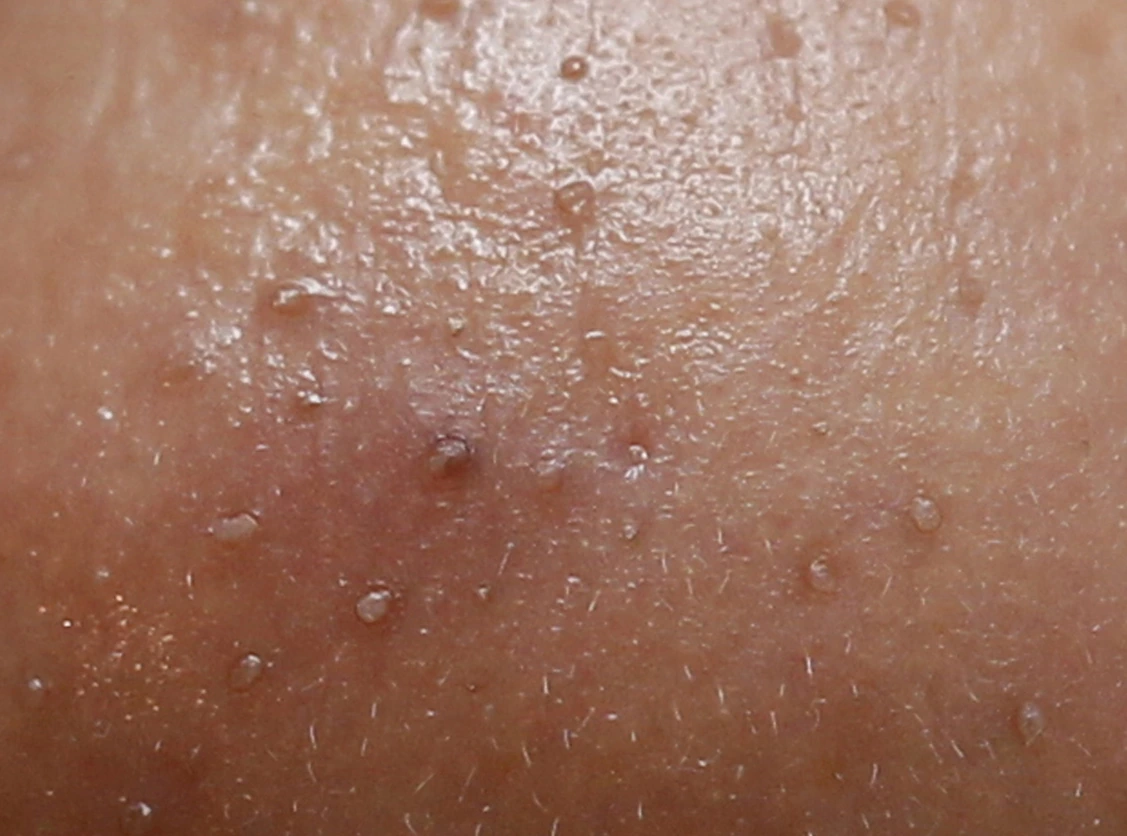
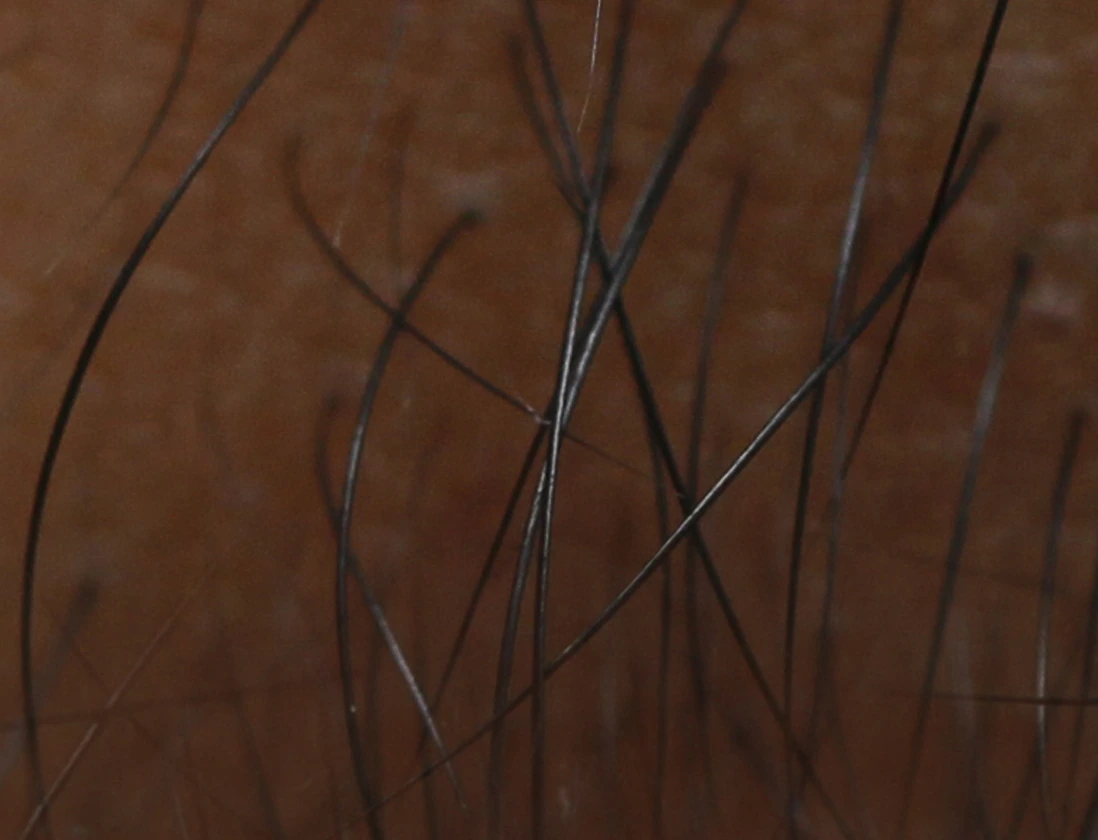
Prepared from page 2 of the artist’s retained portfolio, He Fa Portfolio 3. Chinese titles follow the source; English titles are translations for this site unless already given in English. Images retain their full composition. Dimensions refer to the version listed in that portfolio.
From a distance, a landscape. Up close, photographs made at different times and positions.
Selected works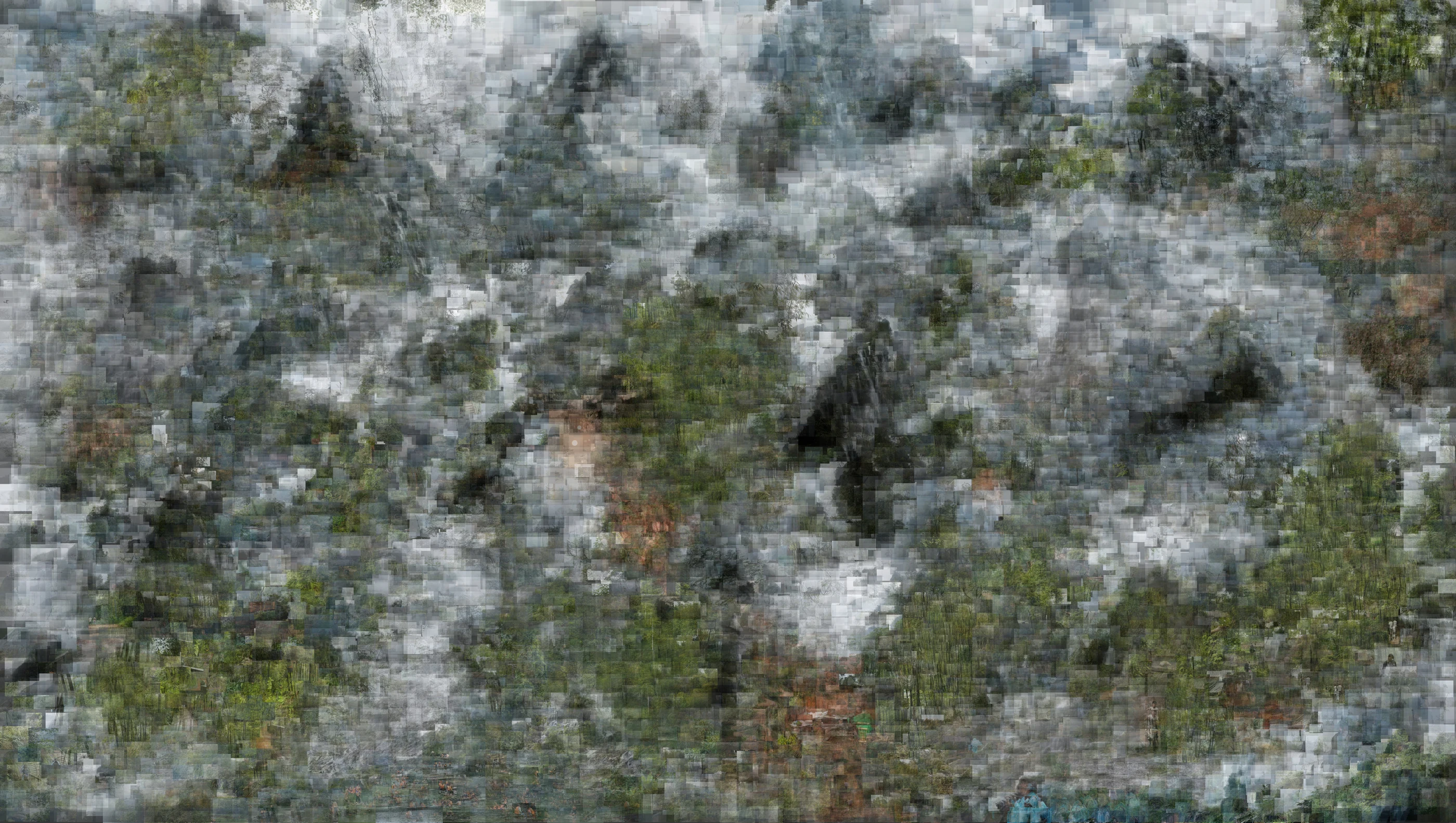
Placing the sun among the mountains rearranges a space that photography cannot ordinarily show.
Selected works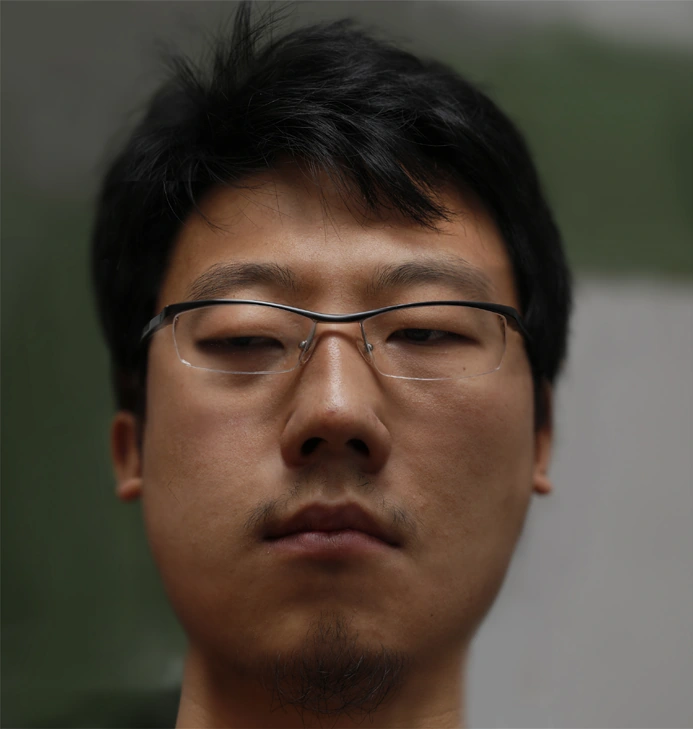
Four portraits unfold alongside three enlarged details of each.
Early explorationsCLOSE READING / 2026 CURATORIAL INTERPRETATION
When I become the terrain, who is looking at whom?
ARTIST’S STATEMENT · PORTFOLIO EXCERPT
I became the mountain, and the camera became the me observing me.
Statement in the artist’s portfolio; distinct from this page’s interpretation
Prepared from page 2 of the artist’s retained portfolio, He Fa Portfolio 3. Chinese titles follow the source; English titles are translations for this site unless already given in English. Images retain their full composition. Dimensions refer to the version listed in that portfolio.
Editorial translation of the Chinese portfolio statement.
Check the work record and source documents ↗This face has two competing scales. Recognizing He Fa from a distance means overlooking individual pores and hairs. Approaching a fragment makes the body’s material clear while personal identity temporarily recedes. The grid is more than a trace of montage technique: it prevents these two tasks from being completed at once. The viewer must choose a distance and acknowledge what remains invisible at another one.
The artist compares himself to a mountain and the camera to the self observing him. This division moves the self-portrait beyond the convention of expressing an interior life: one person can make the image and be the object it cannot encompass at once. The different recorded sizes and compositions should remain visible. They show that this “I” has more than one definitive-looking form: bodily material enters successive versions, placing stable identity beside the revisability of its image.
Different documented versions should not be collapsed into one dimension; the portrait does not establish a personality or psychological state.
Based on He Fa Portfolio 3, p. 2, and the Tangle / About Tangle documents identified on the public work page.
I, 2012. Archival inkjet print. He Fa’s role: Artist: He Fa.
Cite this record: I · 2012 · Artist: He Fa · https://hefa.p4theater.cn/en/work/i-2012
TAKE A PATH ACROSS
Versions of a work
Portrait — He Fa from 2010 and I from 2012 use the same portrait, without and with a grid respectively, and with different dimensions. Source material continues, but titles and versions should not be collapsed.
The two portfolios separately record titles, dates and sizes for the 2010 ungridded vertical version and the 2012 gridded square version, retaining a shared source with distinct versions.
The composition and dimensions of the 2010 Portrait—He Fa and 2012 I follow their respective documents; titles are not merged.
Distance and looking
Shanshui assembles local views into a mountain; I assembles macro photographs of skin into a face. Stepping back makes each recognizable, while approaching leads into places and bodily surfaces respectively. The recognizable whole cannot retain every detail.
The statement on defence page 7 describes an experiment with 1,025 Siguniang photographs, combining different viewpoints as traces of walking; that number is not generalized to every work.
The portfolio statement describes macro observation of the self, becoming a mountain and the camera as observer, directly grounding the internal viewing relation in the self-portrait.
Body and presence
In I, the artist assembles details of his own skin into a portrait. Zhang Shaohua and He Fa jointly develop photography and renewed viewing in Shixiang. Dividing the observer and the observed within a self-portrait entails different responsibilities of interpretation from meeting another person repeatedly.
The portfolio statement describes macro observation of the self, becoming a mountain and the camera as observer, directly grounding the internal viewing relation in the self-portrait.
The public project introduction identifies Zhang Shaohua and He Fa’s shared work, their respective contributions and the process of photography, meetings and return viewing.
FROM HERE, ELSEWHERE
Macro photography turns a face into skin terrain. The more detail appears, the further back one must move to recognize the whole person.