CA · Practice Archive / October 2026
He Fa’s
Artistic Practice
From photographic collage and language experiments
to P4 Theater and collective filmmaking
A mountain need not come from a single fixed viewpoint. A portrait need not be finished when the shutter closes.
In He Fa’s work, photography can become a way of reconstructing a landscape or a reason to meet again. Errors in language can be retained and go on to generate new language. A call for participants, weeks of rehearsal, a discussion or a performance that did not go as planned may all enter the making of a work. Understanding his practice requires attending to two things at once: how he makes specific images, objects and moving images, and how he brings together the people, spaces and time that enable them to happen.
He Fa was born and grew up in Huai’an, Jiangsu. He studied photography at the Central Academy of Fine Arts from 2008 to 2012, then pursued graduate studies in fine art at California College of the Arts (CCA) from 2016 to 2018.
He is a co-founder of P4 Theater. His work encompasses photography, digital collage, design, language experiments, moving-image installation, participatory theatre and film. This includes individual artworks, collaborations with other artists, and collective practices in which he participates through curating, production, documentation and organisation.[1]
It is convenient to describe this trajectory as “from photography to theatre, then to film”, but doing so can obscure the connections that matter most. Photography was not abandoned when theatre appeared, nor was theatre merely preparation for film. They enter and reshape one another while retaining their distinct questions.
He Fa’s practice can be understood through a continually changing approach to work: making artworks with forms of their own while allowing their formation to encounter other people’s actions, responses and uncertainties.These two aims do not always align. The tension between them is precisely what calls for close discussion.
01 /
Photography
Constructing a whole anew
The central concern of He Fa’s early photography was not to find a decisive moment that might sum up the world, but to reorganise photographs taken at different times and from different positions. In this process, photographs retain their references to reality while becoming materials that can be moved, layered, arranged and rescaled.
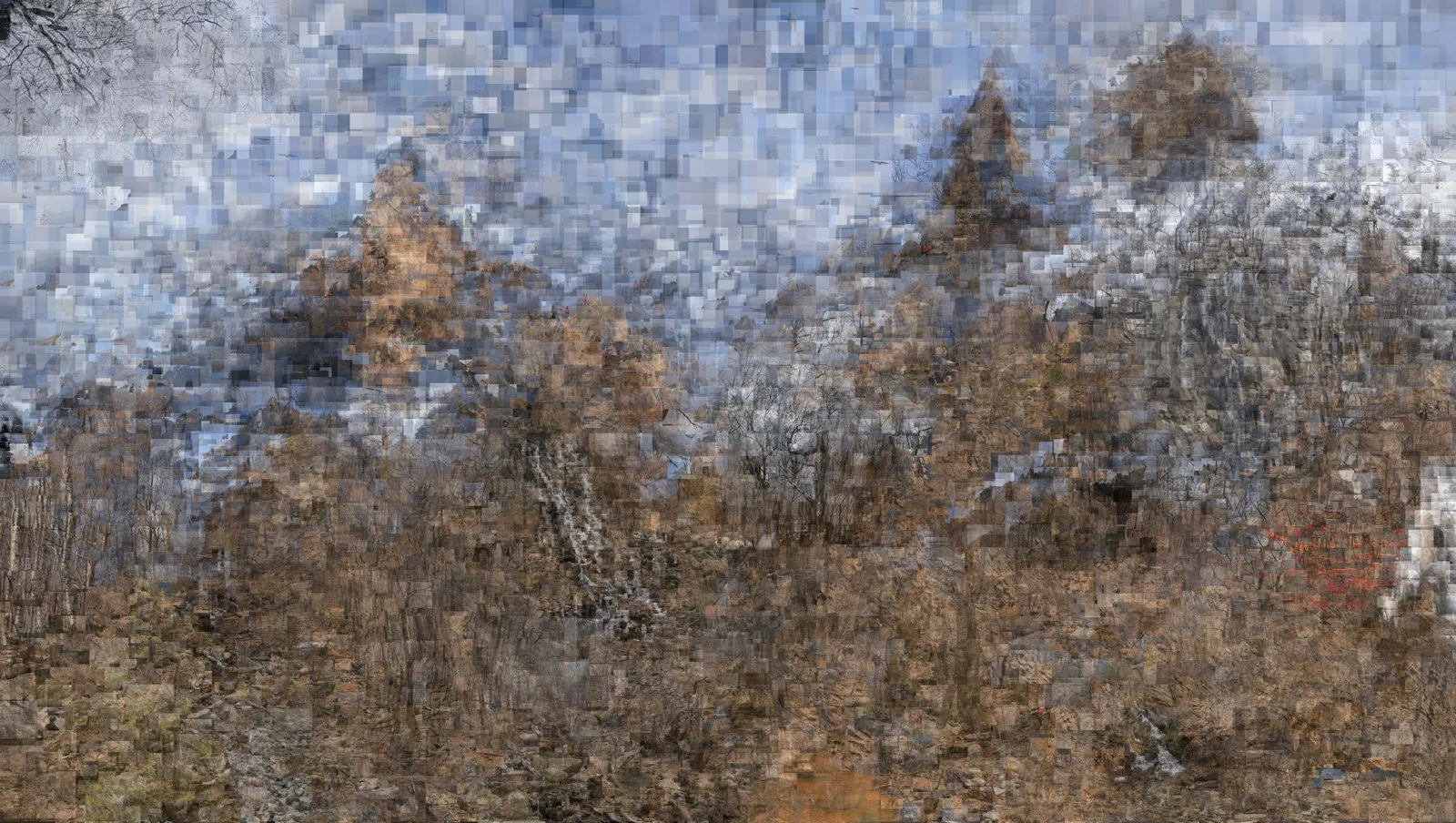
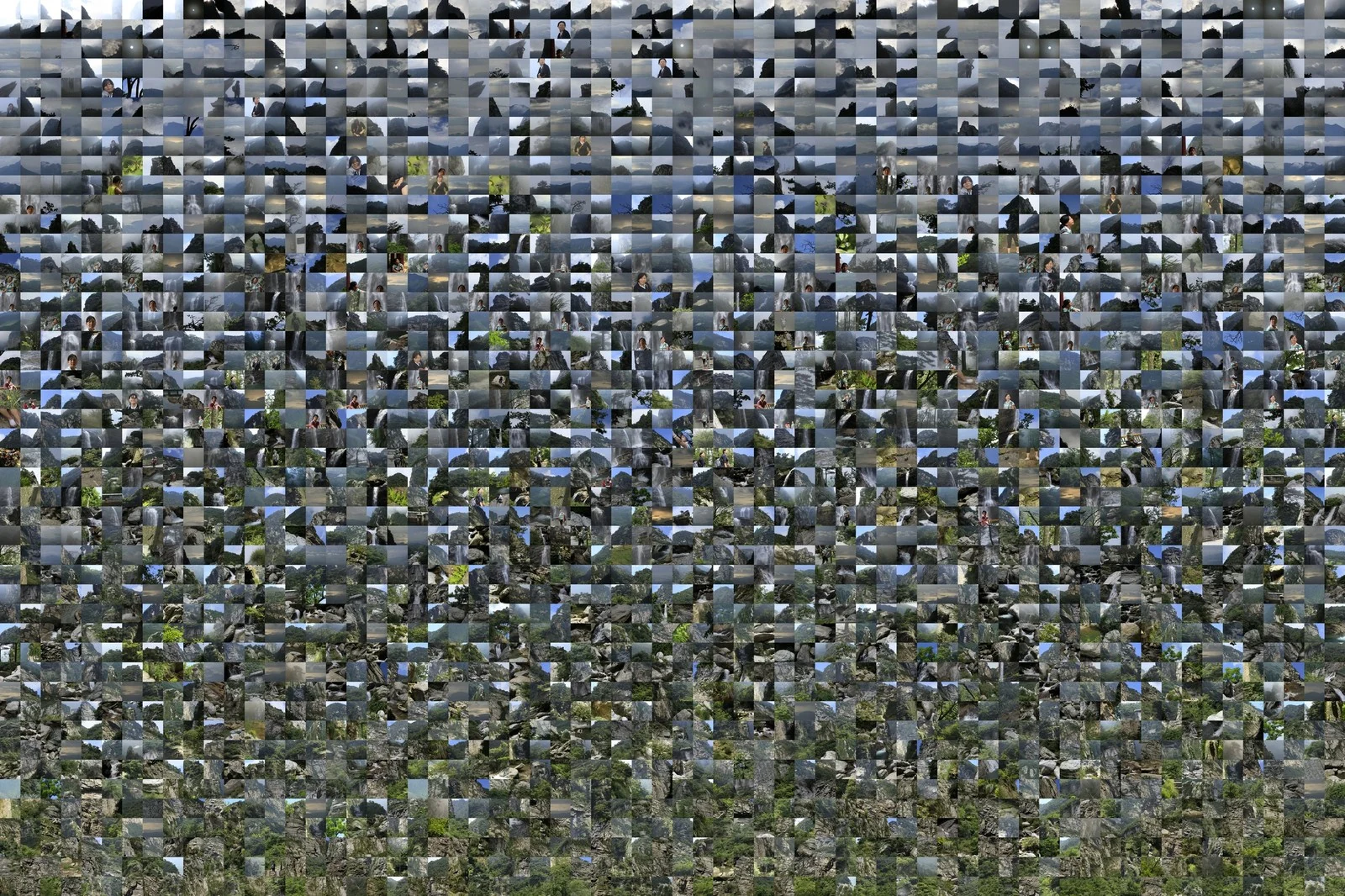
Shanshui (2012) is an important work from this period. From a distance, viewers encounter a whole in the form of a landscape; as they approach, the individual photographs that constitute the mountain gradually emerge. The overall landscape and its constituent images offer different experiences of looking. One allows viewers to recognise mountain forms, space and atmosphere; the other makes them aware that this mountain is composed of many incomplete observations.
The work’s archive also documents methods including grid-based colour organisation, subjective arrangement, layering, displacement and adjustments to transparency. This indicates that the photographs were not simply piled together: rules and visual judgement both took part in composing the image.[2]
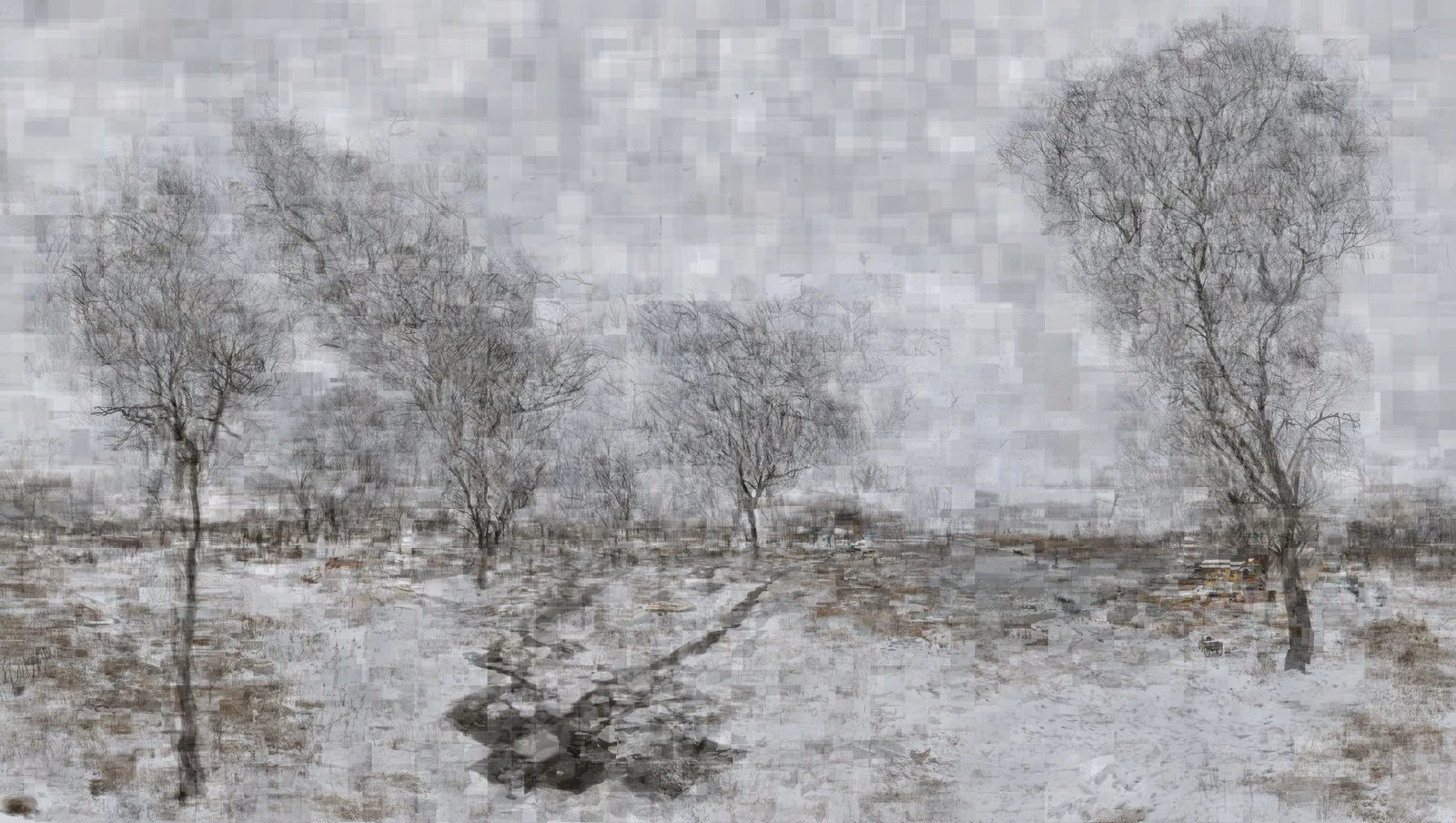
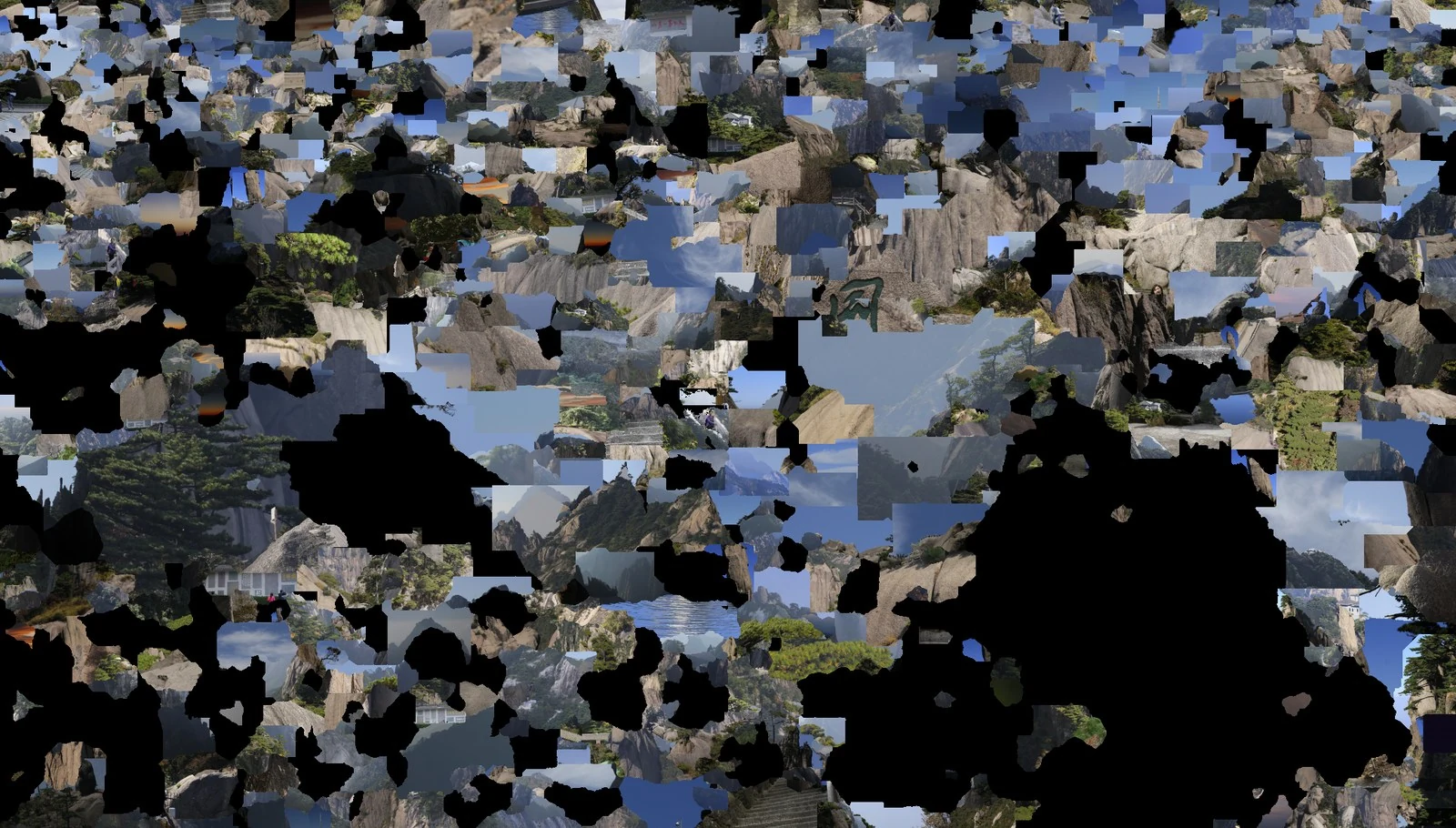
What matters here is more than “using many photographs” or “making photography look like landscape painting”. Once removed from their original settings, photographs take on new formal functions: the light and dark, colours, edges and textures of one photograph can become parts of another mountain. The whole that results is neither equivalent to any single original photograph nor a reconstruction of a landscape from a fixed viewpoint.
Collage here is therefore not simply fragmentation. On the contrary, it involves a strong desire to construct a whole: to make images from different sources into a world that can be looked at and establish its own order, while keeping that world’s seams visible.
The CAFA Art Museum’s records of works collected from the 2012 graduating class list He Fa’s Shanshui — Red and Shanshui — White as C-print transparencies with lightboxes, each measuring 110 × 190 cm. This record also reminds us that these works are not merely digital puzzles on a screen. They are photographs with an actual scale, luminosity and viewing distance.[3]
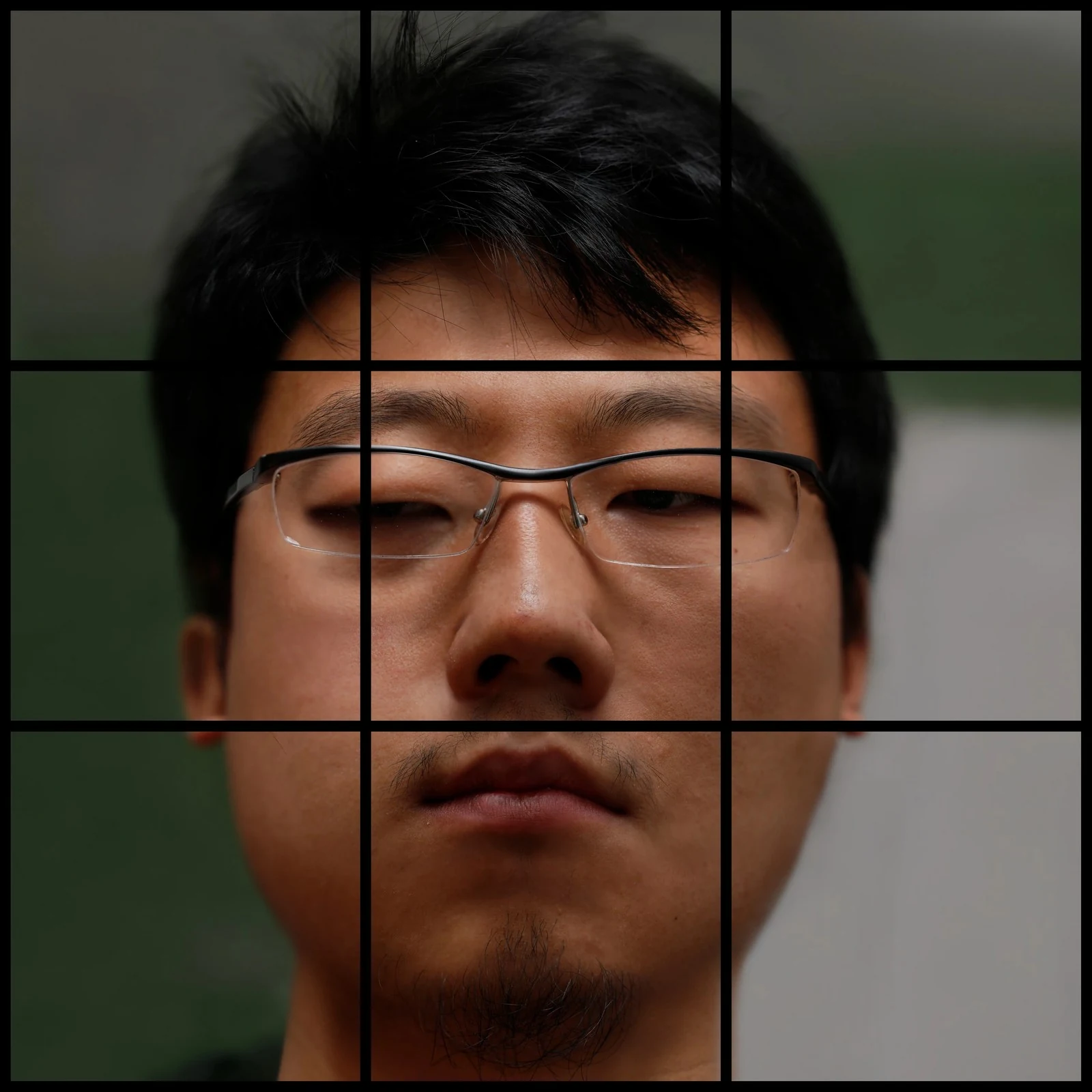
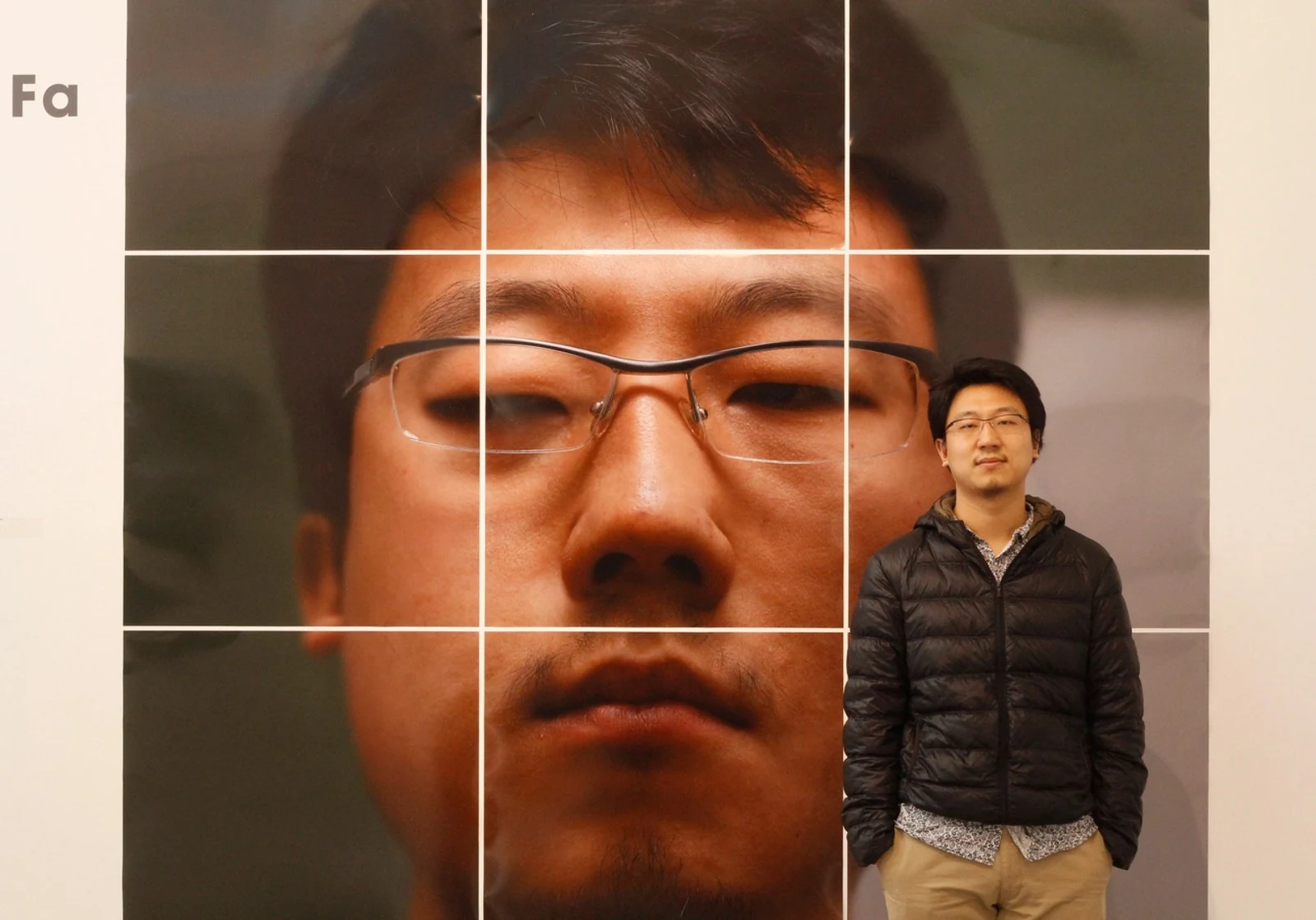
Alongside the landscape collages, I and the portrait versions made around it turn the body itself into something that must be recognised anew. The face is no longer merely a sign through which identity is quickly confirmed. It becomes a surface that can be photographed in parts, enlarged and reassembled. From a distance, a person remains recognisable; up close, the viewer encounters the photographic materials composing that person. The work does not simply dissolve the portrait’s wholeness. It makes the whole and its parts cease to fit together exactly.[2]
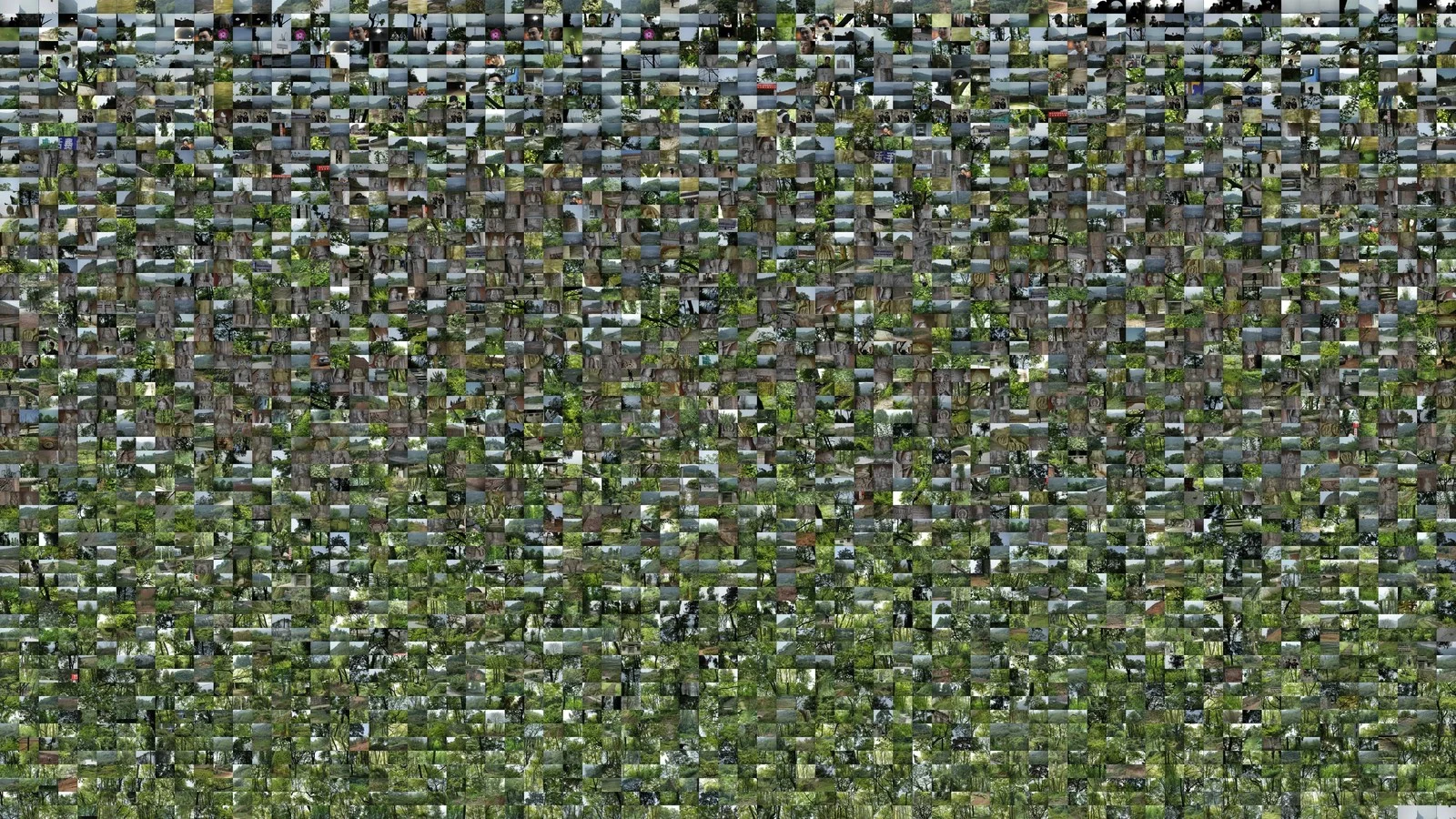
Cocktail (2013) offers another way of organising images: He Fa arranged mountain-climbing photographs according to their JPEG file sizes. A property normally associated only with file management became part of how the image took shape. The artist still selected the material and set the method, but handed some compositional decisions over to this rule. Unlike free collage, it allows the viewer to ask: why this sequence? How do the properties of digital files enter the landscape we see?[2]
These works reveal a foundation for much of He Fa’s later practice:Creation takes place not only in deciding “what to express”, but also in deciding “which conditions will help determine the result”.
02 /
Gewu
How form, material and light work together
In 2012, He Fa and Song Bowen co-founded Gewu Studio, beginning a practice involving art products, parametric design and 3D printing. This experience cannot be dismissed as an unrelated interlude between photography and theatre. It carried questions of image construction into physical materials: how a form emerges, and how folds, openings, thickness and an internal light source form an interdependent whole.[1][2]
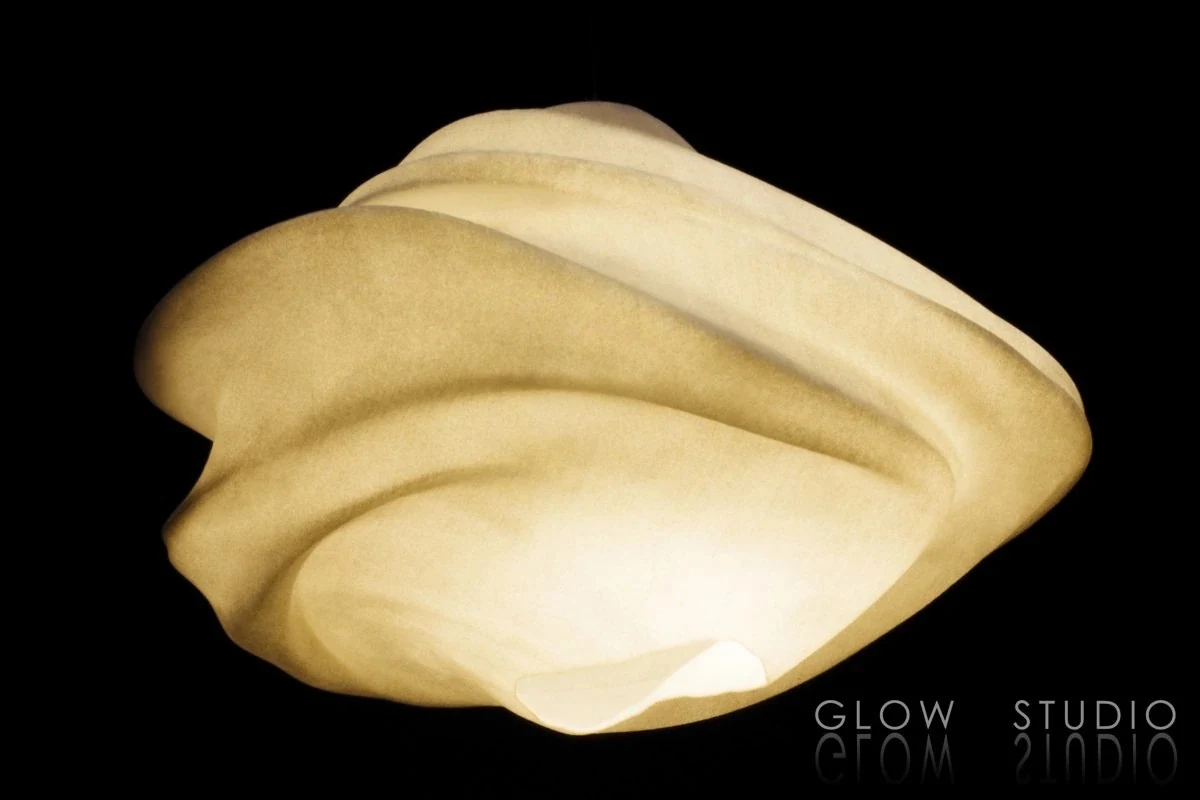
Twelve Water Lamps offers an important way into this practice. It does more than apply a “water-like” shape to a lamp: ripples, curved surfaces, folds and the ways light passes through become questions of form. Looking at these works requires considering three things together: how a shape is designed, how material turns it into a physical object that can be made, and how lighting and photography make that object visible.
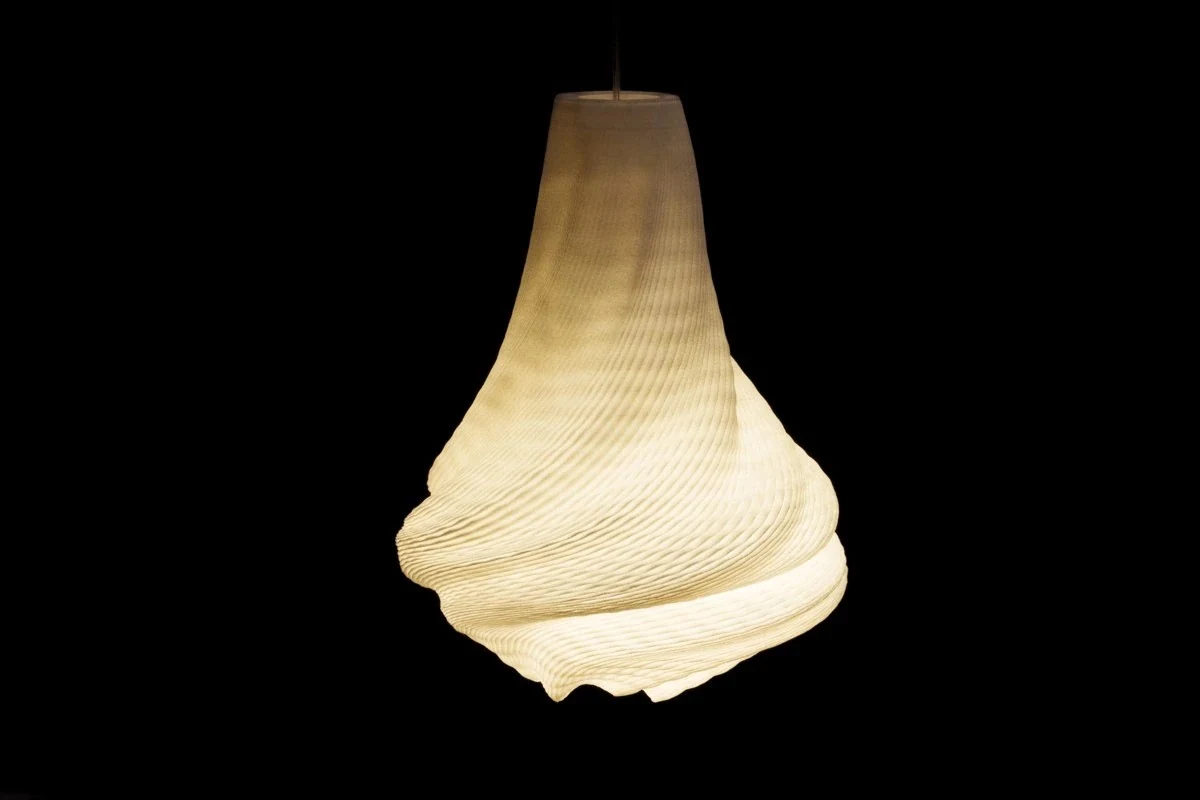
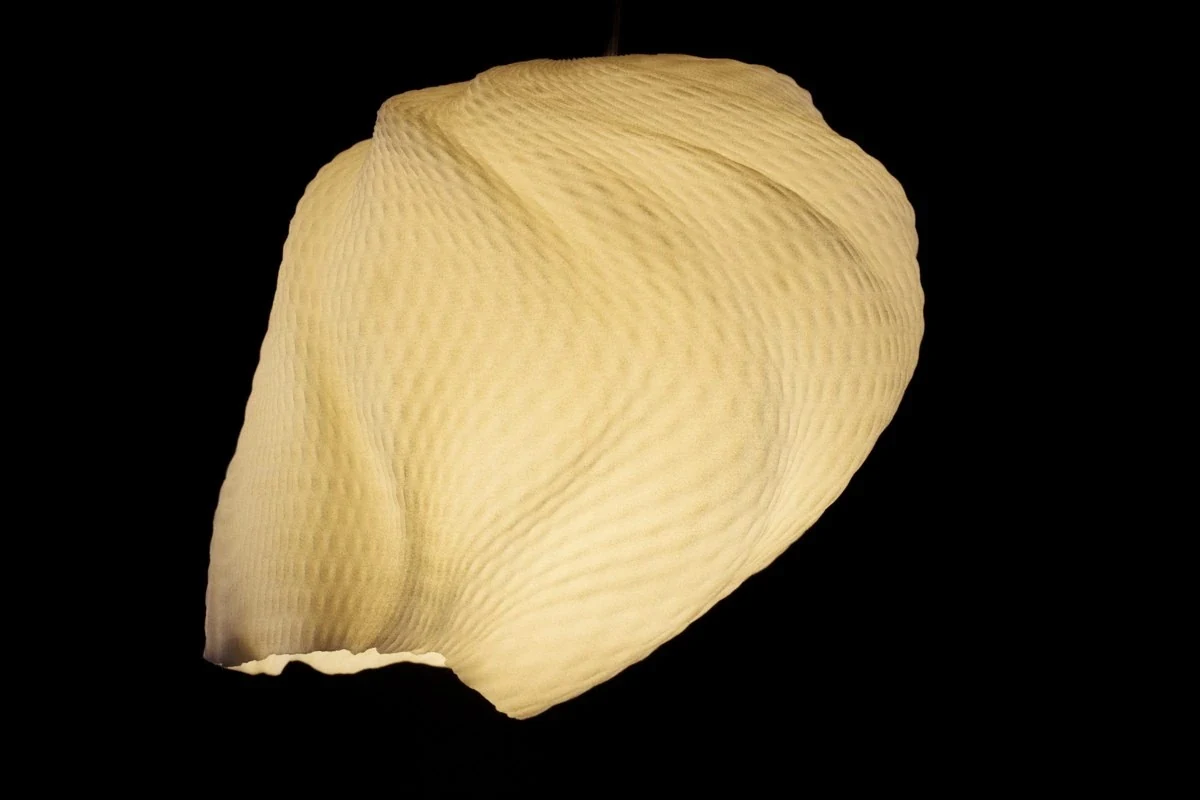
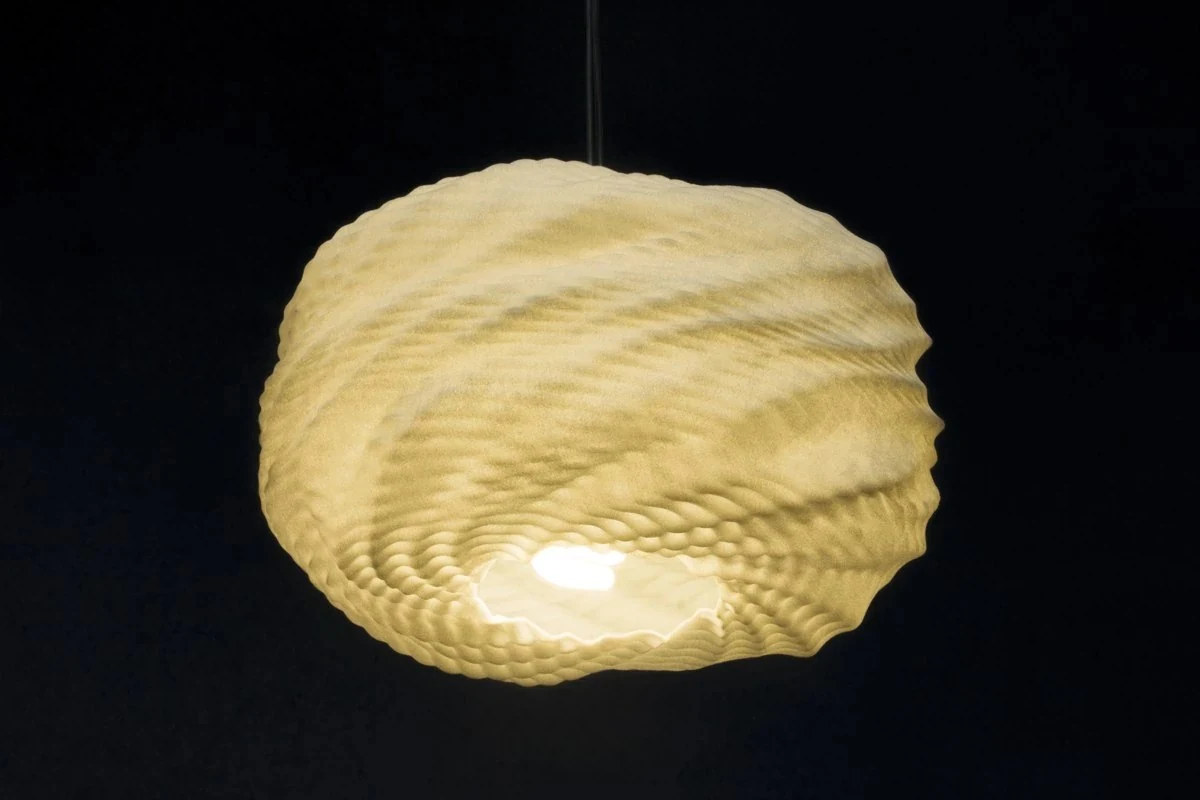
He Fa’s contribution to this project also needs to be presented through its specific collaborative relationships. The current work archive identifies it as a collaborative project and preserves accounts of his photography and art direction. Earlier reports and catalogues, meanwhile, explicitly record Song Bowen’s design background and particular credits. An accurate account must retain these distinctions instead of combining co-founding, collaborative creation, photography and individual awards into a generalised personal achievement.[1][4]
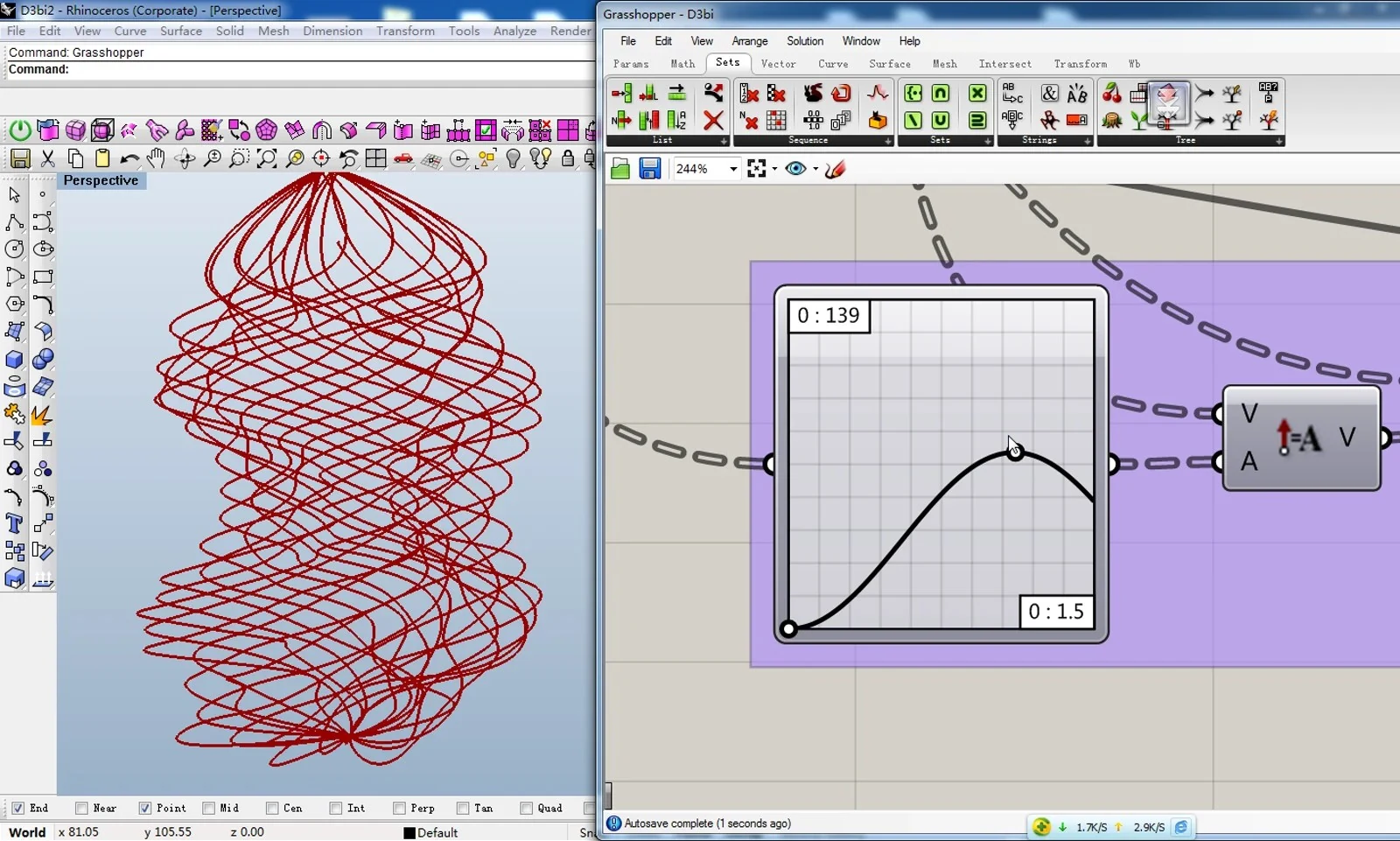
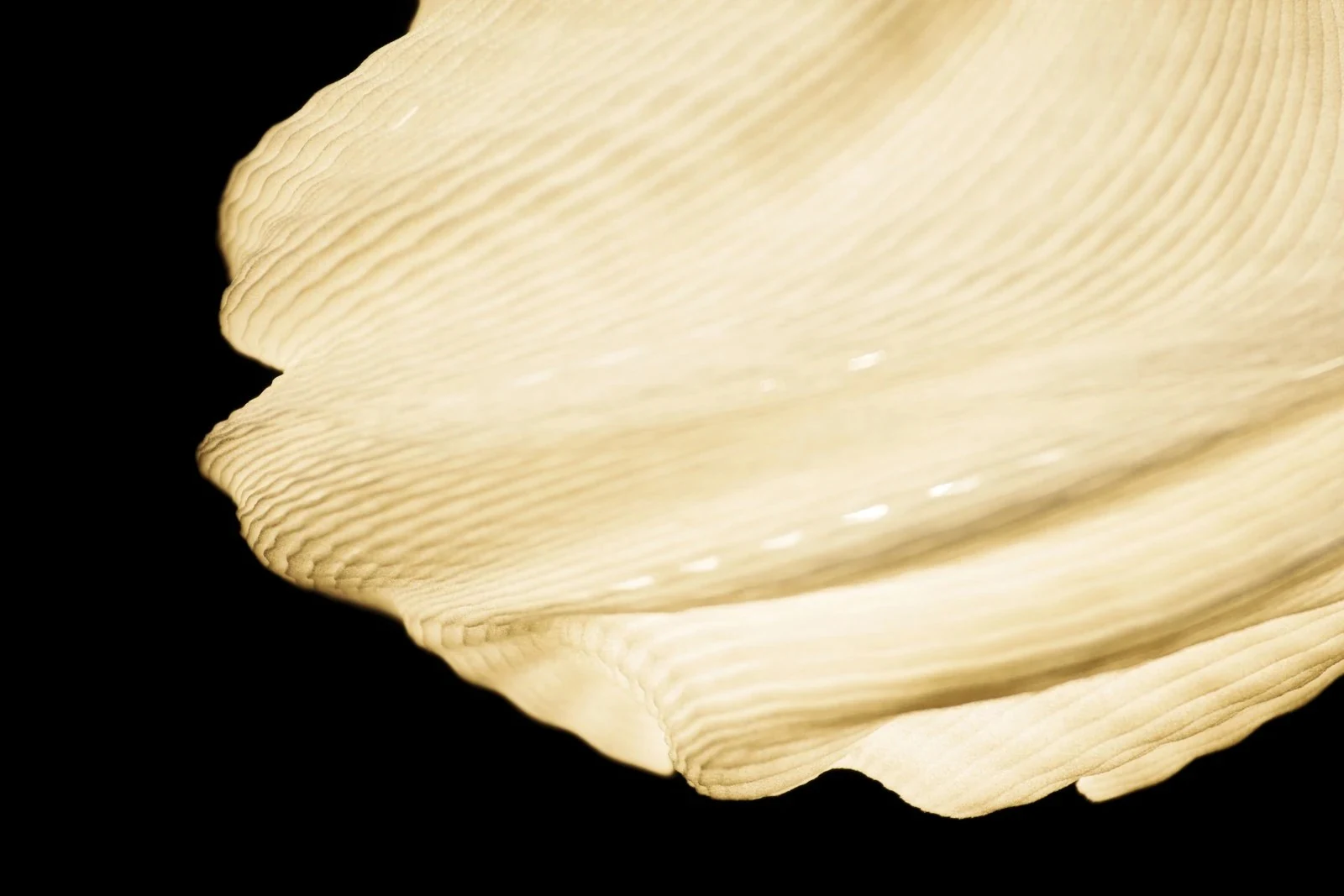
It is particularly significant that He Fa later turned the water lamps back into photographic subjects. The group of works sharing the title Wu includes photographs of Twelve Water Lamps. A luminous object formed through design and fabrication re-entered framing, exposure and two-dimensional composition to become another kind of image. This was not a one-way departure from photography towards objects, but a journey from photography to objects and back to photography.[2]
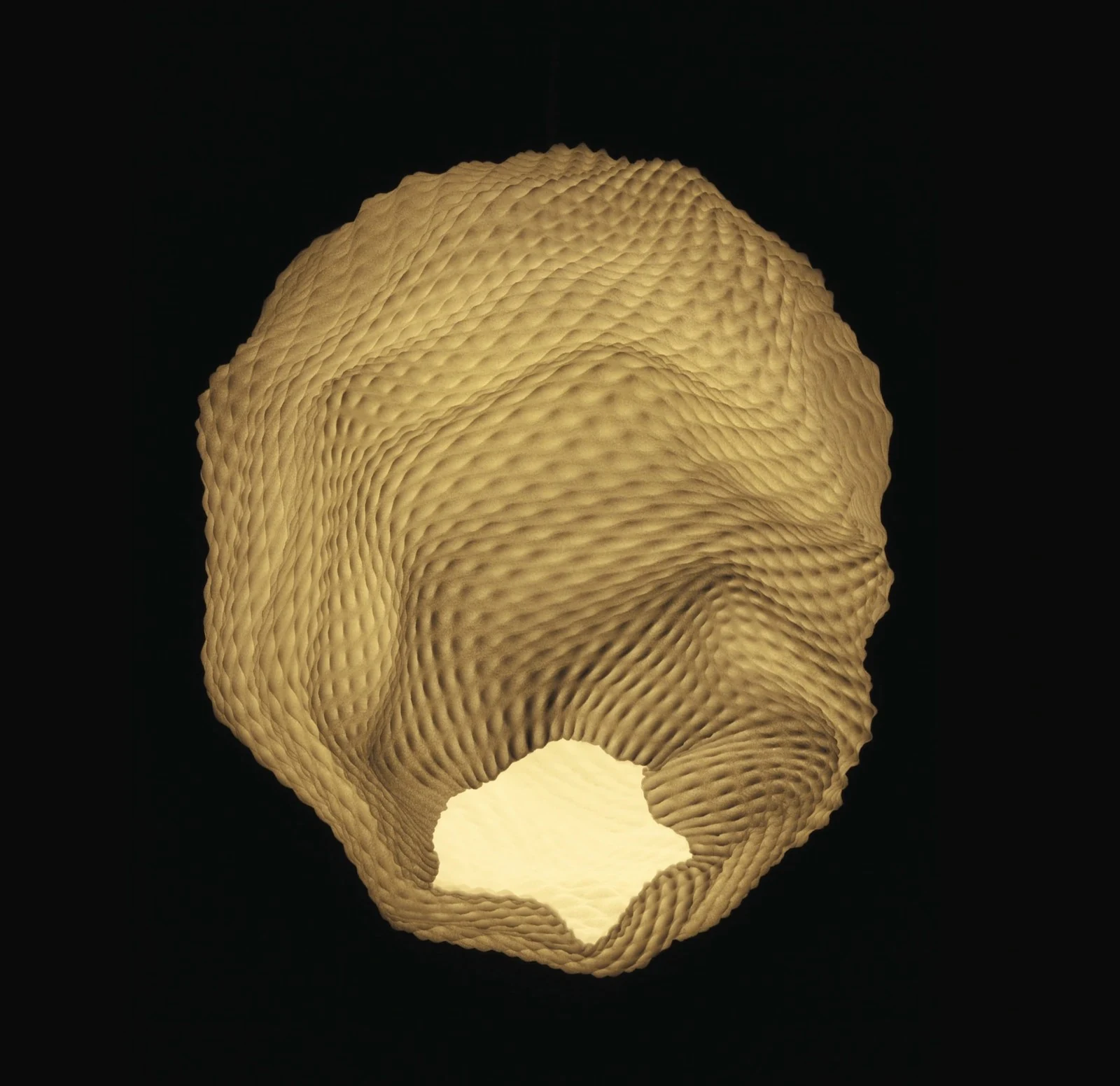
This thread shows that He Fa’s interest in “relations” is not confined to relations between people. Relations between materials, between parts and wholes, and between objects and their images are also subjects of his work.
03 /
Fafalish
Turning accent, mishearing and translation into creative material
In Fafalish, or “Fafa language”, He Fa extends the rearrangements of photography into language. This does not simply mean assembling words like photographs. He establishes a process of transformation in which text, voice, bodies and tools intervene in succession.
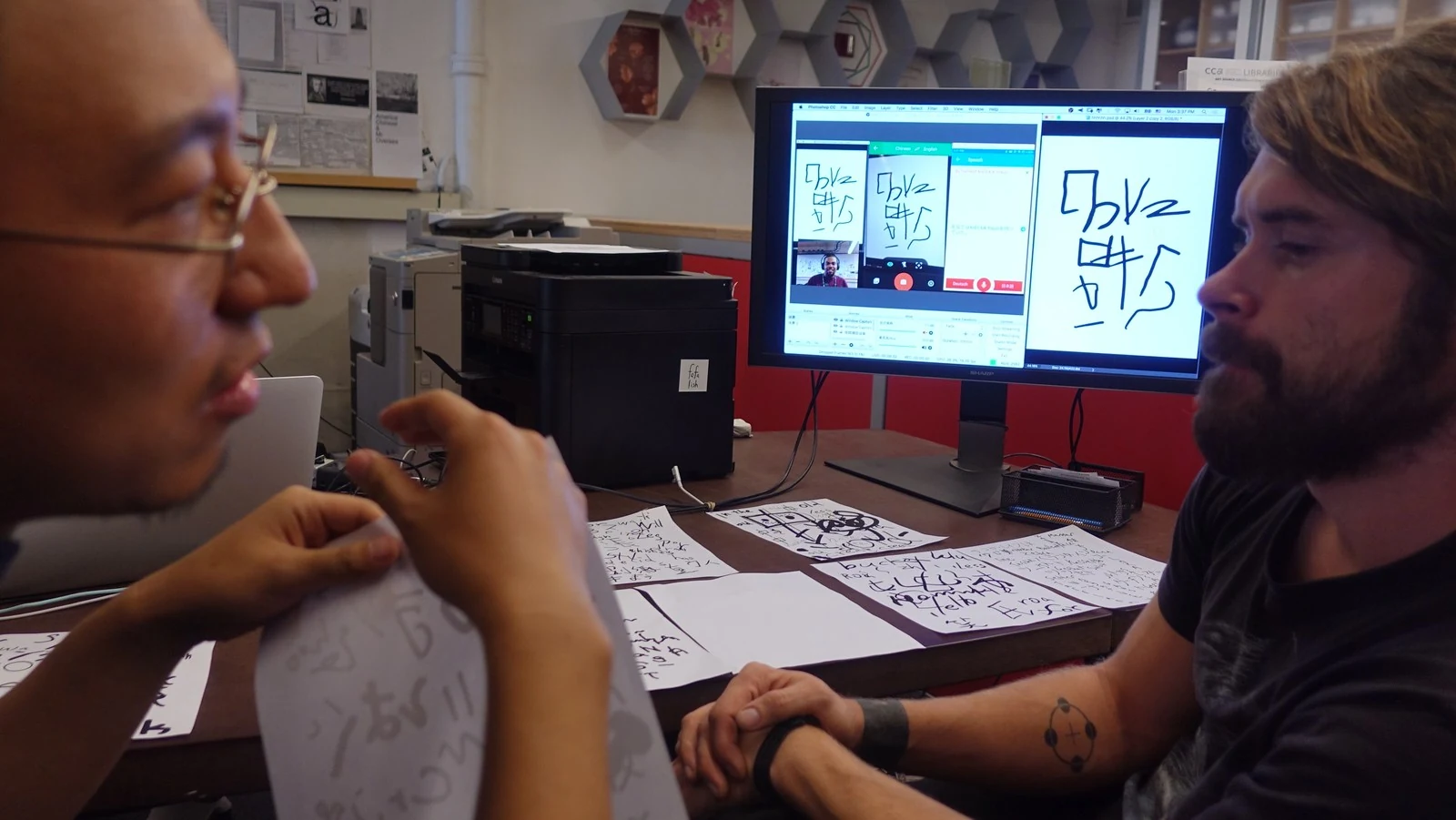
Take the 2017 video Kunlun (Brother Order). Beginning with Chinese poetry, the work translates Chinese characters into English word by word, then reads them aloud in English with a Chinese accent. The sounds are subsequently heard as material resembling Chinese pinyin, reassigned to Chinese characters and finally translated into English by machine. Meaning does not return to its starting point after this circuit. It shifts at every stage. CCA’s institutional archive records the process in detail.[5]
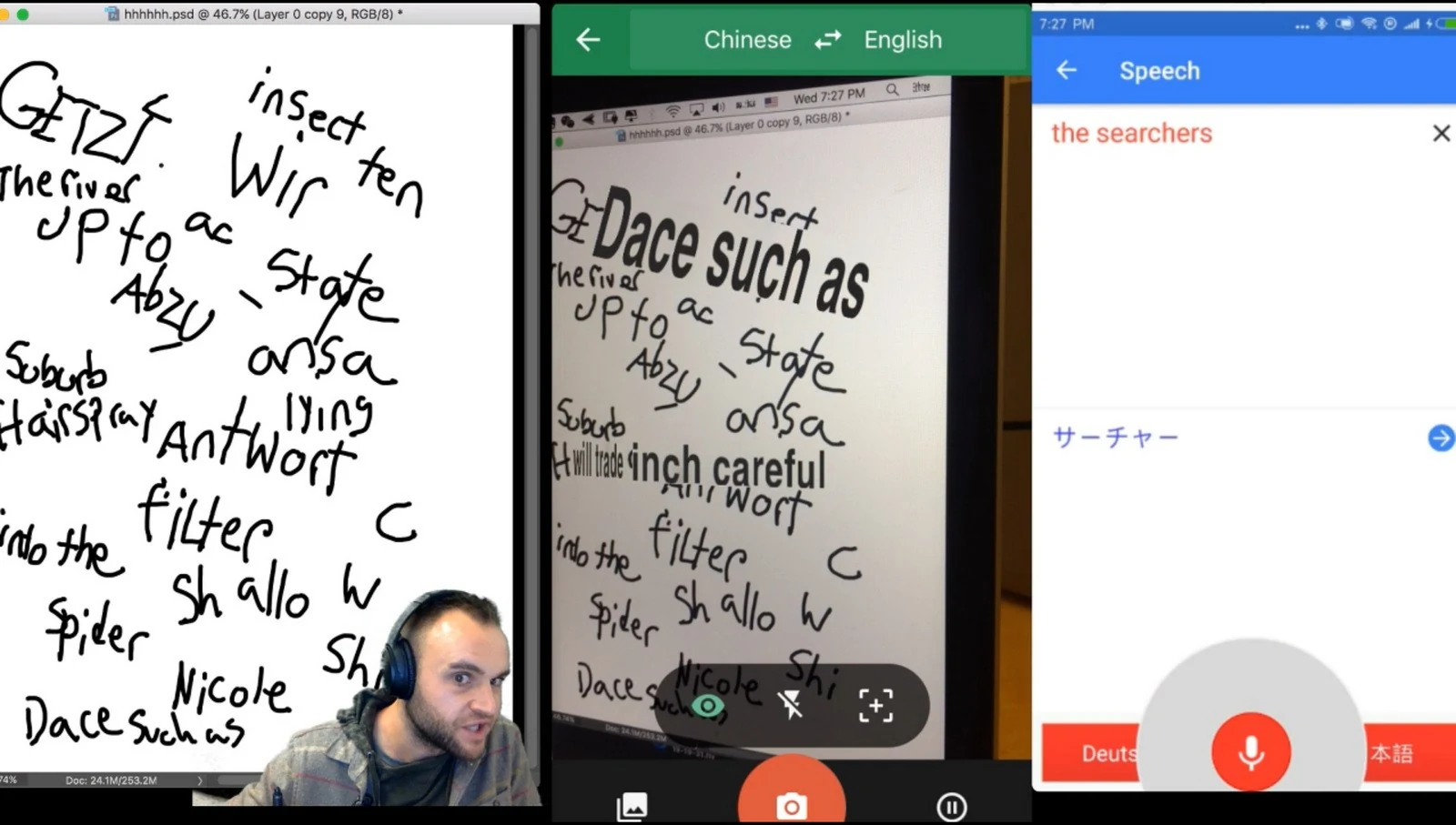
The point is not to prove that translation is “inaccurate”. Things commonly excluded by language training—accent, misreading, auditory associations and machine errors—are retained as material for the next step. A speaker need not first master a standard language in order to begin expressing something. Linguistic deviation itself helps generate expression.
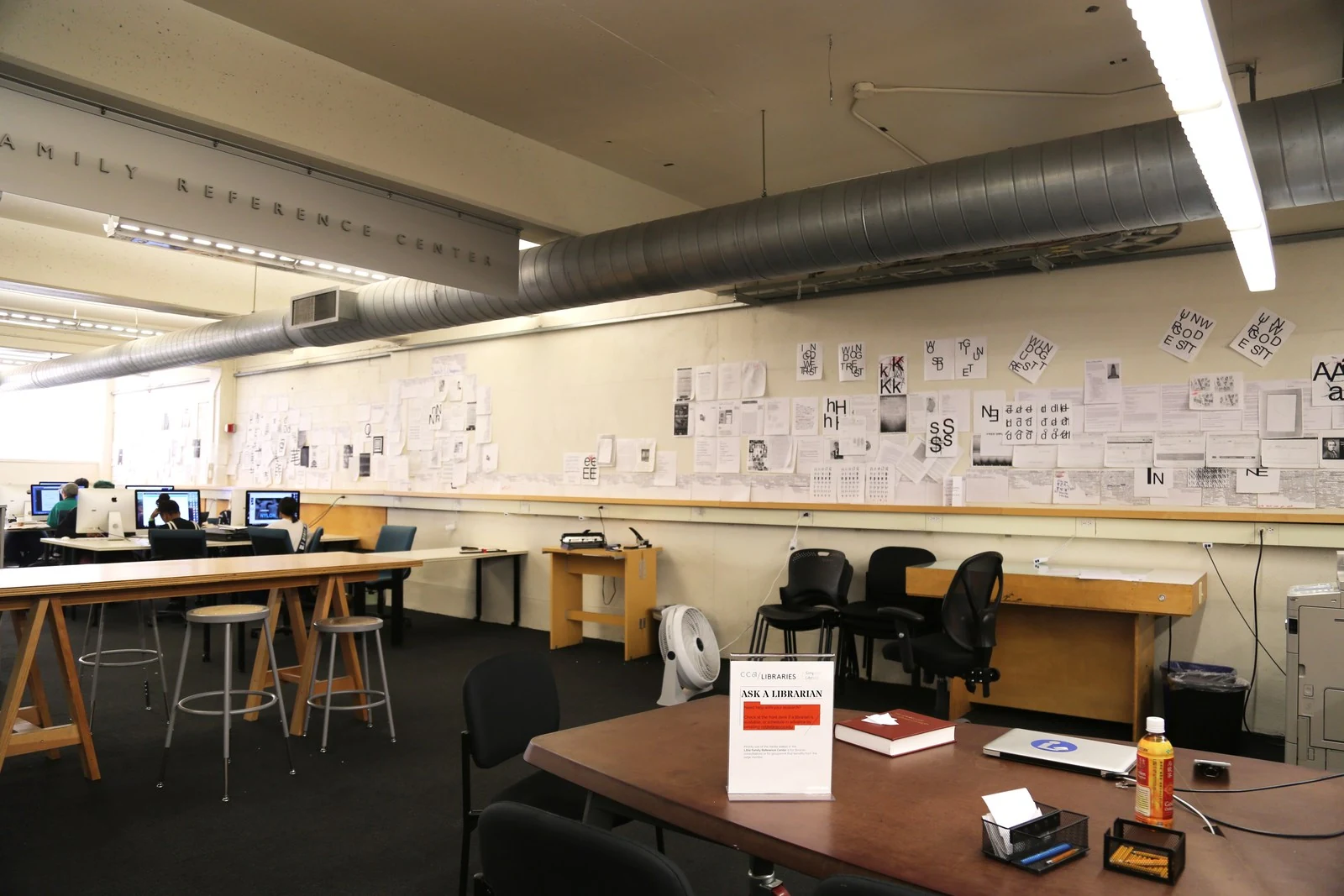
Nor is Fafalish merely a word game on paper. From 2 October to 15 December 2017, the project was exhibited at Simpson Library on CCA’s San Francisco campus, bringing video and printed-text installations into the library’s reading environment. The long wall of text, tablet and headphones documented in the exhibition archive present language through reading while walking, looking at a screen and listening individually.
Text and sound are not compressed into a single explanation. Instead, viewers are asked to move between different media.[5][2]
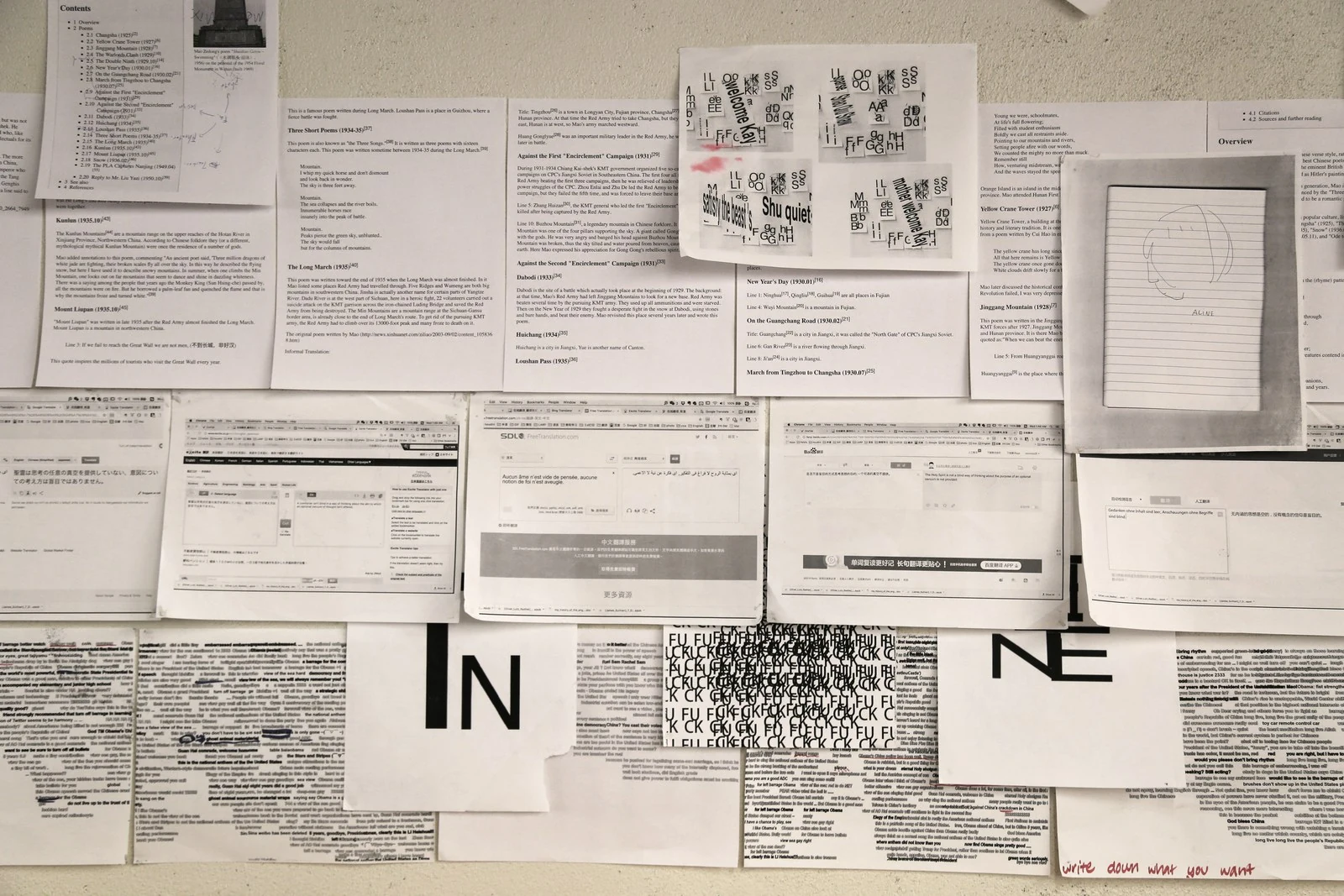
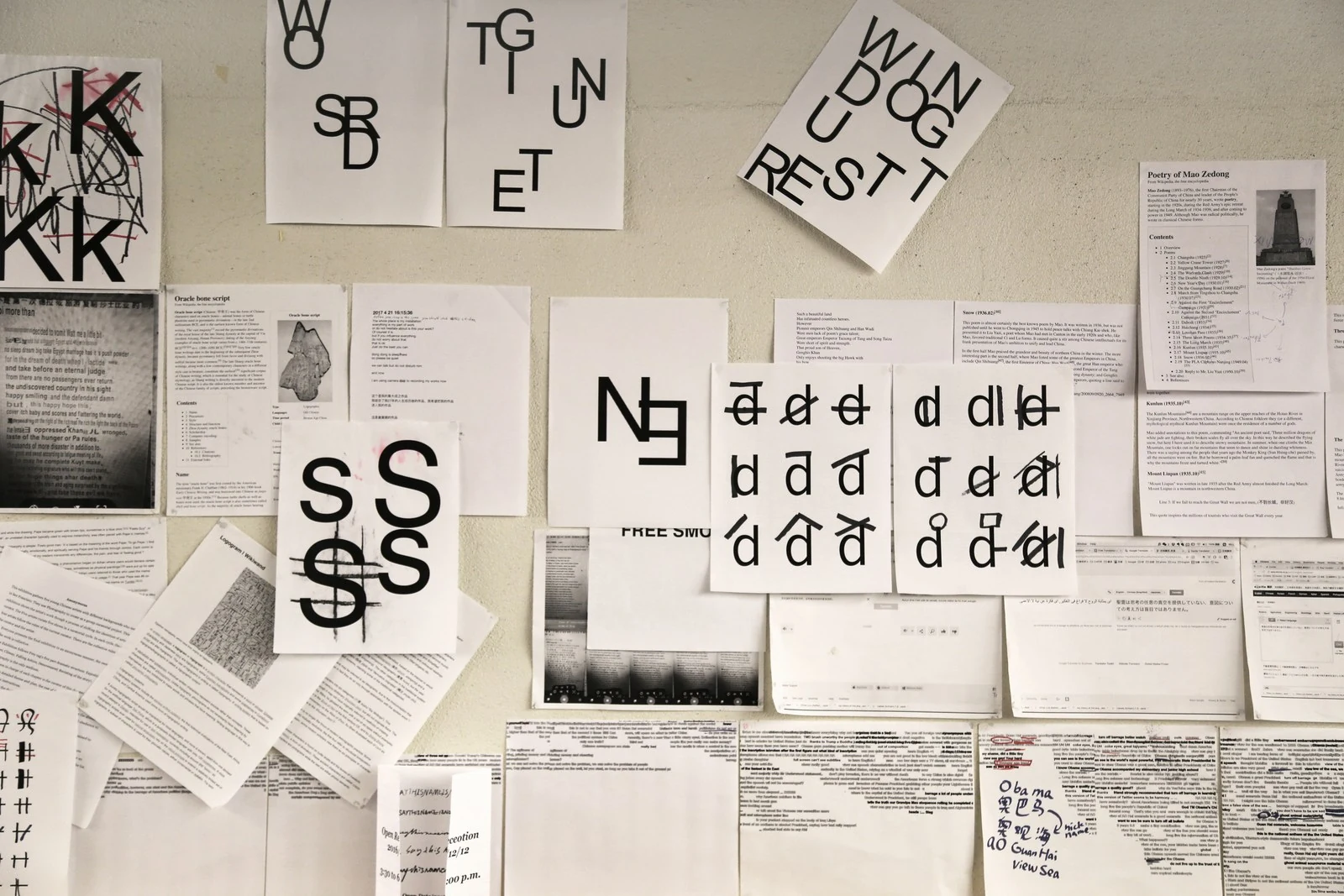
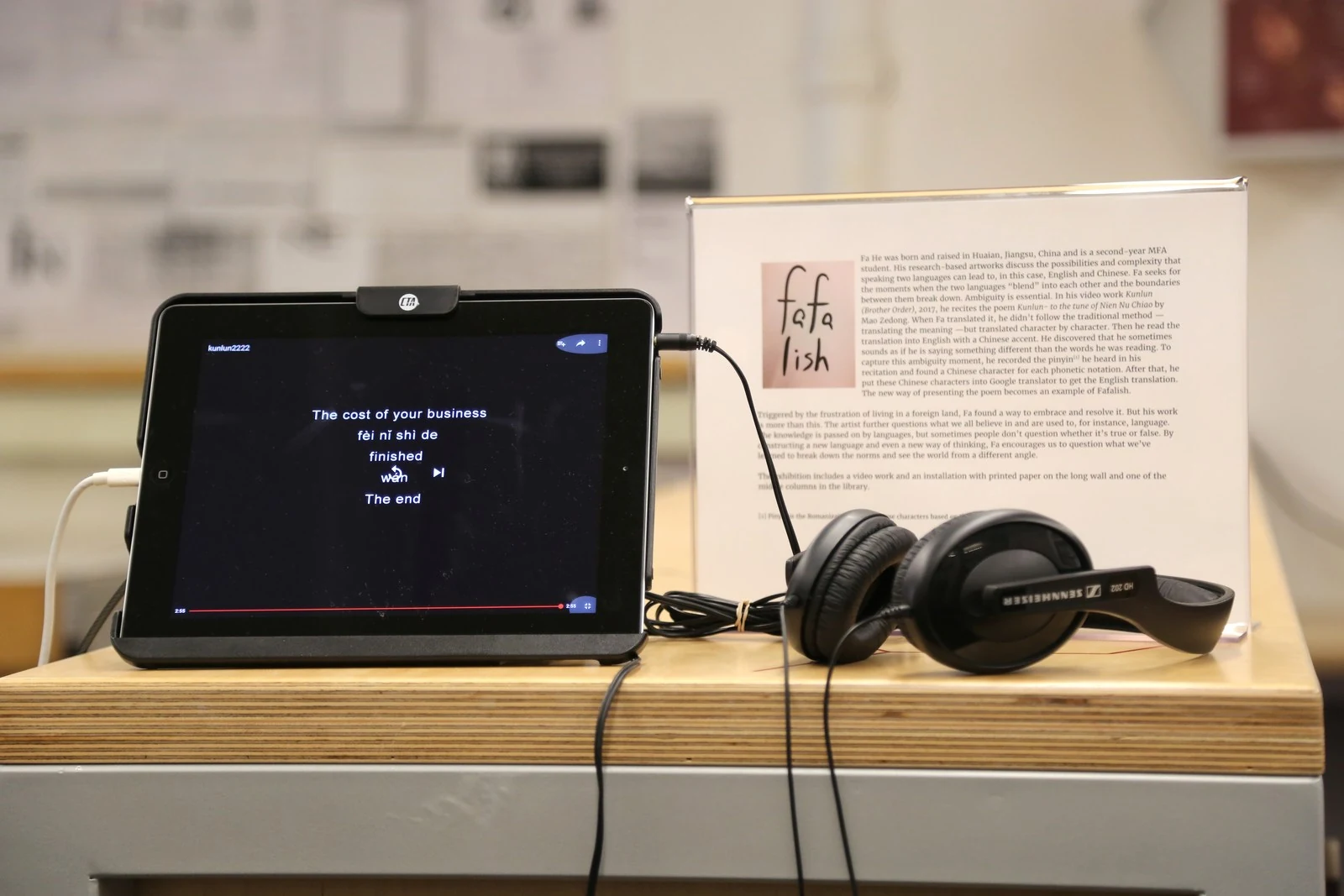
In methodological terms, this work gives “failed communication” a different place. Failure is no longer only an obstacle to be corrected; it can also become a condition for further creation. This does not mean that misunderstanding is inherently liberating. Unfamiliar writing can open new possibilities of perception, but it can also form a barrier that is difficult to cross. The work’s strength lies precisely in allowing both possibilities to coexist.
04 /
YourTube
What screens connect—and what they separate
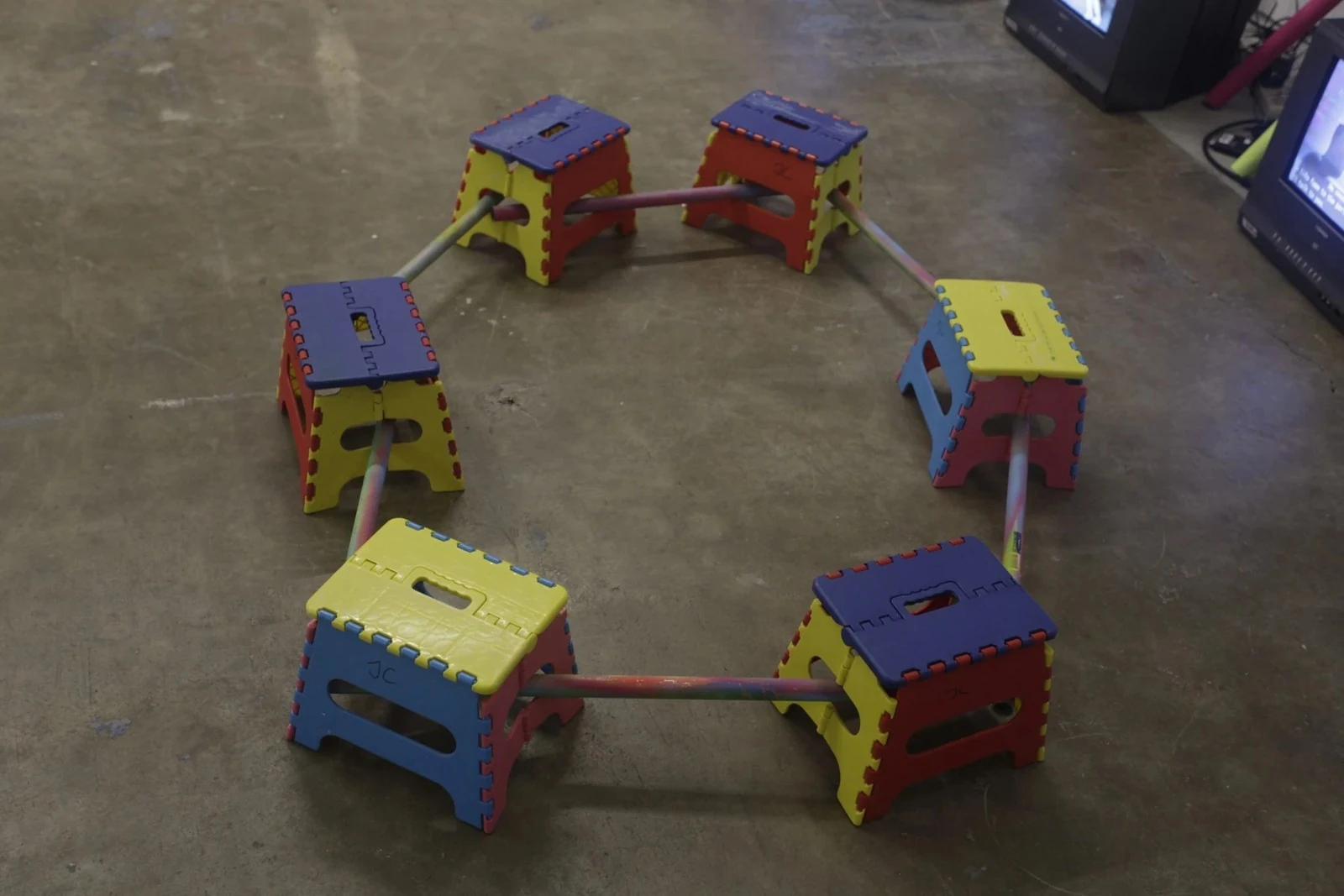
YourTube (2018) brings language, online moving images and viewing space into closer relation. According to the installation archive, it comprises six CRT televisions, five flat-panel screens and six seats connected by coloured pipes. Screens sit at different heights, and the seats form an interconnected structure. Looking no longer revolves around a single screen directly in front of the viewer.[6]
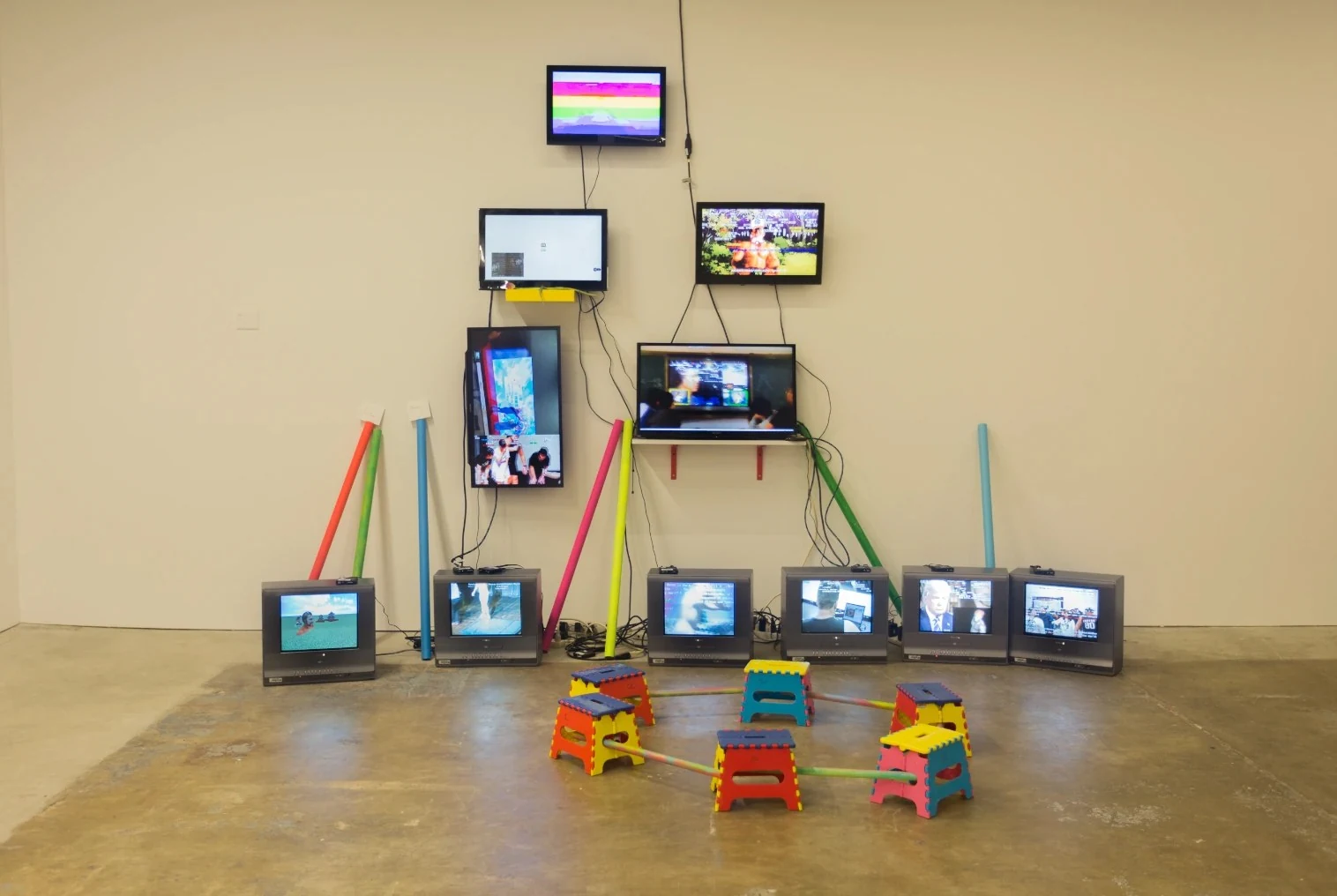
In this arrangement, viewers must choose where to direct their attention: towards a lower screen or upwards to another group of images; following a clip or turning towards neighbouring sounds and actions. People may sit close together without watching the same thing.
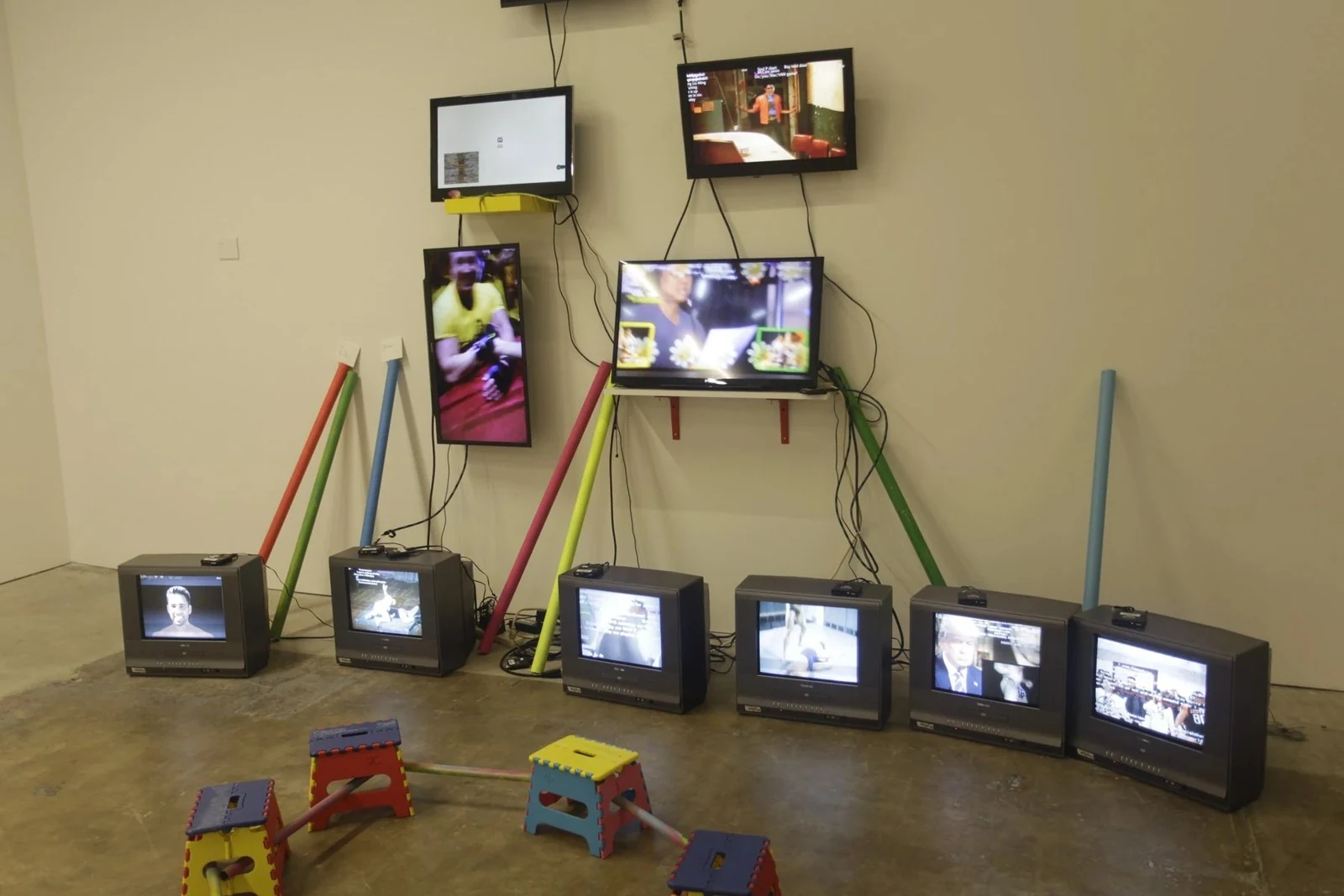
The circulated and re-edited online material used in the work also carries traces of previous viewers: scrolling comments, written responses and sounds. New viewers in front of the screens therefore encounter not only a body or an action but also other people’s responses to it. Before viewers have understood an expression for themselves, comments within the image may already have classified it as a joke, an object of desire or a judgement.[6]
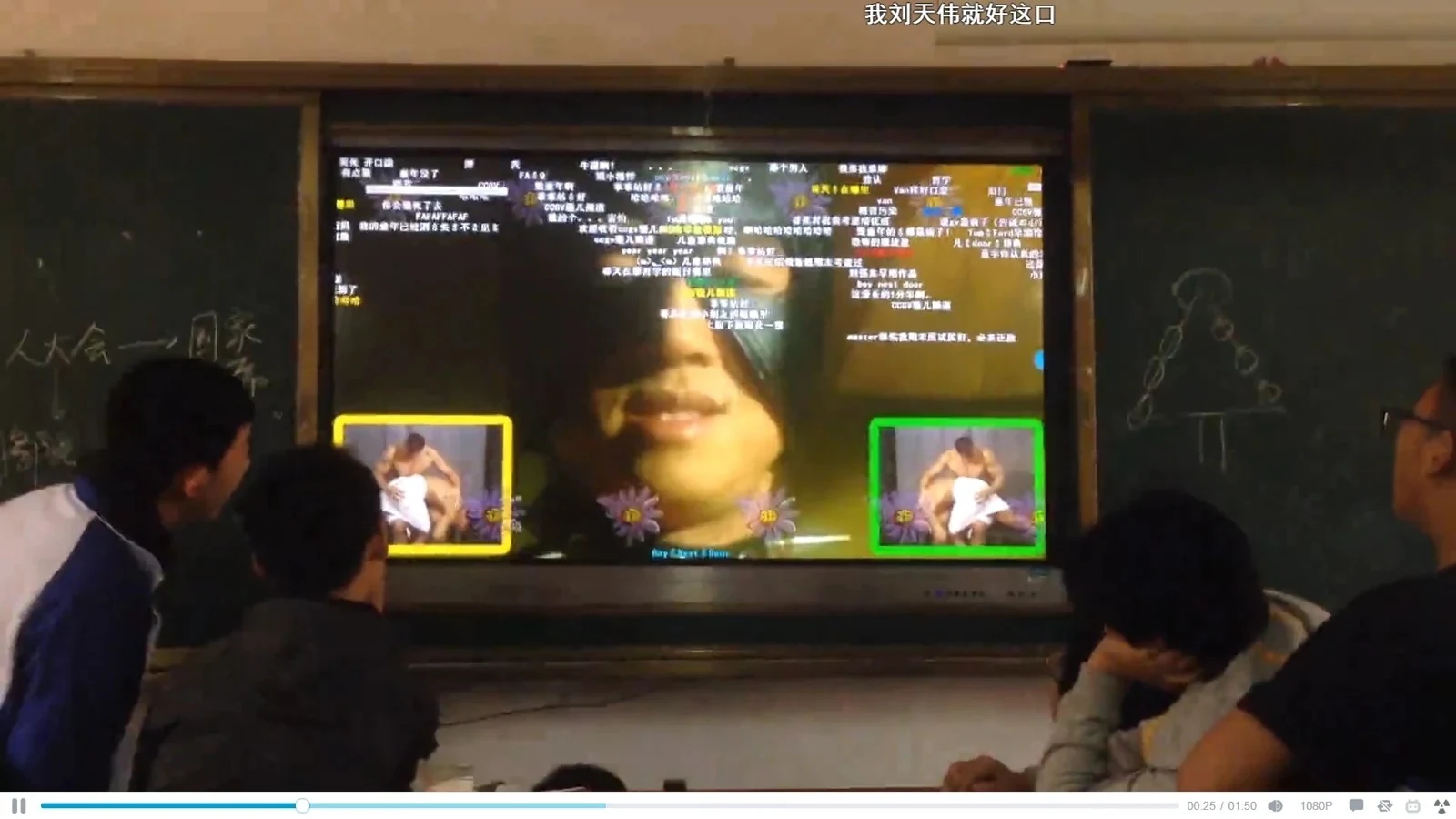
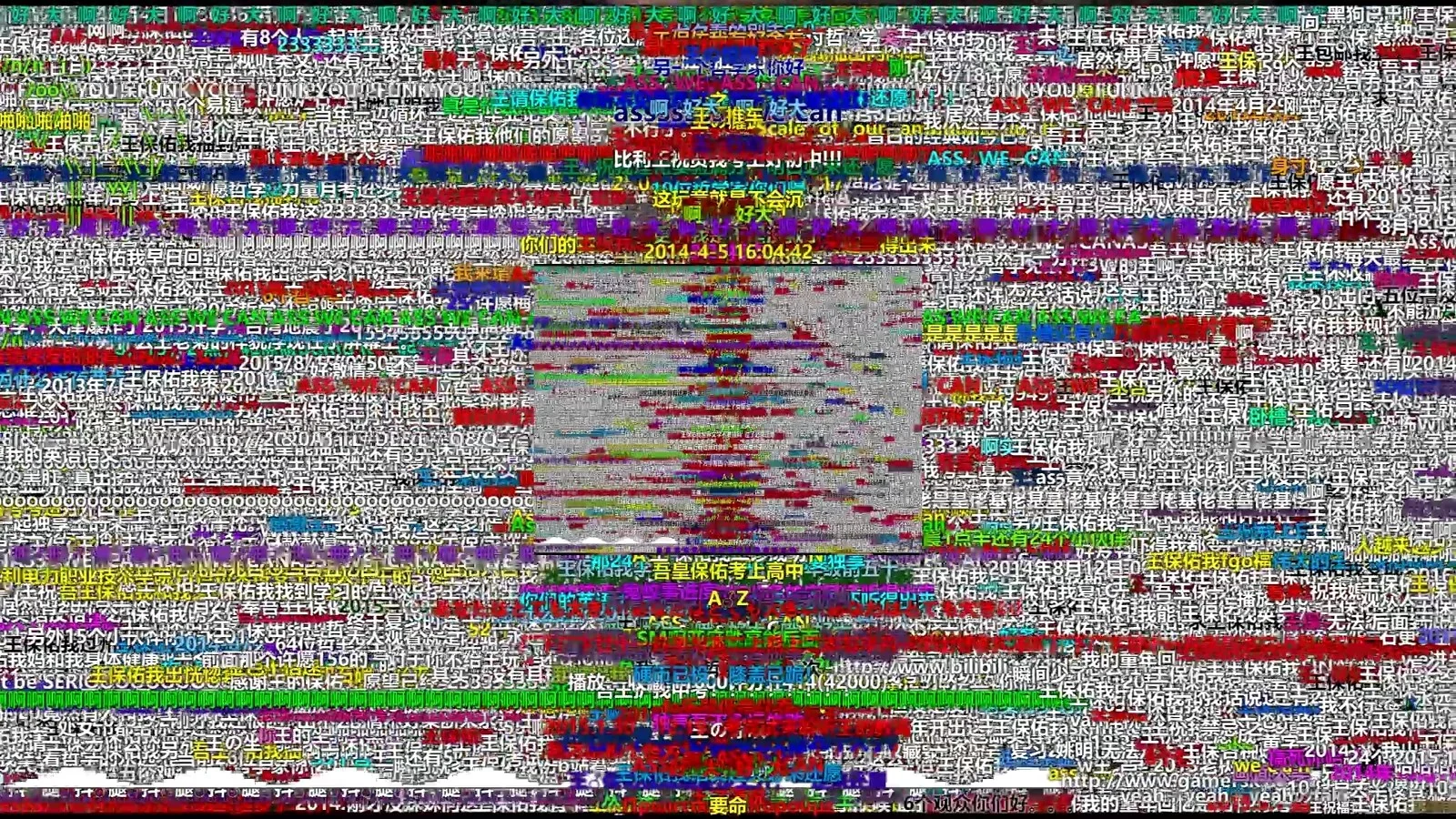
“Connection” must not be equated directly with “participation” here. Seats connected by pipes do not mean that their occupants already form a community. Comments within an image do not mean that viewers on site have the right to alter its content immediately. The prerecorded videos in the surviving playback materials are better understood as traces of earlier participation than as a verified system of live interaction.[2]
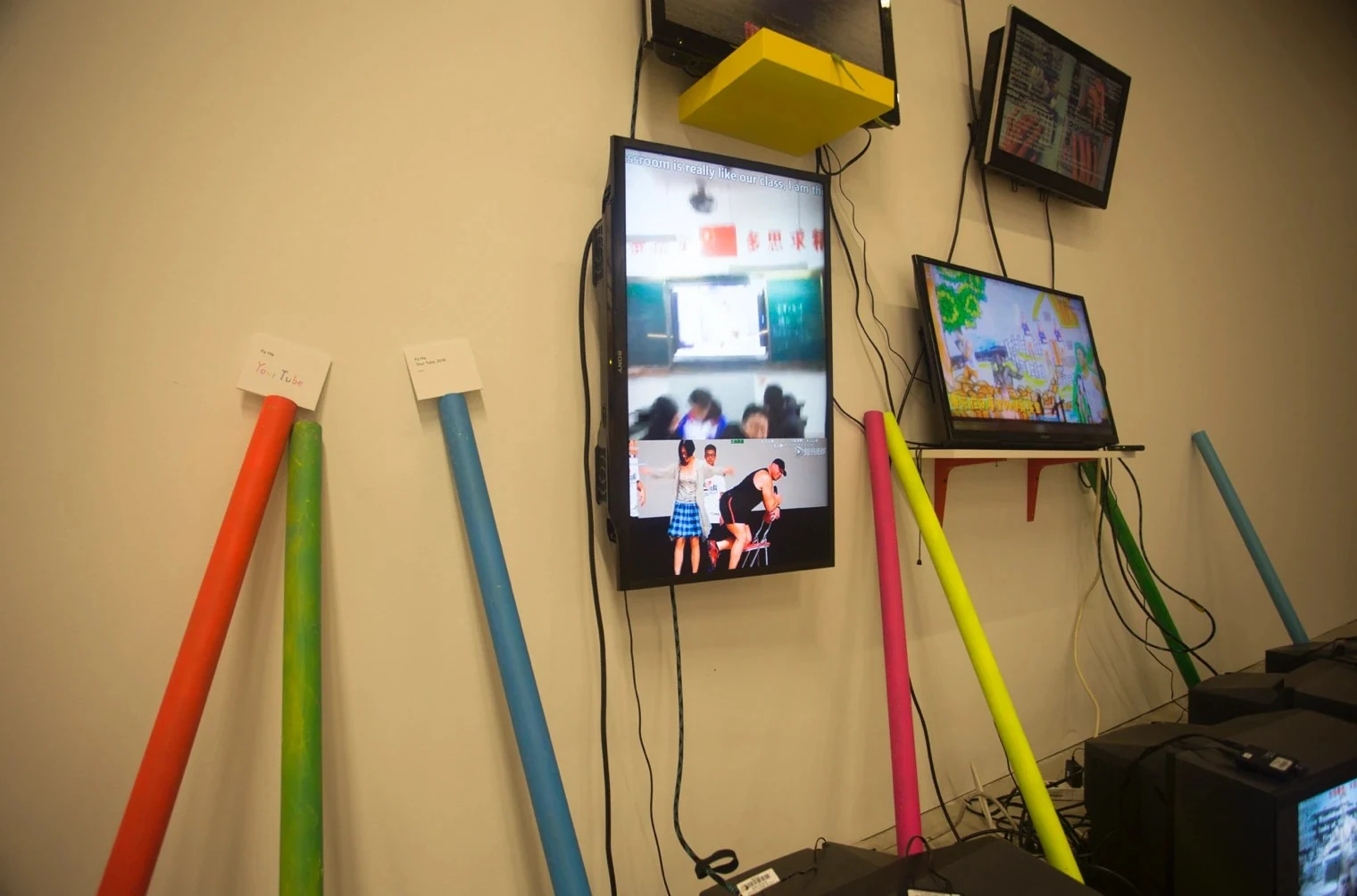
YourTube therefore poses a specific question: how much of an image-space named “yours” is actually determined by its viewers? It returns the experience of online viewing to a physical space, making the differences between attention, bodily position and permission to participate observable.
05 /
The formation of P4
Images begin to face people who can respond
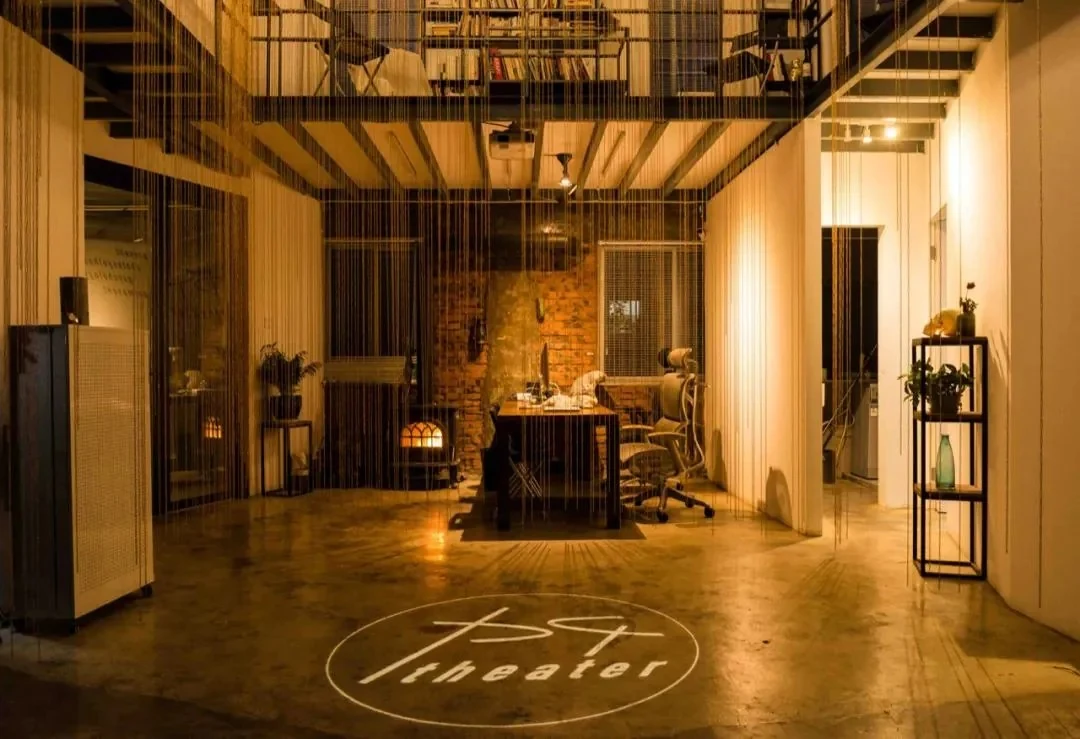
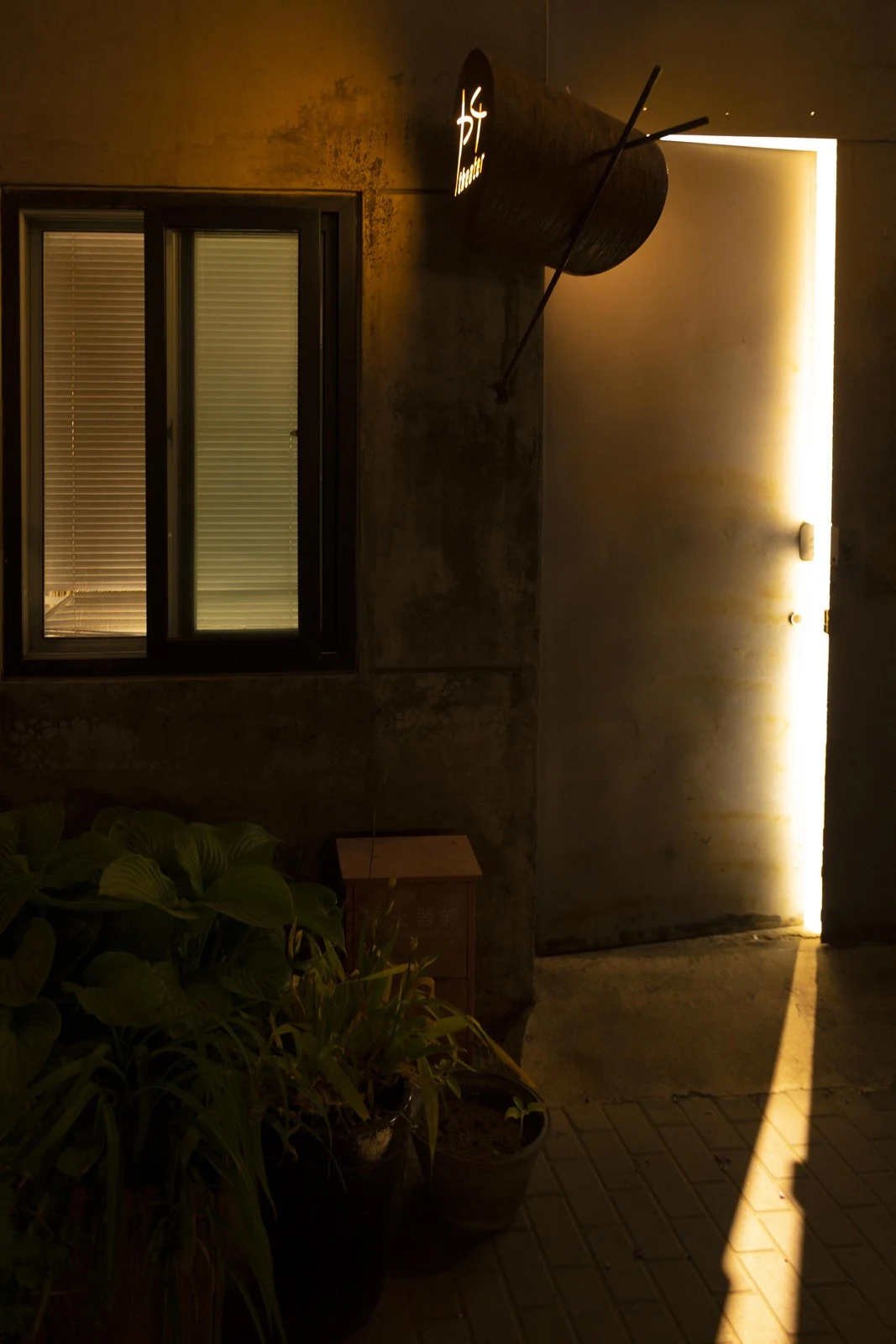
P4’s history requires distinguishing between its joint initiation, the building of its space and its formal opening. The current archive traces its beginnings to around 2015, when He Fa and Zhang Shaohua jointly initiated it; Zhang Aoshuang participated in the early conception of the theatre and related creative work. P4 formally opened to the public on 4 June 2016 inside the Diaosutai studio in Beijing. A contemporary report on the Central Academy of Fine Arts’ art information website explicitly records He Fa and Aoshuang as co-planners of the experimental theatre work Shadow Counterpoint.[7]
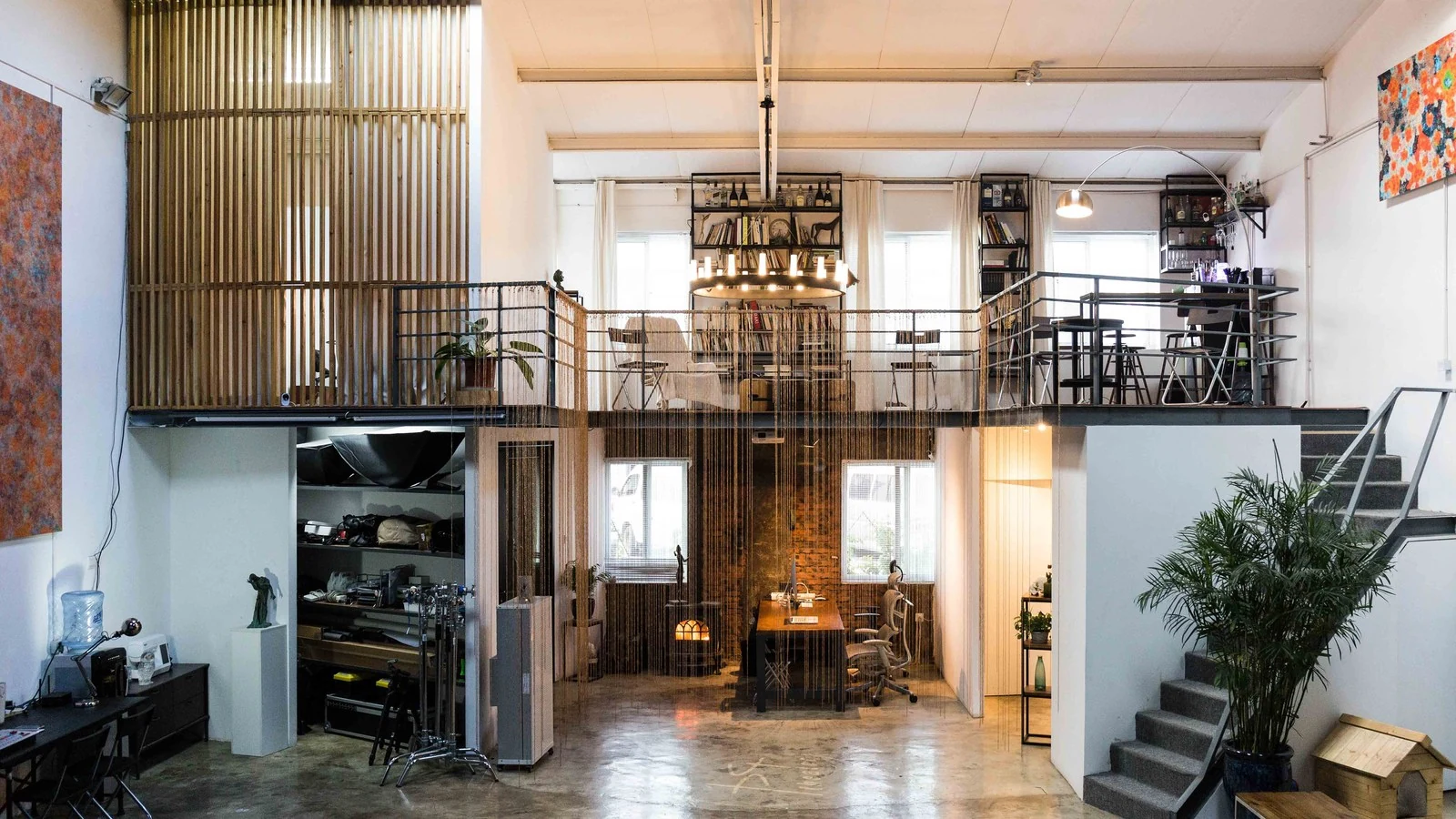
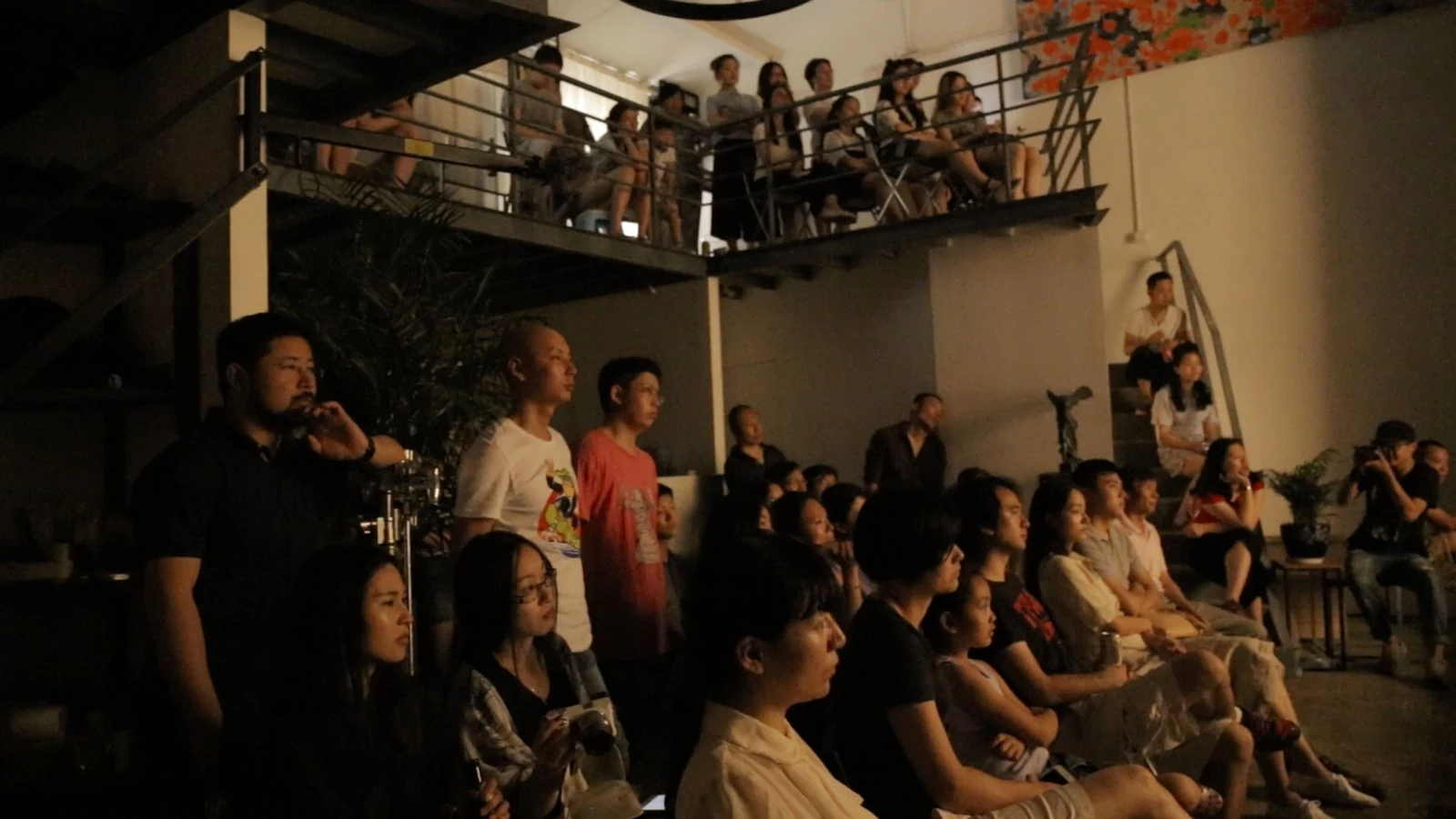
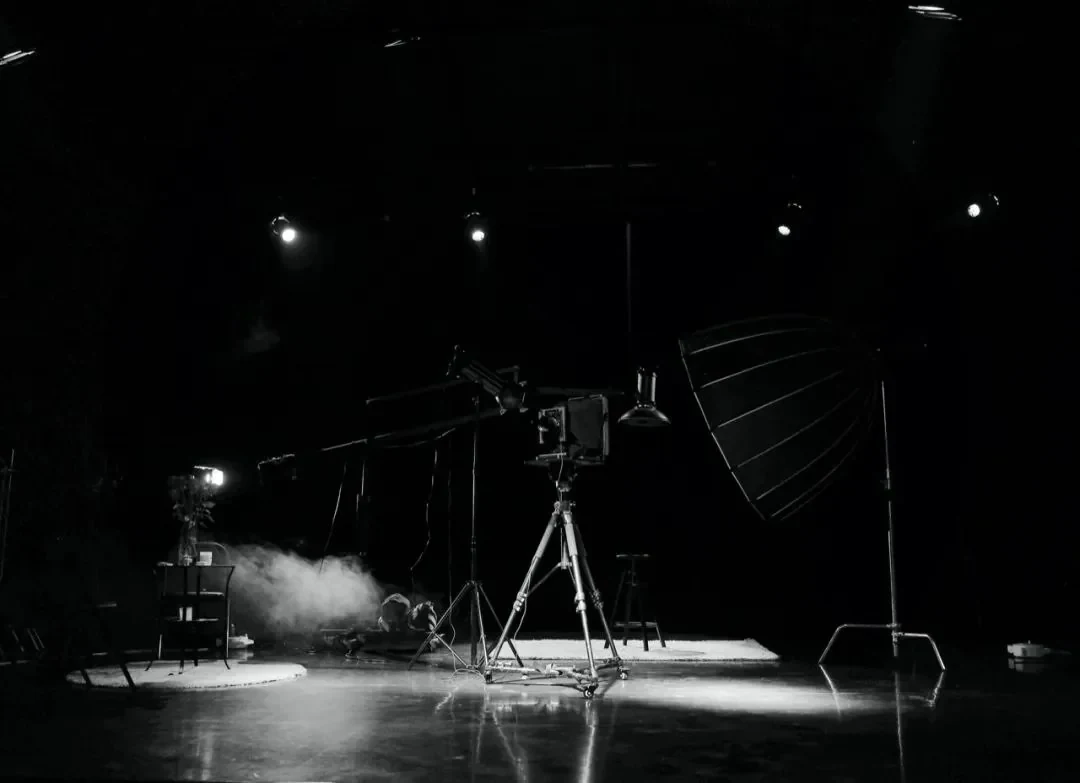
Early descriptions of the space already show that P4 was not a theatre venue unrelated to photography. Black curtains, filming areas, performance areas and the positions from which bodies were viewed were part of its spatial conception from the outset. The relationship between images and theatre was not a later decorative gesture across disciplines; it was one of the space’s original questions.[8]
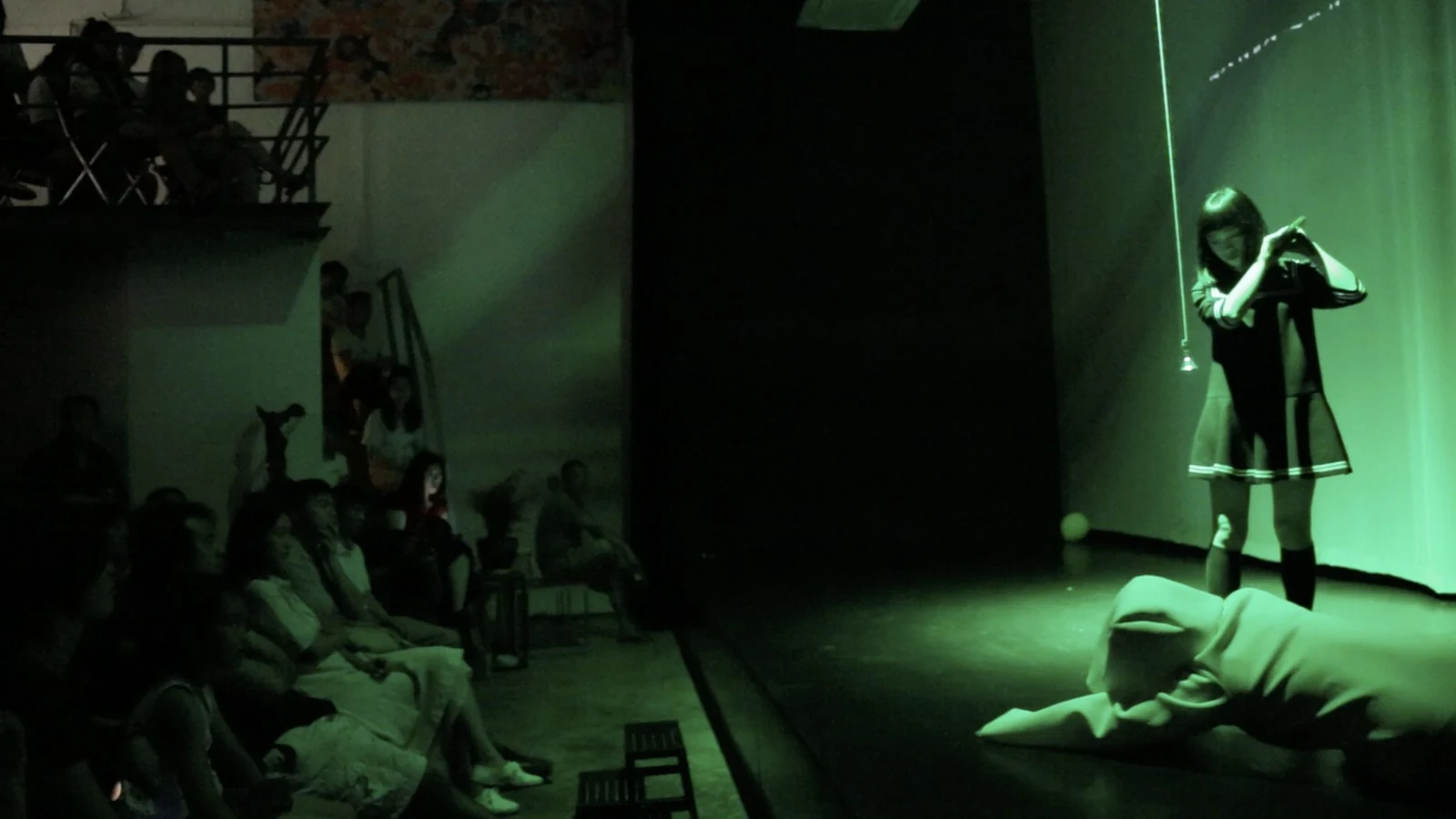
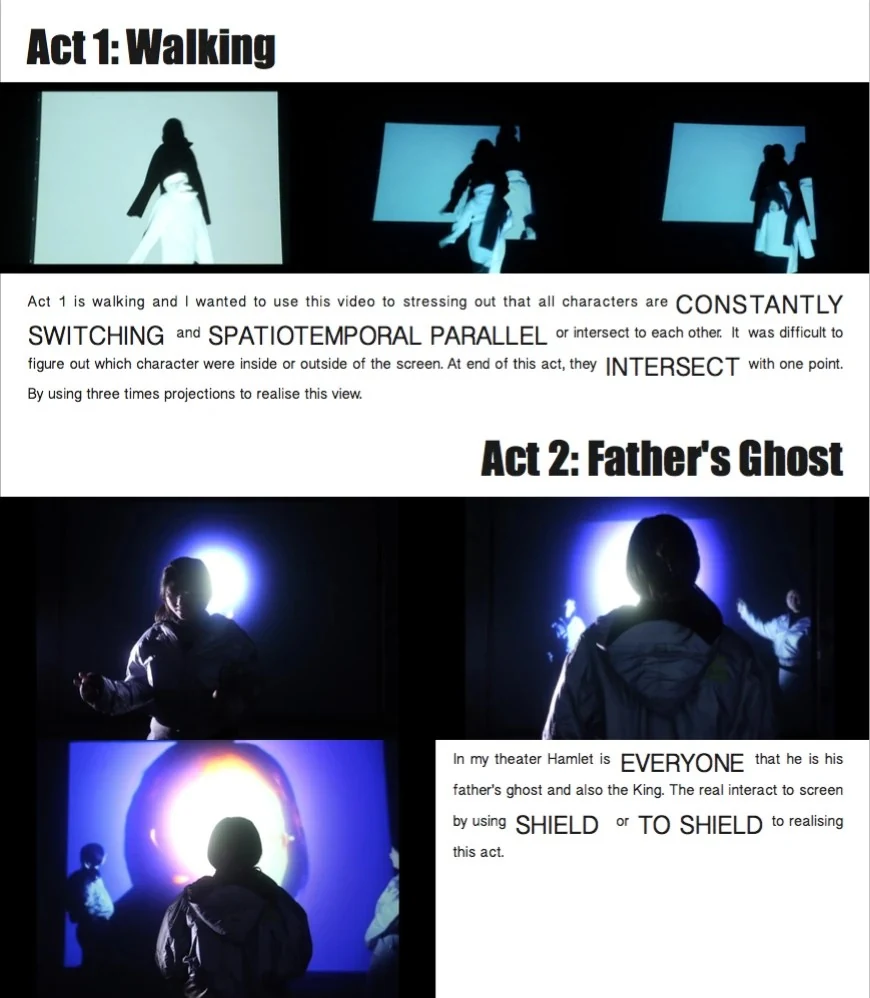
Hamlet’s Mirror, a collaboration between He Fa and Zhang Aoshuang, gives this question a concrete form. Its early version centres on screens, performers, projectors and cameras. Bodies take part in the performance while also entering the formation and obscuring of images. The audience encounters not only a person performing, but also how that person becomes an image, and the relationship between body and image in which the two never fully coincide.[9]
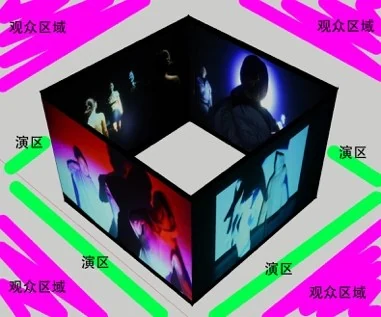
On 26 November 2016, Hamlet’s Mirror | To Be or Not to Be, created by He Fa and Aoshuang as FakingAosome, was presented in the “Theory Opera” programme of the 11th Shanghai Biennale. It combined a surrounding screen, live performance and text subjected to repeated machine translation. This actual performance must be distinguished from a separate four-screen enclosure proposal retained in the archive. Not every proposal should be treated as a realised version.[1][9]
An important difference between photography and theatre emerges here. An artist can rearrange photographs, but people who enter a live situation can respond, hesitate, change their actions or reject the original arrangement. Composition thus begins to involve collaboration, and a work’s form begins to be affected by other people’s actions.
06 /
Shixiang
The photograph is not an endpoint, but a condition for meeting again
In June 2019, He Fa and Zhang Shaohua began Shixiang (Real Image). It takes portrait photography as an entry point, but its aim is not limited to producing a photograph that is “most like the person”. Instead, it connects conversation, photographing, image selection, looking back and further participation. The public call described it as “a theatre for two, just to see you again”.[10]
In Shixiang, the photographed person is first of all someone who has arrived at the venue, rather than an object waiting for a photographer to adjust their pose. Spending time face to face and talking are important parts of the work. In a 2021 interview with a specialist publication, Zhang Shaohua and He Fa described this way of meeting without a predetermined script: some people recount their experiences, some arrive with intense emotions, and some remain silent. Photography takes place within this time together; that time is not treated as dispensable preparation before the “proper shoot”.[11]
Their specific roles differ. Zhang Shaohua primarily undertakes the work at the photographic session, while He Fa participates in the project’s structure, discussions, image selection and interpretation. He Fa’s contribution therefore cannot be measured simply by the number of times he presses the shutter. It also lies in setting up the process, looking together and understanding the images that remain.[1]
Shixiang’s most distinctive arrangement is to bring photographs from one session into the next meeting. A photograph does not immediately exhaust its uses; carrying the time of the previous encounter, it becomes a new subject of conversation. Participants can also decide whether to continue and whether their photographs may be made public. Under the call for participants at the time, those who chose not to continue could receive their photographs by post.[10]
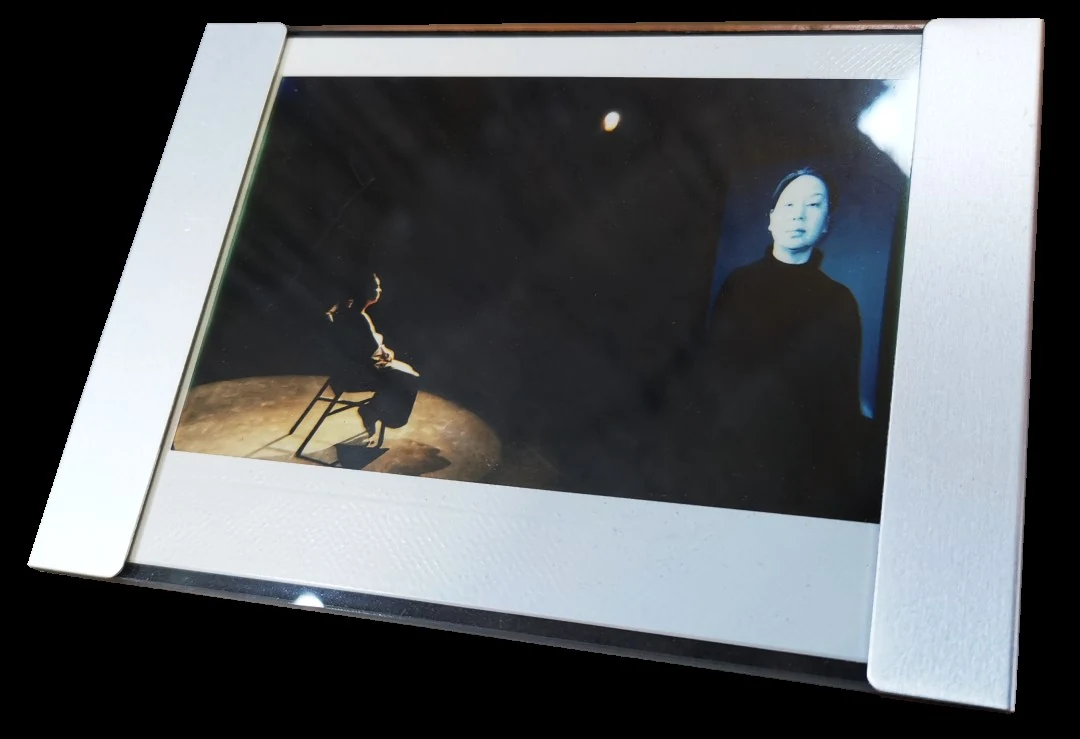
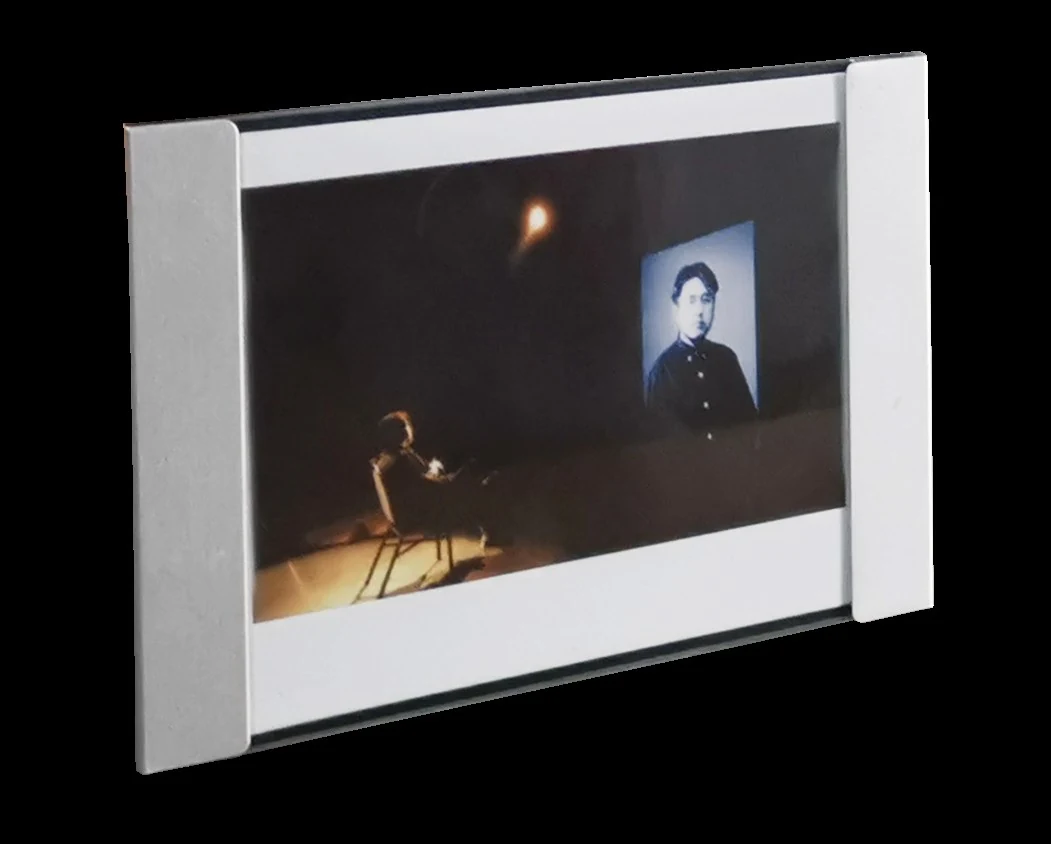
This changes the structure of portraiture. A photograph fixes a past posture, yet it is brought before a person who has already changed. That person can identify with it or find it unfamiliar, reinterpret who they were at the time, or refuse to let a single photograph sum them up.
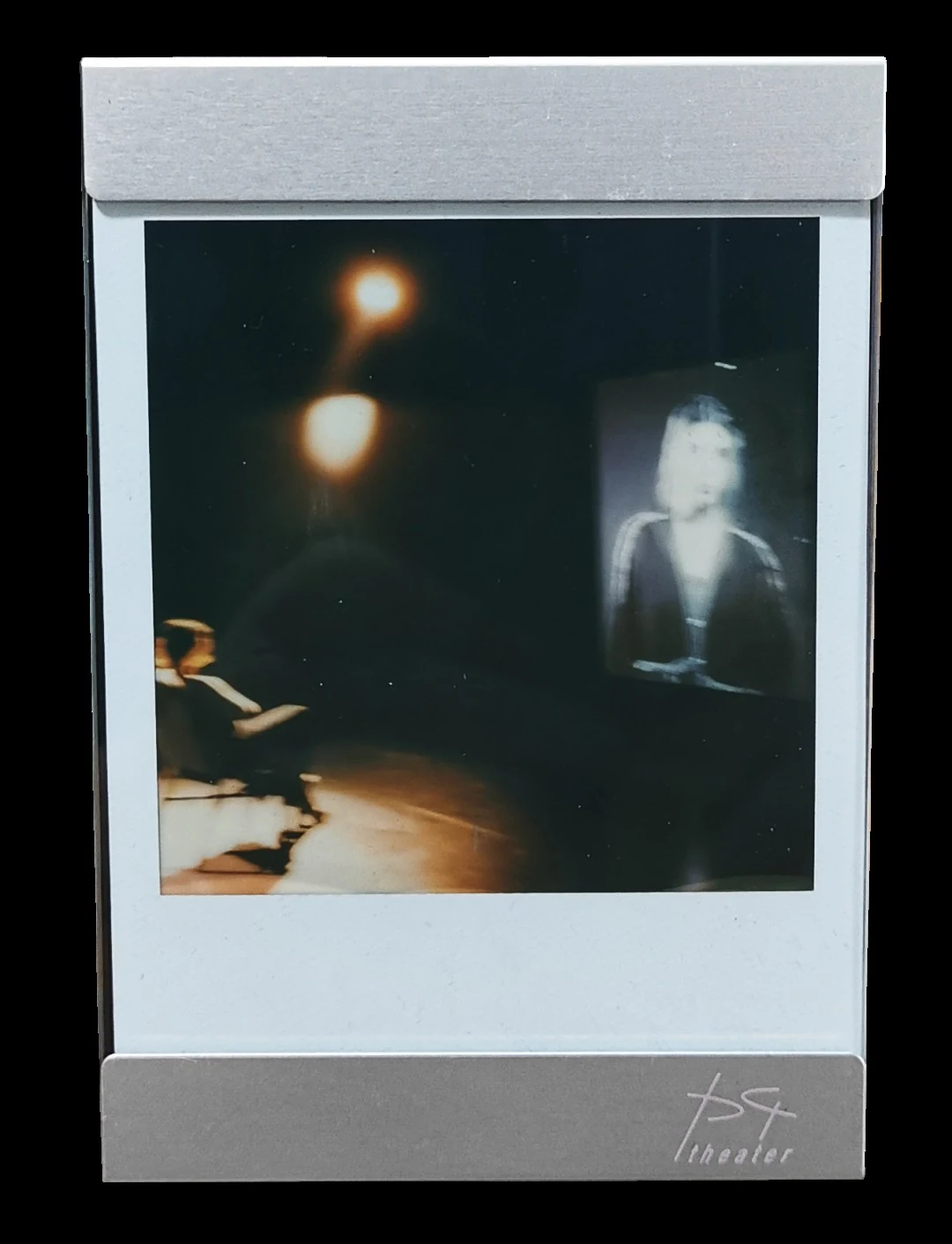
Shixiang thus does not use photography to prove that someone has finally revealed their “true self”. It keeps the relationship between a person, a photograph and the next meeting open to discussion. The photograph’s obstinacy and the person’s changes operate together.
The project devised a long-term structure called “Eight and a Half”, but this design does not mean that eight and a half stages were completed. At the time of the 2021 interview, no participant had completed all the stages. Later accounts also retain the fact that the project did not reach the end of its planned structure. This incompletion should not be erased: it makes visible the distance between the wish to “meet again” and the realities of time, collaboration and departure.[1][6]
Likewise, participants may experience comfort, understanding or a new sense of themselves, but these experiences should not be presented as proven therapeutic effects. Shixiang’s artistic significance lies first in how it organises looking and encounters, rather than in its ability to guarantee a particular outcome.
07 /
Organisation and production
Recruitment, rehearsal, production and documentation
He Fa’s practice cannot be introduced solely through finished works bearing his individual credit. P4’s recruitment methods, rehearsal arrangements, screenings and discussions, production and process documentation also constitute work to which he has committed himself over many years.
P4U’s 2020 call proposed bringing creators and participants together through projects, working collectively over a defined period, with a public presentation as a clear deadline. A professional art education was not the only basis for participation, but the project retained mechanisms of selection, organisation and judgement. The process from recruitment to public performance was also documented, with the involvement of the 3P documentation group: Huang Lucang, Zhang Shaohua and He Fa.[12]
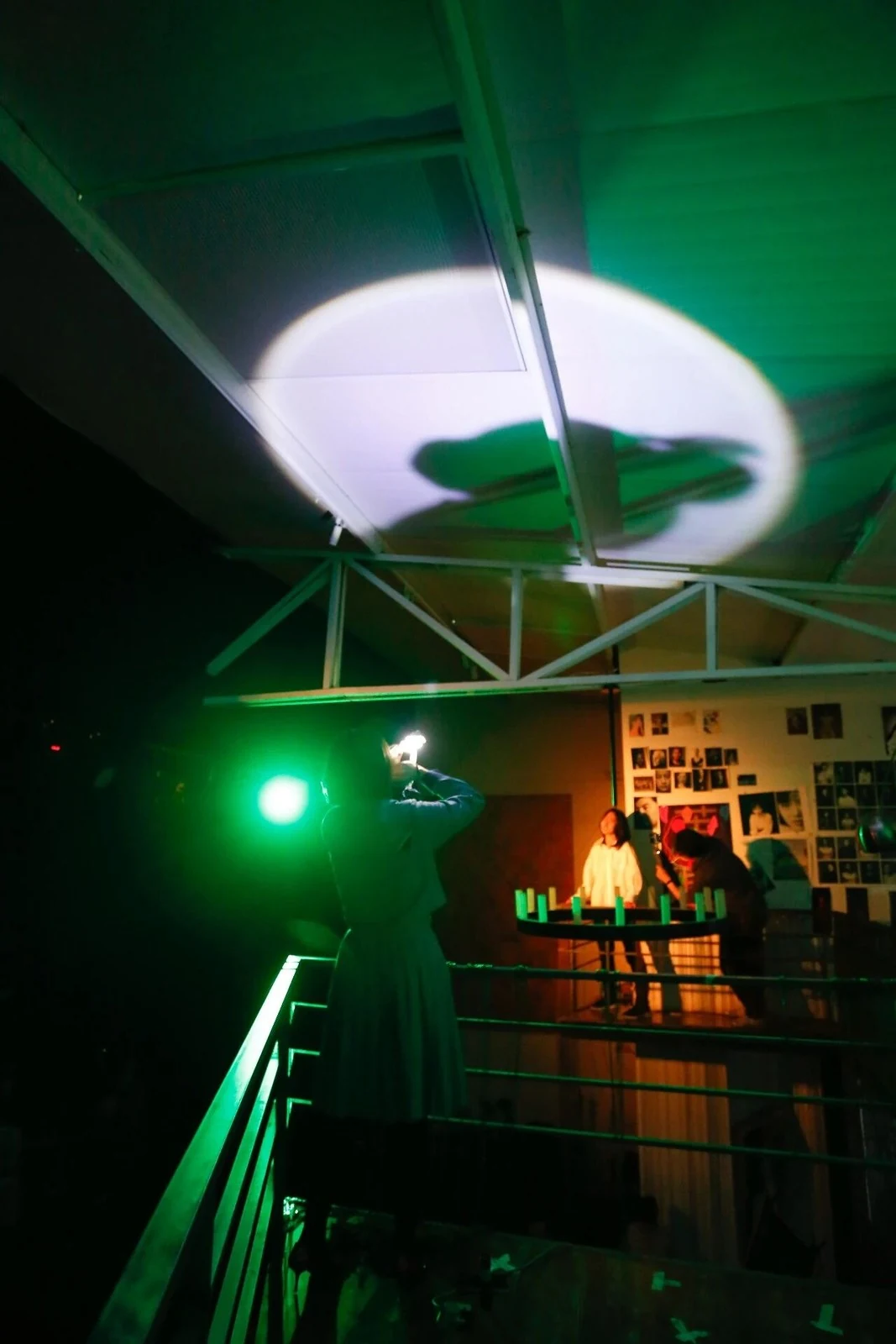
This structure is not the same as “everyone doing whatever they like”.
Once a performance date is set, participants must confront practical decisions: who will propose material, who will perform, whether a passage should remain, how to proceed when opinions differ, when to stop discussing, and when to turn a proposal into an action. A work is made not only of what appears on stage; it also takes shape through these decisions.
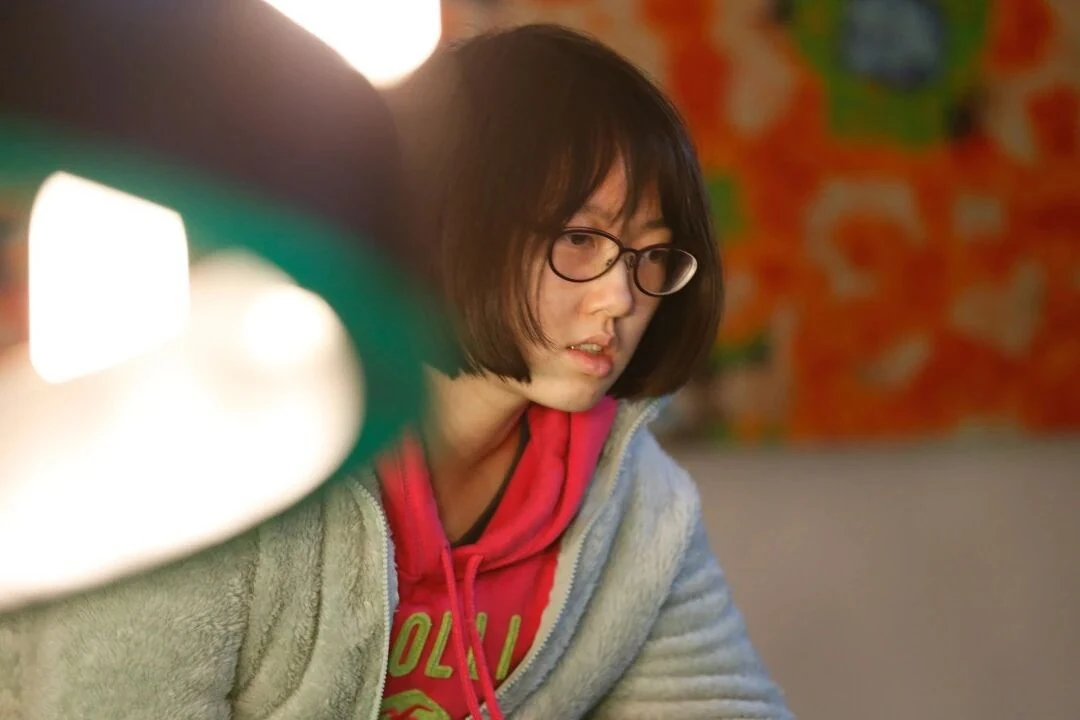
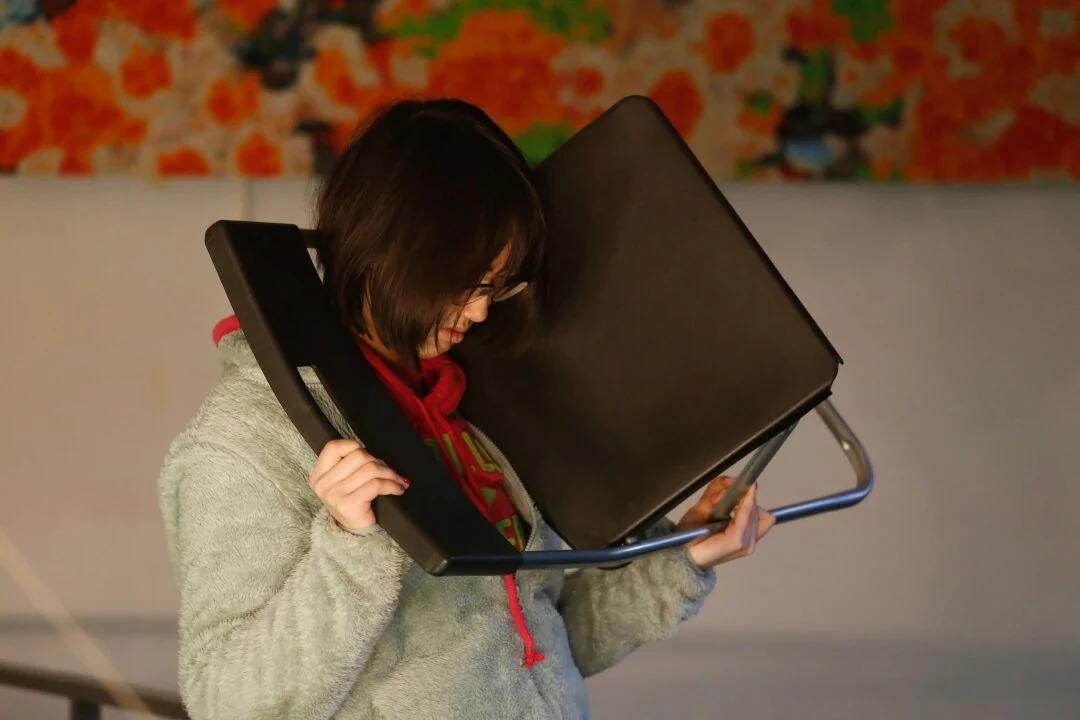
In this sense, He Fa’s work sometimes comes closer to establishing the conditions of production: finding people who can work together, providing space and equipment, giving time to an idea that does not yet have a complete form, bringing it into rehearsal, and making the material that emerges available to be seen and organised. Such organisation does not mean that authorial power disappears. Who sets a project’s aims and who has the final choice remain part of its creative structure.
Nor should He Fa’s roles in different projects be conflated. Howlers on the Rooftop involved P4’s organisation and 3P’s on-site documentation; in Iceberg, he undertook production work; on Breaking the Moon, directed by Xu Shuai, he was supervising producer. Calling all of these “works directed by He Fa” would be inaccurate. Equally, overlooking these contributions because he was not the sole director would fail to explain how the works actually came about.[1]
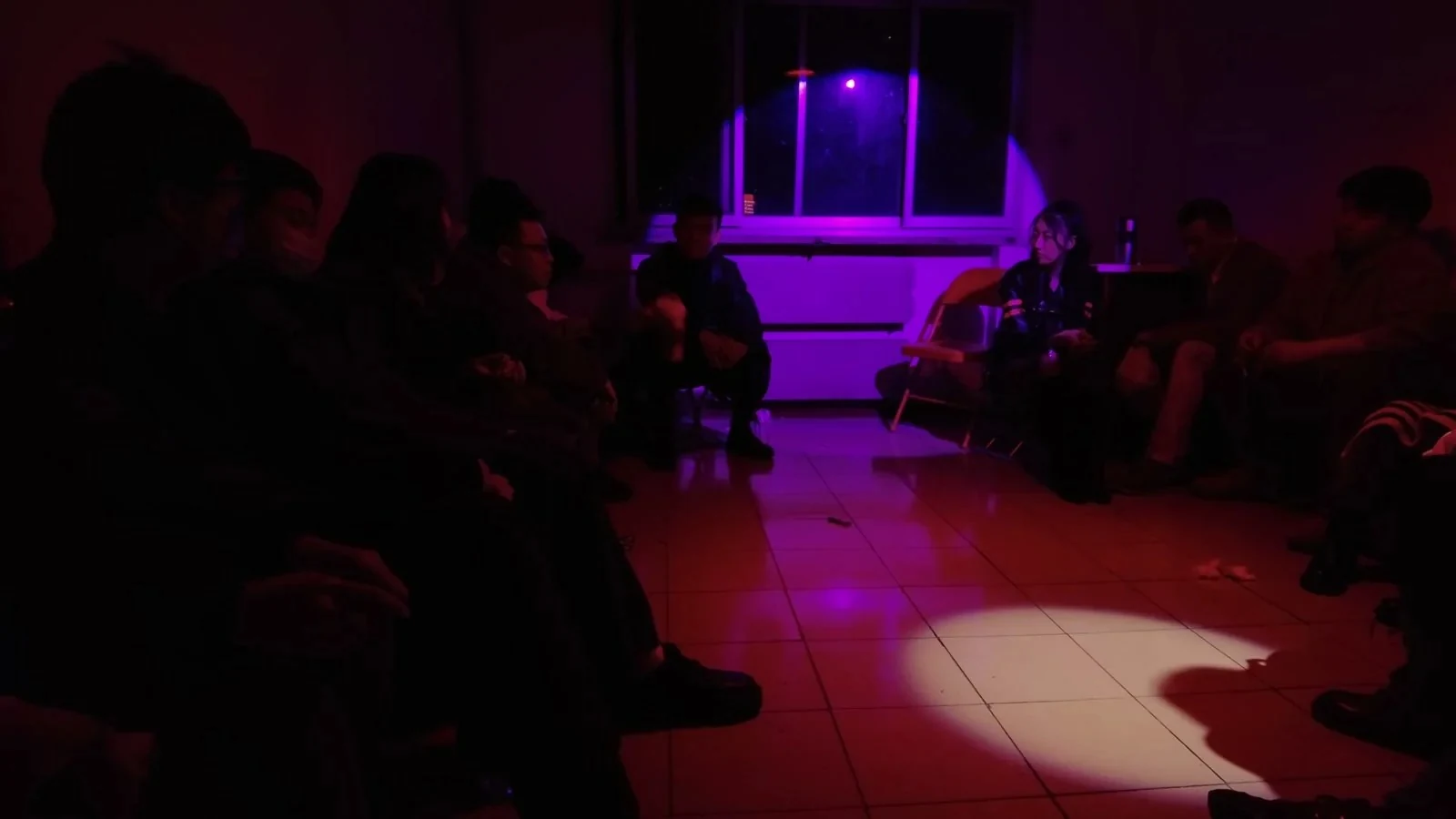
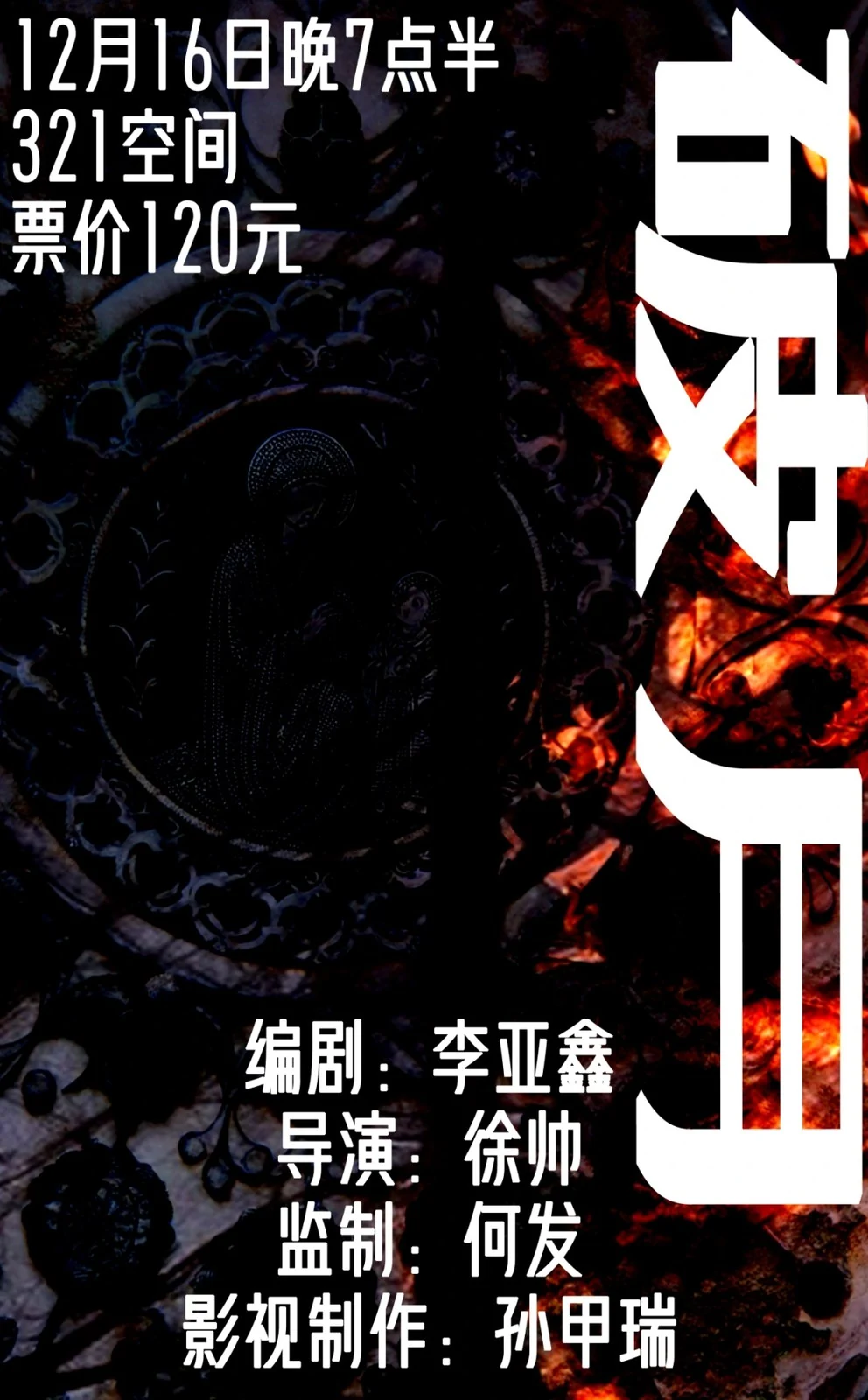
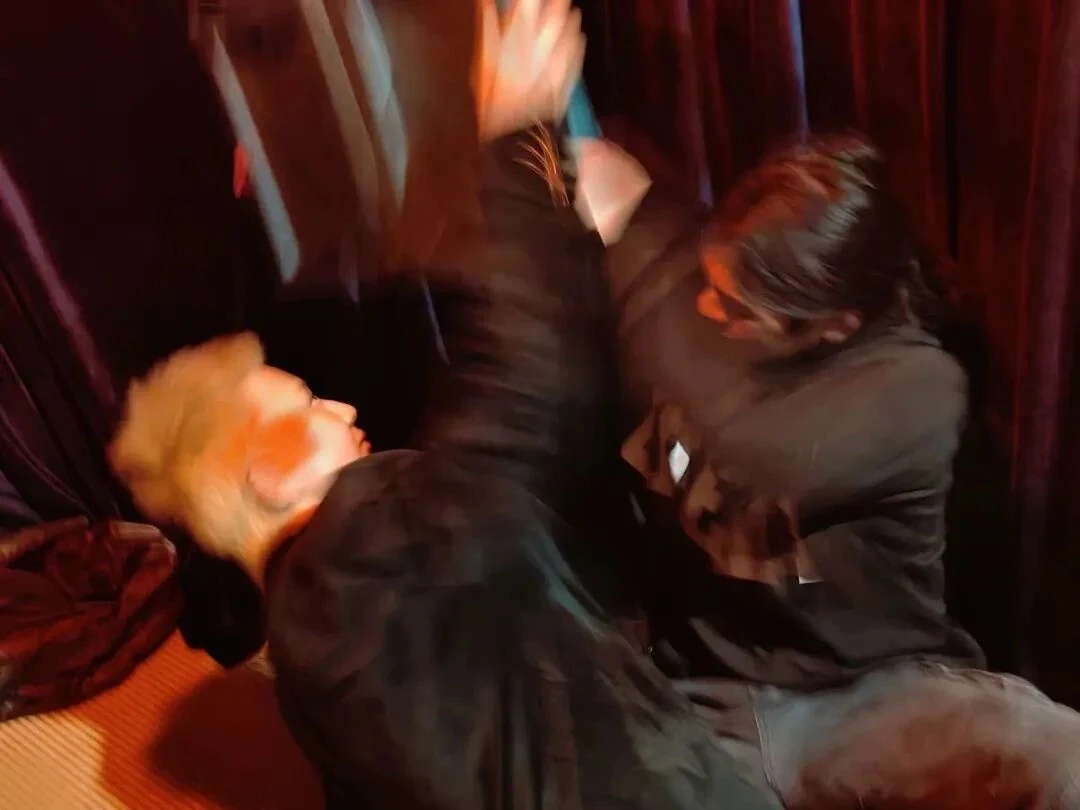
P4 later left its original premises and continued working in smaller venues, bringing production conditions directly into the work. Small spaces mean more than limited resources: they also entail different viewing distances, bodily scales and pressures in the live situation. Yet proximity does not automatically produce intimacy, nor do fewer people necessarily mean deeper exchange. These possibilities must be realised through particular rehearsals and spatial arrangements.[13]
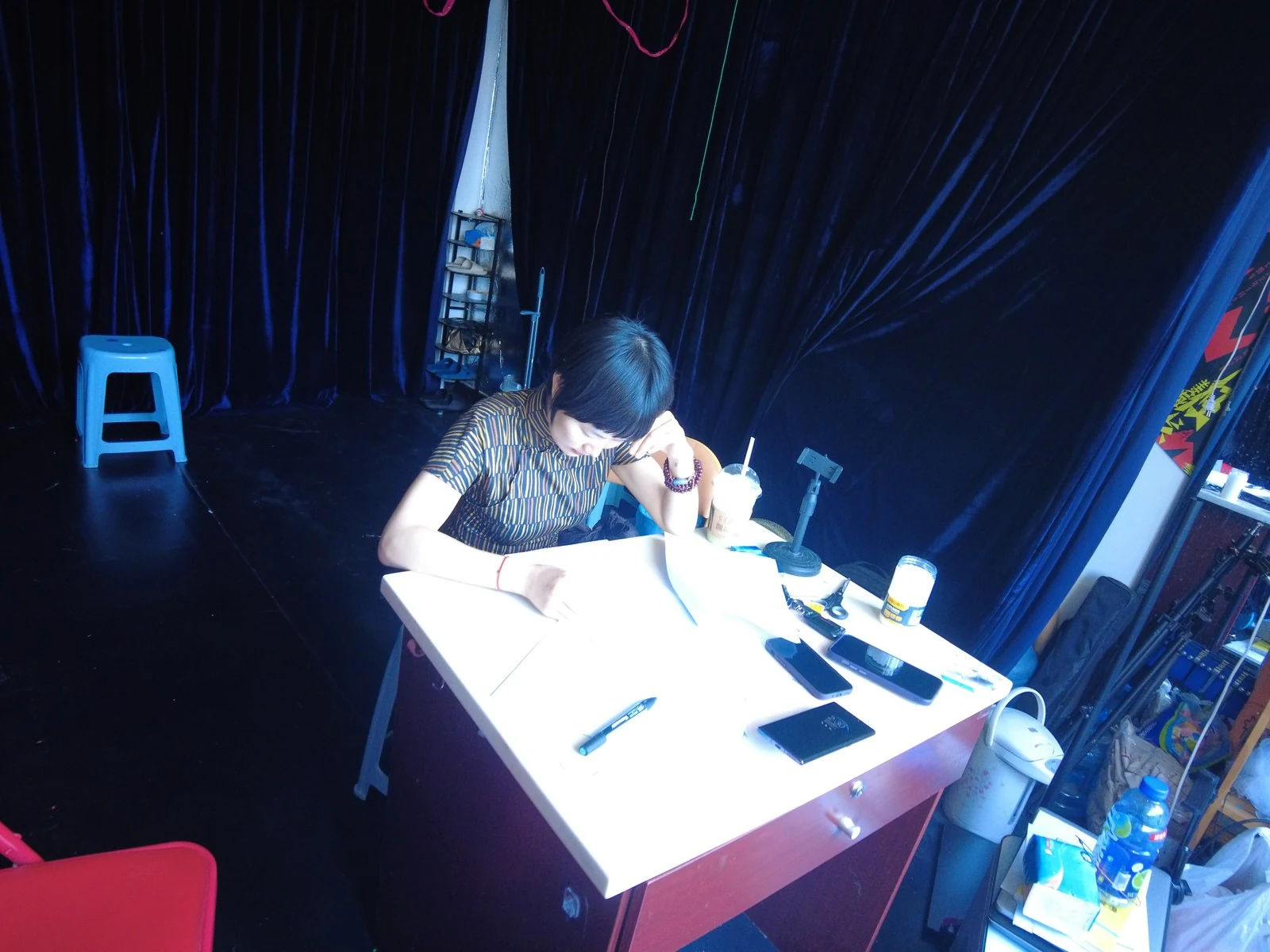
He Fa has described P4’s approach as “using the false to prise open the true”. Here, “the false” can be understood as constructed roles, lines, scenes and rules. “The true” is not a simple copy of unprocessed life, but the actions and experiences that actually take place under these conditions. Someone may use another person’s lines to say what they could not previously say, or encounter someone differently for the first time through a role. A preset situation nevertheless offers only possibilities; it cannot guarantee a result.[14]
08 /
Participatory experiments
The audience enters the work—and its rules
Purple Action and related projects, in which He Fa participated alongside Shen Bolun and Shao Yifan, push questions of organisation further into the rules themselves. Participants are not simply invited on stage to carry out an action. Viewers’ judgements, votes and choices may also become part of how the live event unfolds.[15]
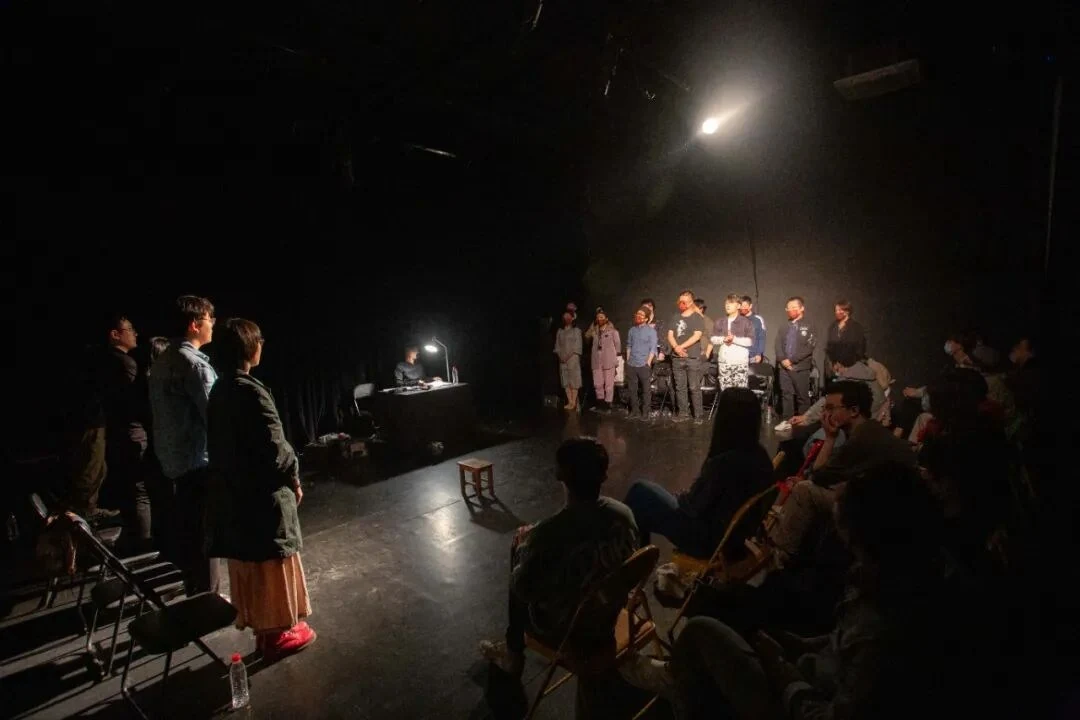
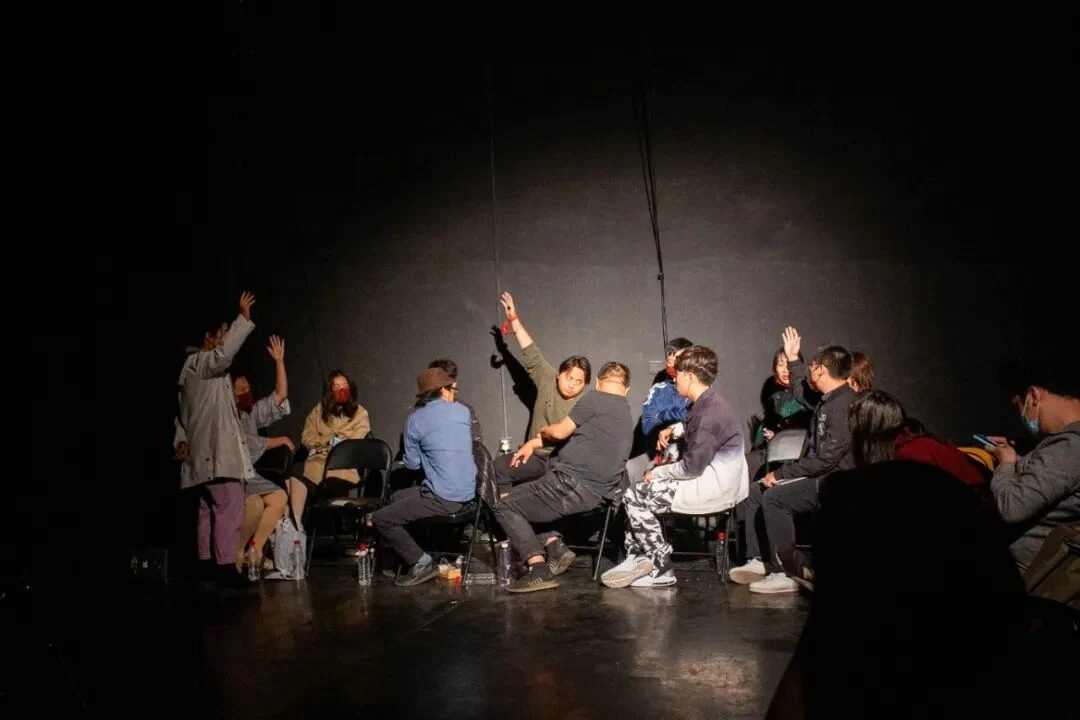
“Saturday’s Four-Hour Duel Club”, held on 23 October 2021, is a specific example. Set in a boxing venue, the performance brought six “fighters” into a four-hour contest, with audience voting helping determine the outcome. Participants’ expression and live competition were placed in one structure. Watching was no longer only a matter of judging a finished story; it could affect what happened next.[15]
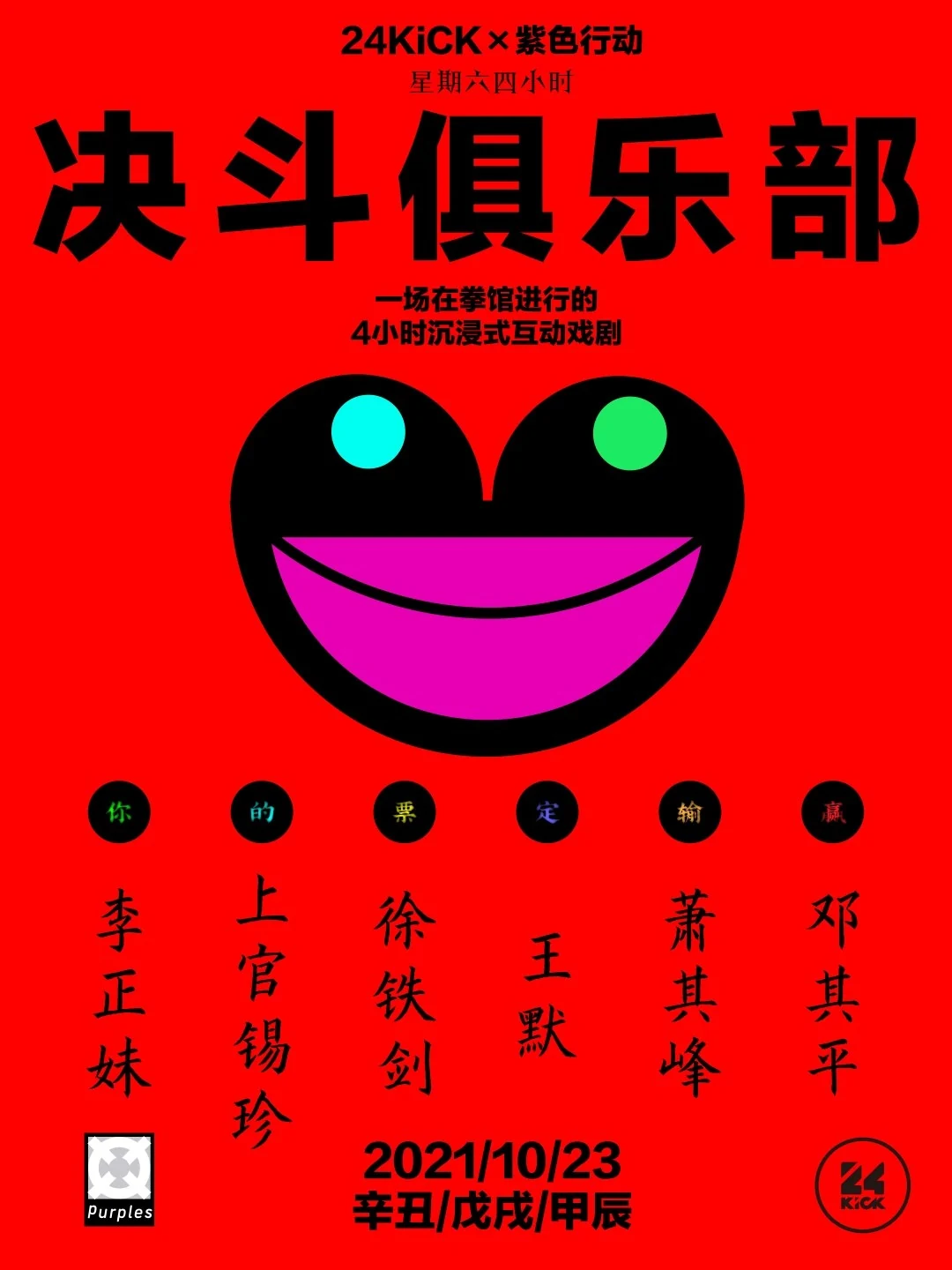
In such projects, rules themselves become theatrical material. How someone seeks attention and explains themselves, why an audience supports one person, and how a host arranges speaking and voting may generate conflict more directly than a prewritten plot. The publicly preserved written record also shows how voting periods, opportunities to speak and vote allocations entered the performance.[16]
These works should therefore not be described simply as “removing the boundary between performers and spectators”. The boundary does not disappear; it changes. Viewers who previously did not have to decide must now take a position through their choices. People who were previously only performers may now have to face competition, comparison and elimination.
Similarly, participation does not mean equality, and voting does not automatically resolve questions of power. Who designs the rules, who can interpret them and who has more opportunities to speak still require specific observation. Keeping these questions open does not dismiss the project. It acknowledges that the project has actually entered social relations, rather than merely borrowed the appearance of “participation”.
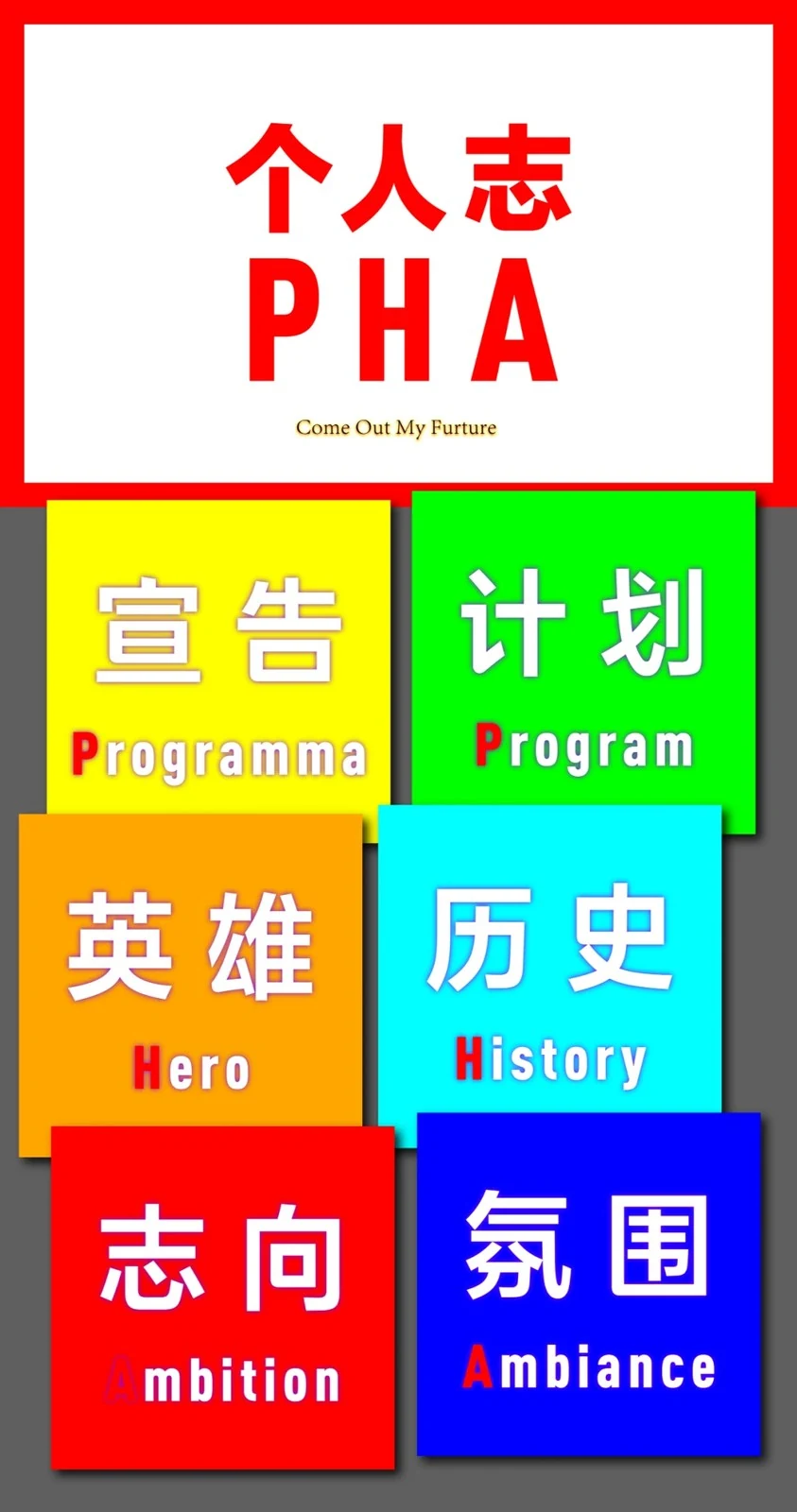
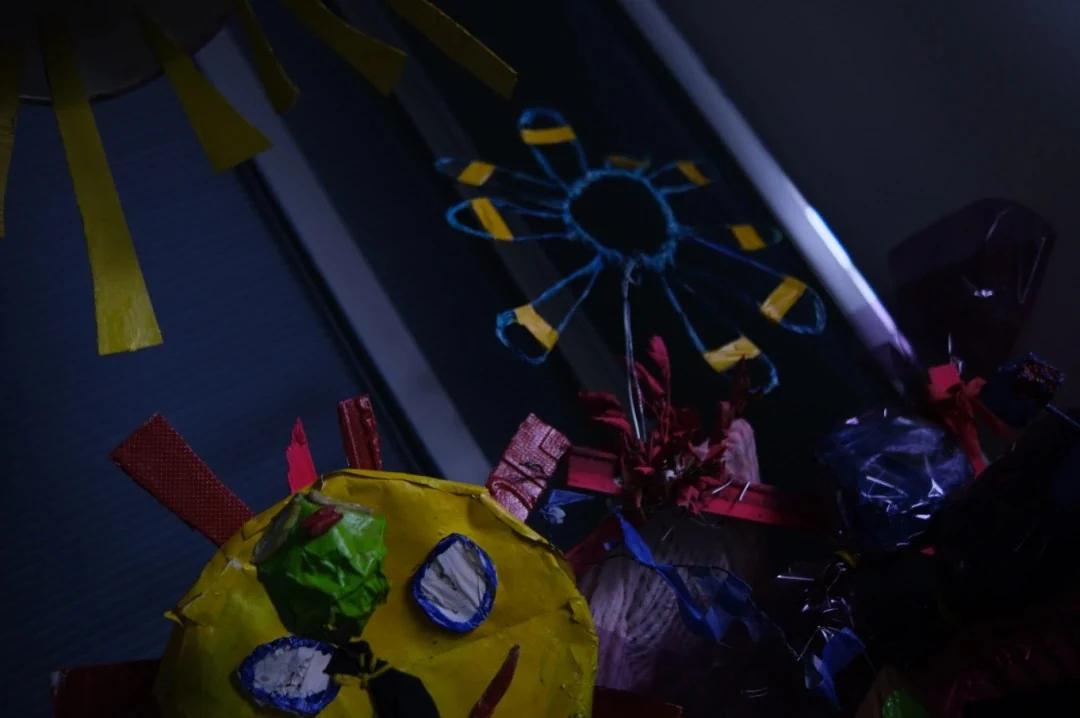
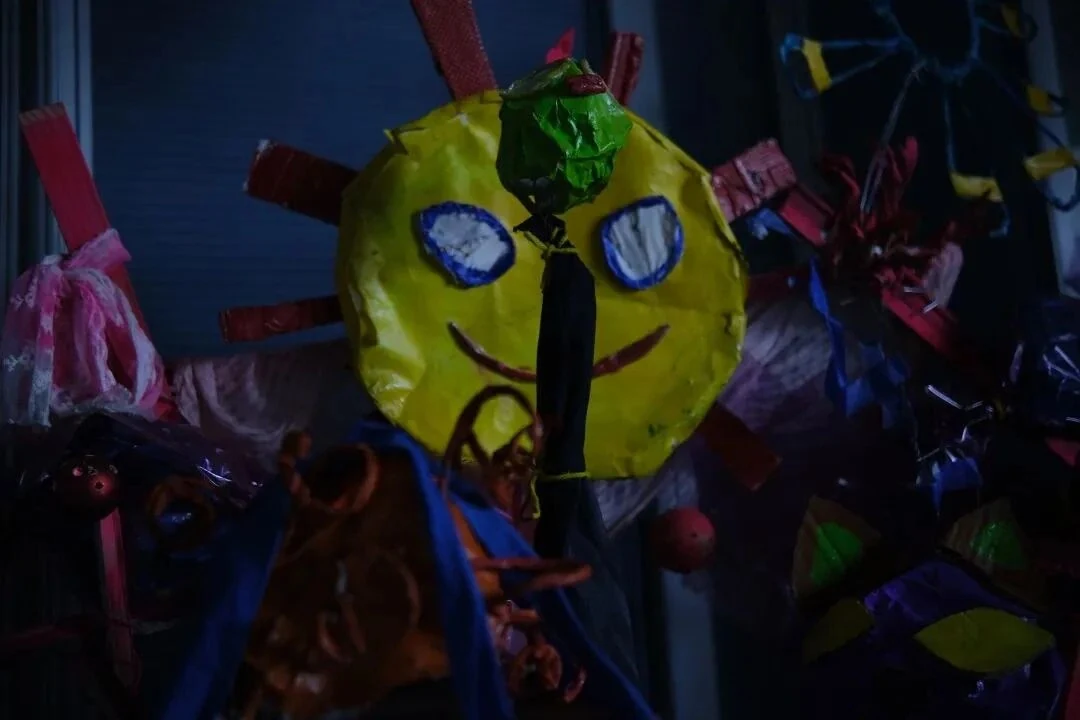
The PHA framework and proposal for public records in Personal Chronicle, and the shared design of characters, objects and ways of playing in Happiness Kingdom, carry this direction into other forms. They concern, respectively, how personal experience is archived, how characters are generated collectively, and how a set of premises changes through continued use. These projects should not be reduced to a single established model simply because they all involve participation.[1][17]
09 /
Shoot Self with You
Bringing the relations of filming into the film
Renlei Touxiangpai, whose English title is Shoot Self with You, brings the relationship between He Fa’s theatre practice and his filmmaking into focus.
The project had a film plan from its recruitment, rehearsal and shooting stages. It was not a completed play whose performance recording was later renamed a film. Rehearsals, filming and live performance in 2023 jointly supplied its materials. On 26 August 2023, The Last Rehearsal was publicly presented at the Inside-Out Theatre branch of Ciyu Bookstore, in connection with the film that followed. In 2024, the project took the form of a film lasting approximately 156 minutes.[18][1]
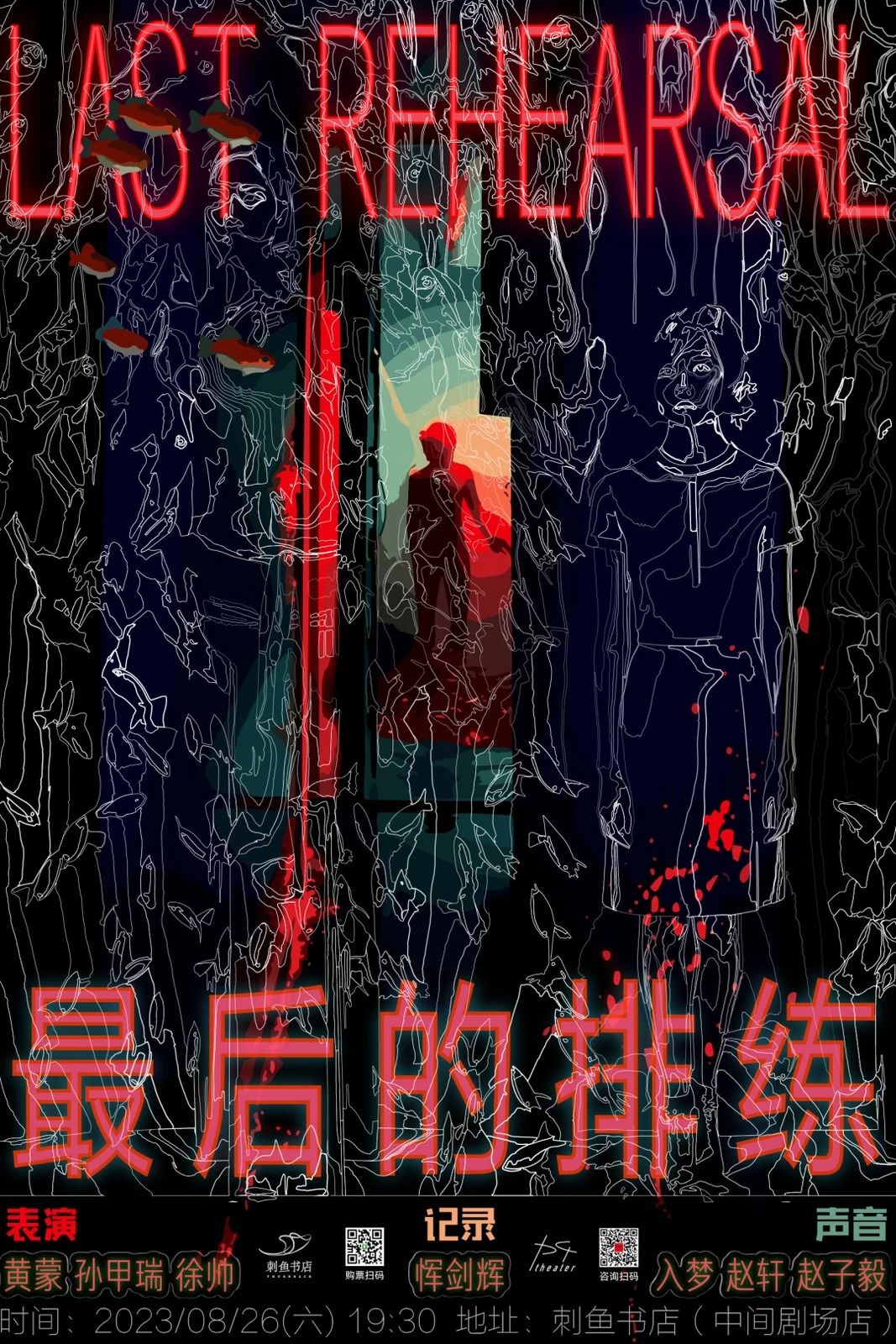
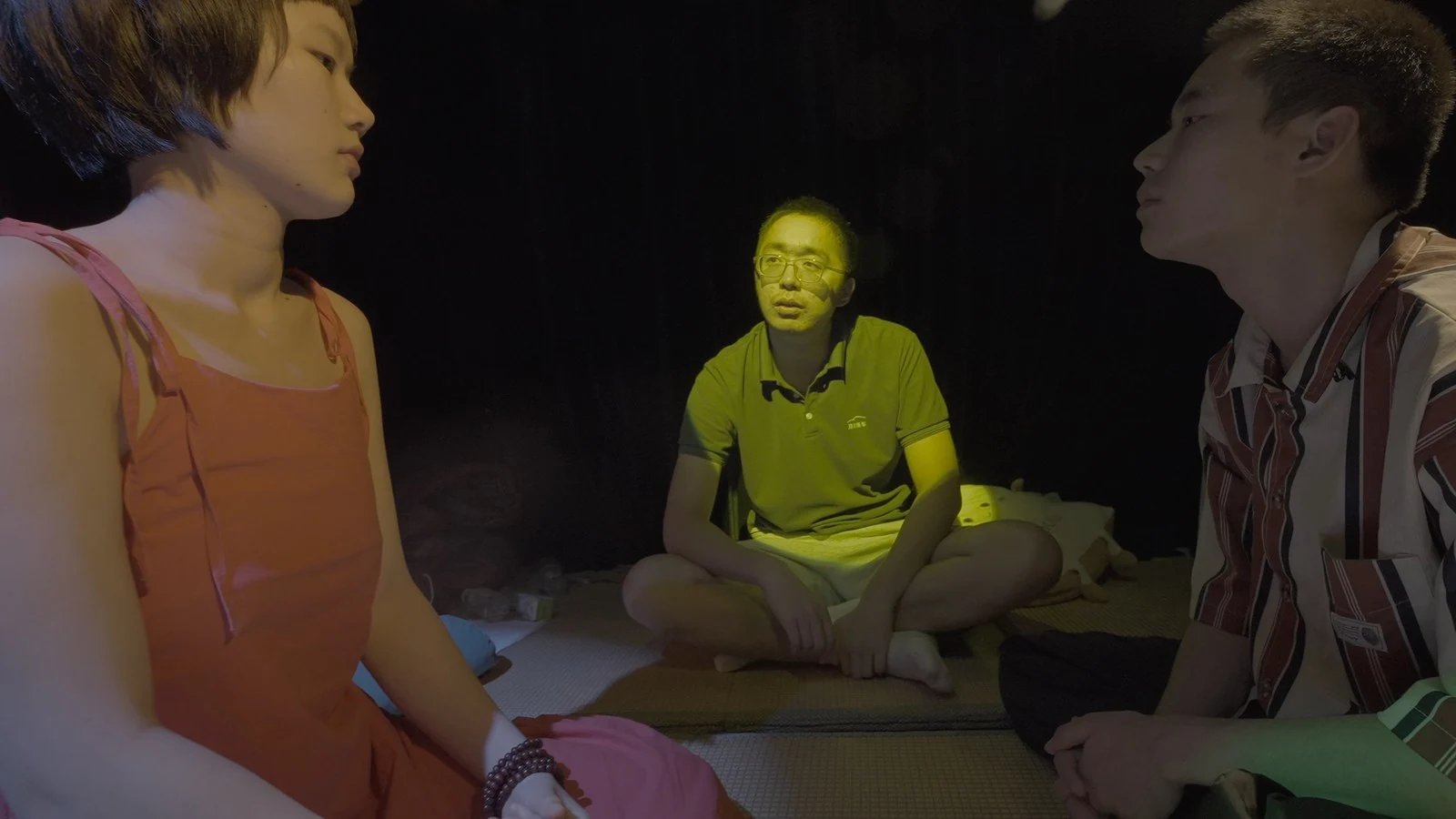
The film’s detailed credits are particularly important. According to the current work archive, directing and screenwriting were undertaken collectively by the crew. He Fa’s central work included initiating, producing and editing the film, alongside contributions to cinematography and art direction. Some external databases register Fa He as director; this should not supersede the more specific collective-creation credits.[19][1]
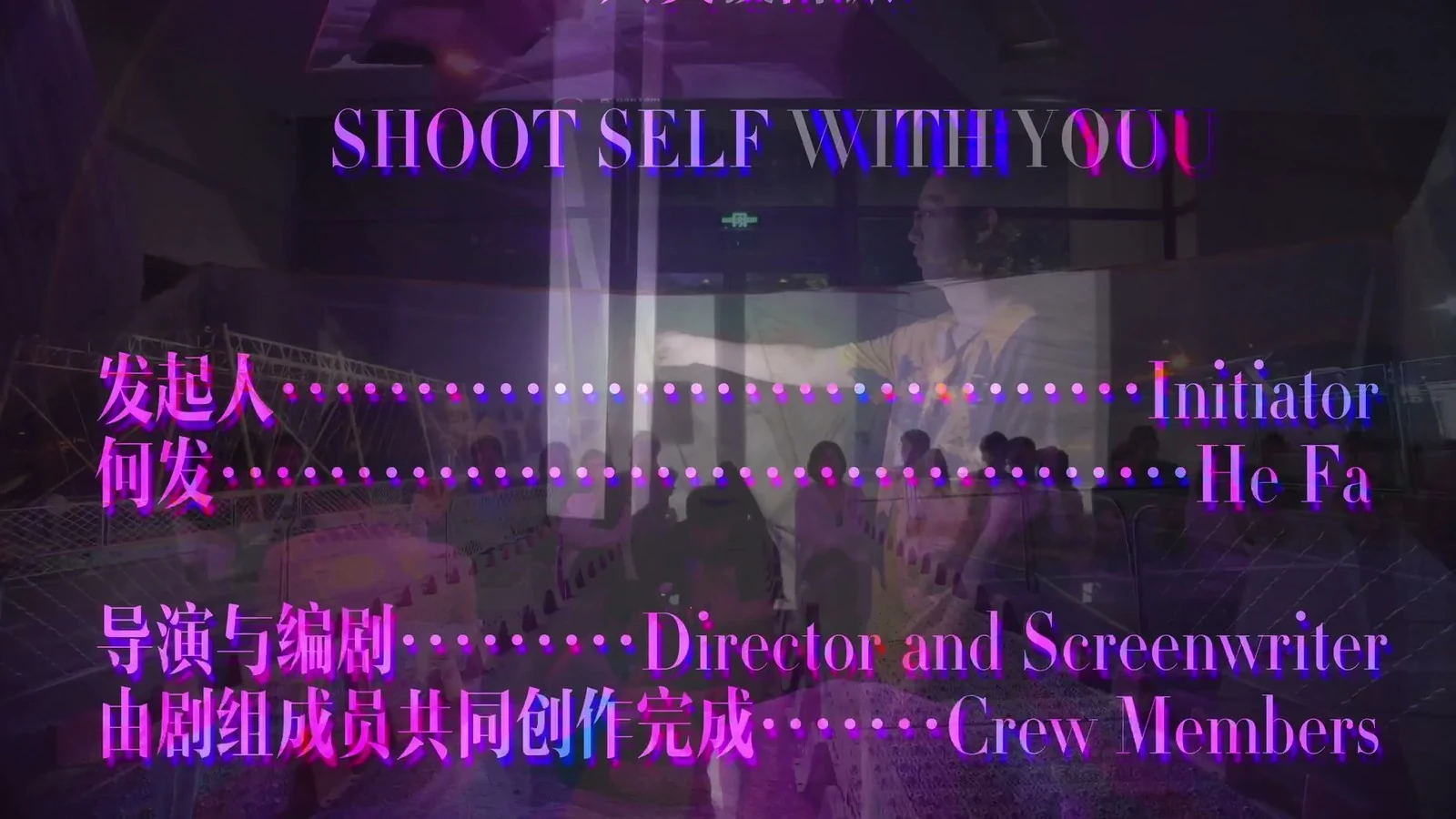
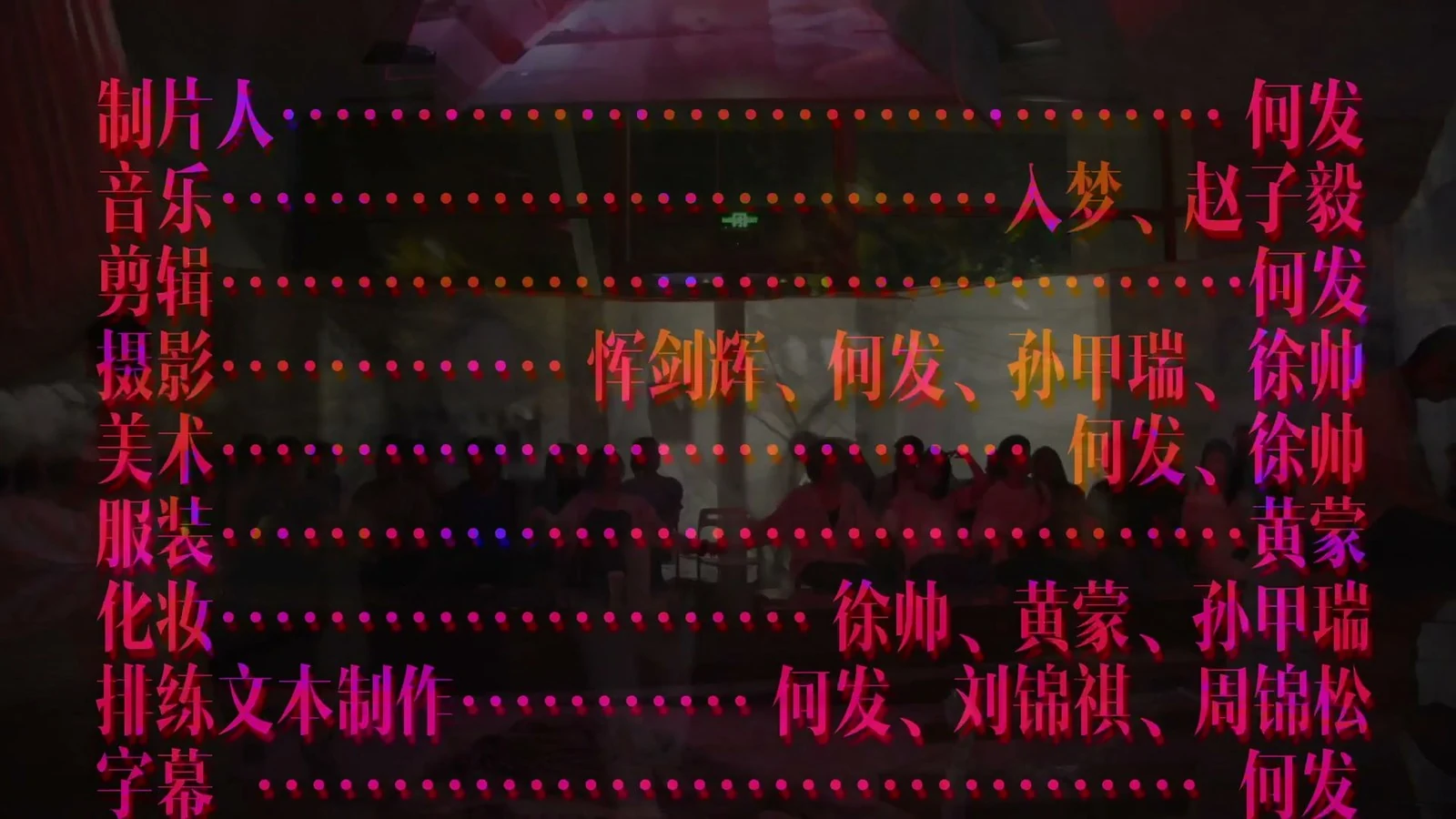
Seen through this mode of production, the film records more than a performed story. The director’s position, the conduct of rehearsals, the ways people speak to one another and the changes filming itself brings to the situation all become questions within the work. The camera is not a neutral witness arriving after everything has been established. From the beginning, it is one of the conditions participants must face.[2]
This gives the film at least two different temporalities. In the live situation, people do not yet know how an attempt will end; in editing, outcomes that have already occurred become material that can be rearranged. An action may be cut as the culmination of all the words that preceded it, or placed in new relationships with other passages. Waiting may be shortened, a failure retained, and an unanswered statement may encounter a response much later.
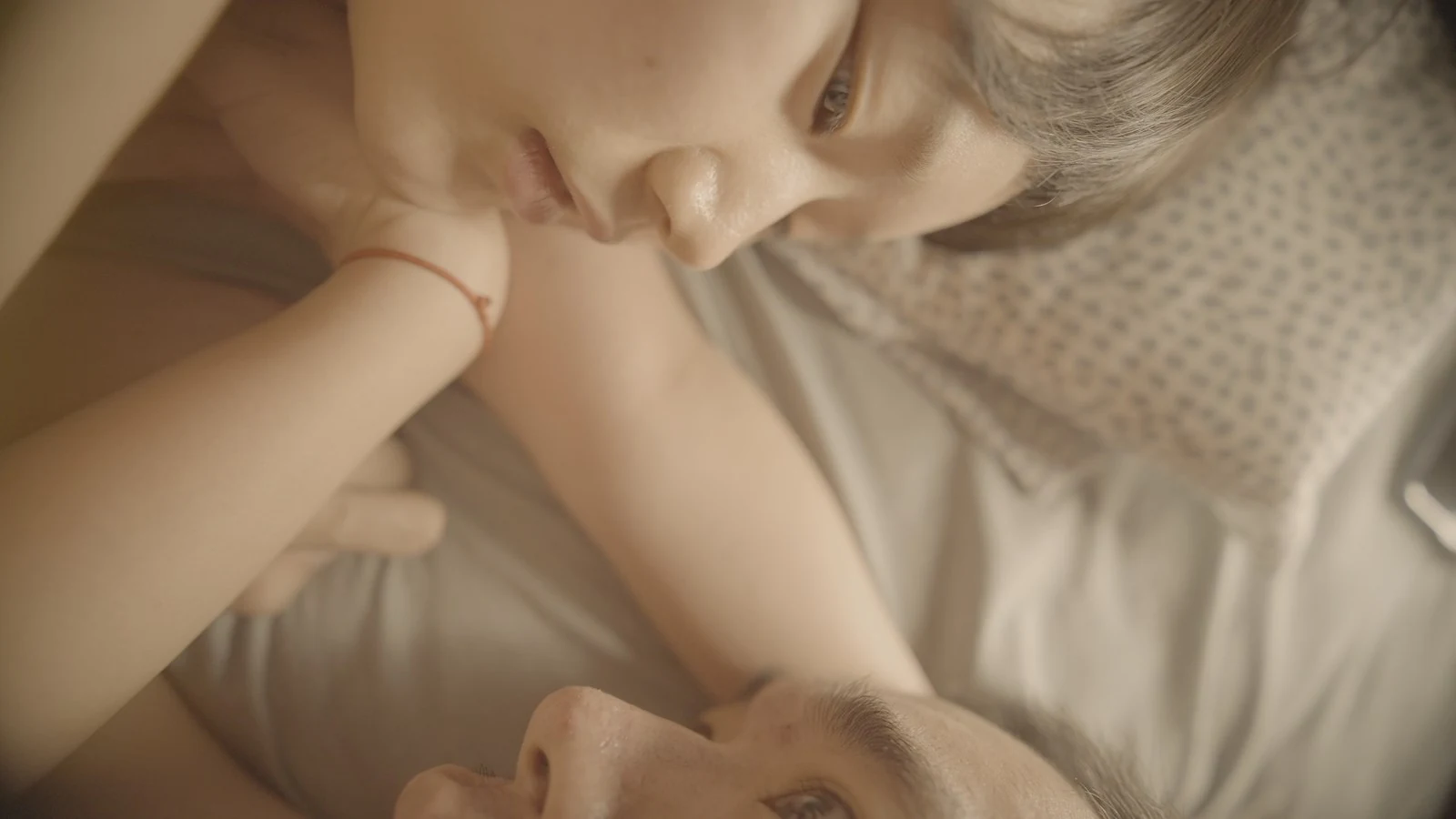
From this perspective, a connection can be discussed between He Fa’s editing and his early photographic collages: in both, material can leave its original position and produce meaning through new adjacencies. Yet they cannot be equated. Mountains in photographs and people in films do not bear the consequences of rearrangement in the same way. Participants in a shoot continue to live, while the work is repeatedly screened in a fixed version.
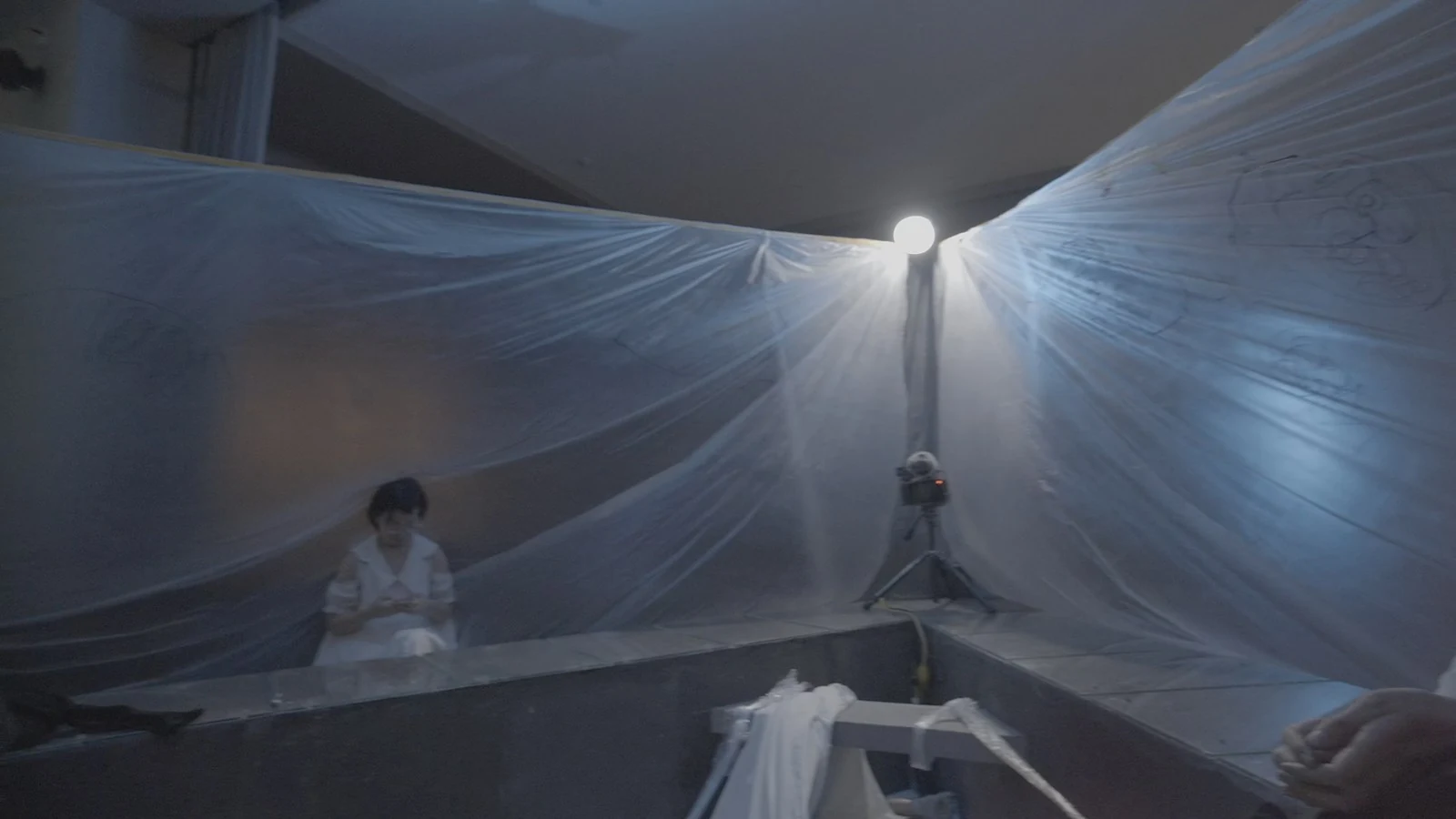
Collective creation therefore means more than “everyone contributing material”. It also concerns who can decide how that material is used, who can object to their own representation, and how the final film accommodates different participants’ understandings of the same event. Bringing the director’s position into the image does not automatically resolve these questions, but it can prevent them from remaining entirely outside the work.
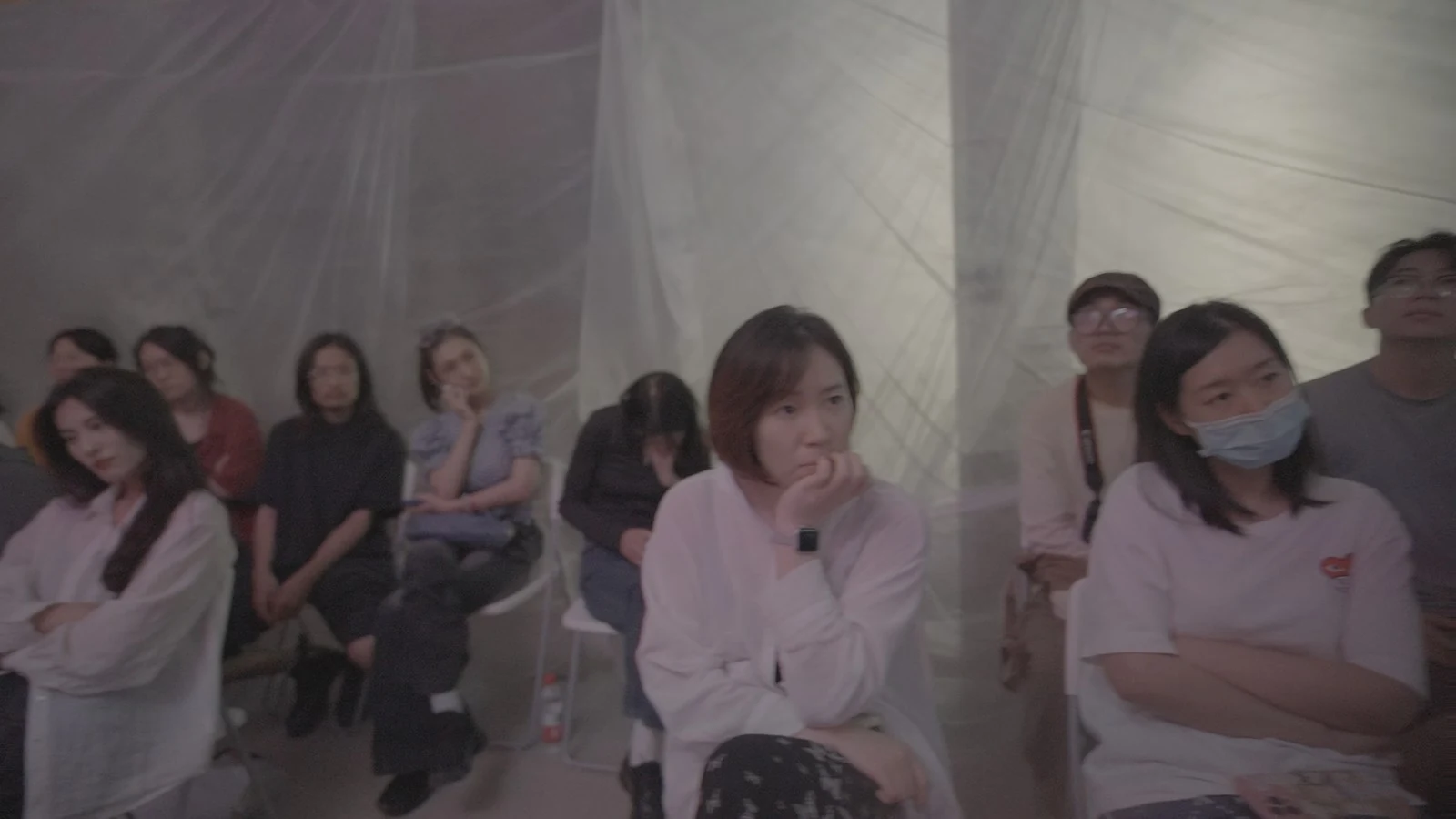
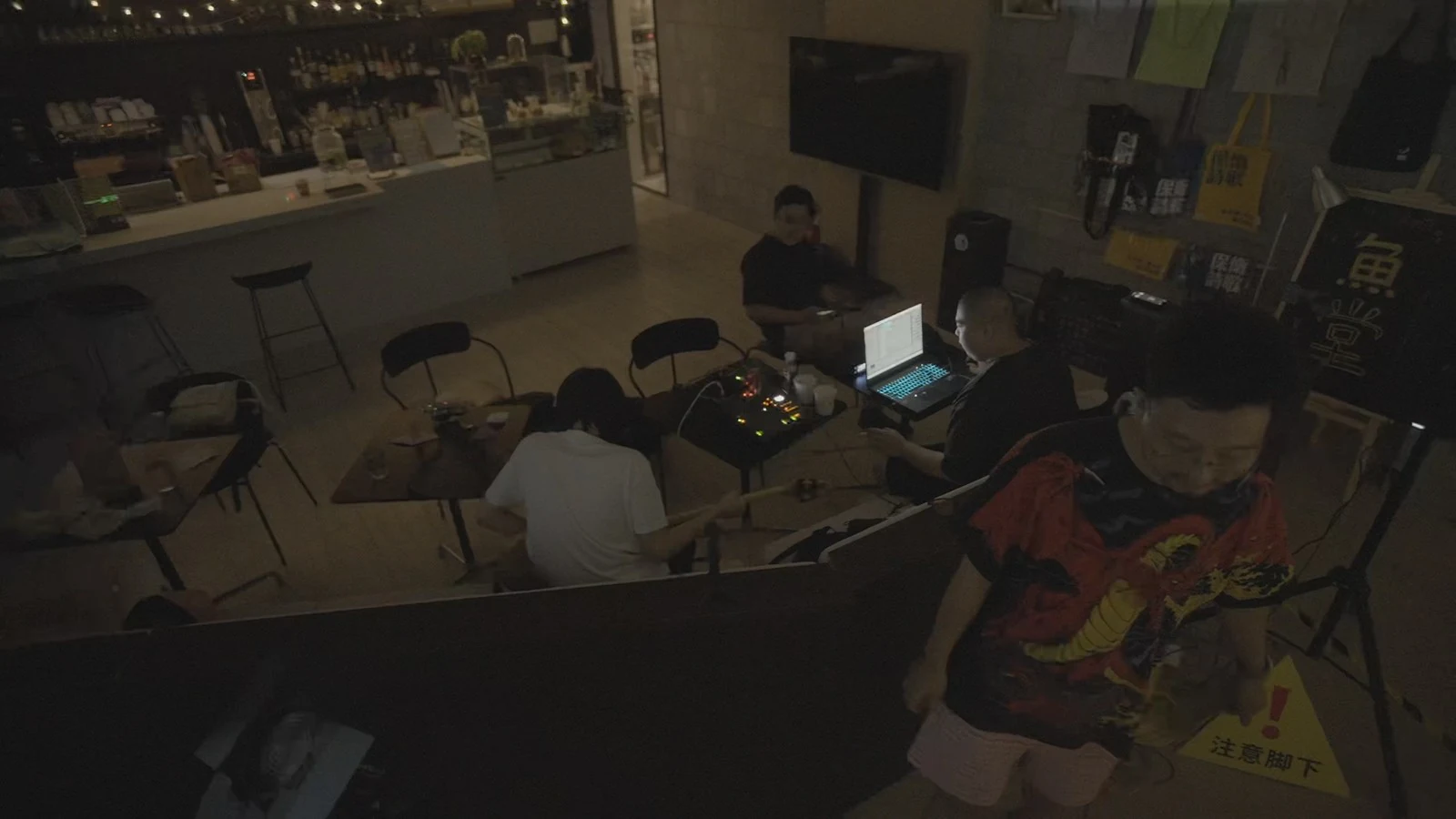
Shoot Self with You won Best Feature at the 2025 Esoteric Film Festival. The official winners list gives the film’s English title and the credit Fa He. This is a verifiable award record. A more important way into understanding the work, however, remains its organisation of rehearsal, time spent together, performance and editing into a film, rather than allowing an award to stand in for an account of its methods.[20]
10 /
Archives and writing
Reading again, and continuing to work
There is another part of He Fa’s practice that is easily placed after the artworks, though it is becoming increasingly important: documentation and rereading.
P4’s surviving materials include not only performance photographs and finished films, but also calls for participants, creative statements, rehearsal records, interviews, participants’ recollections and reflections on projects. They do not always offer the same explanation. Organisers may remember how a project came into being; participants may remember a moment they found unacceptable; a film completed later may reorganise these experiences yet again. He Fa’s works and documents website is placing these different kinds of material within an interconnected reading structure.[21]
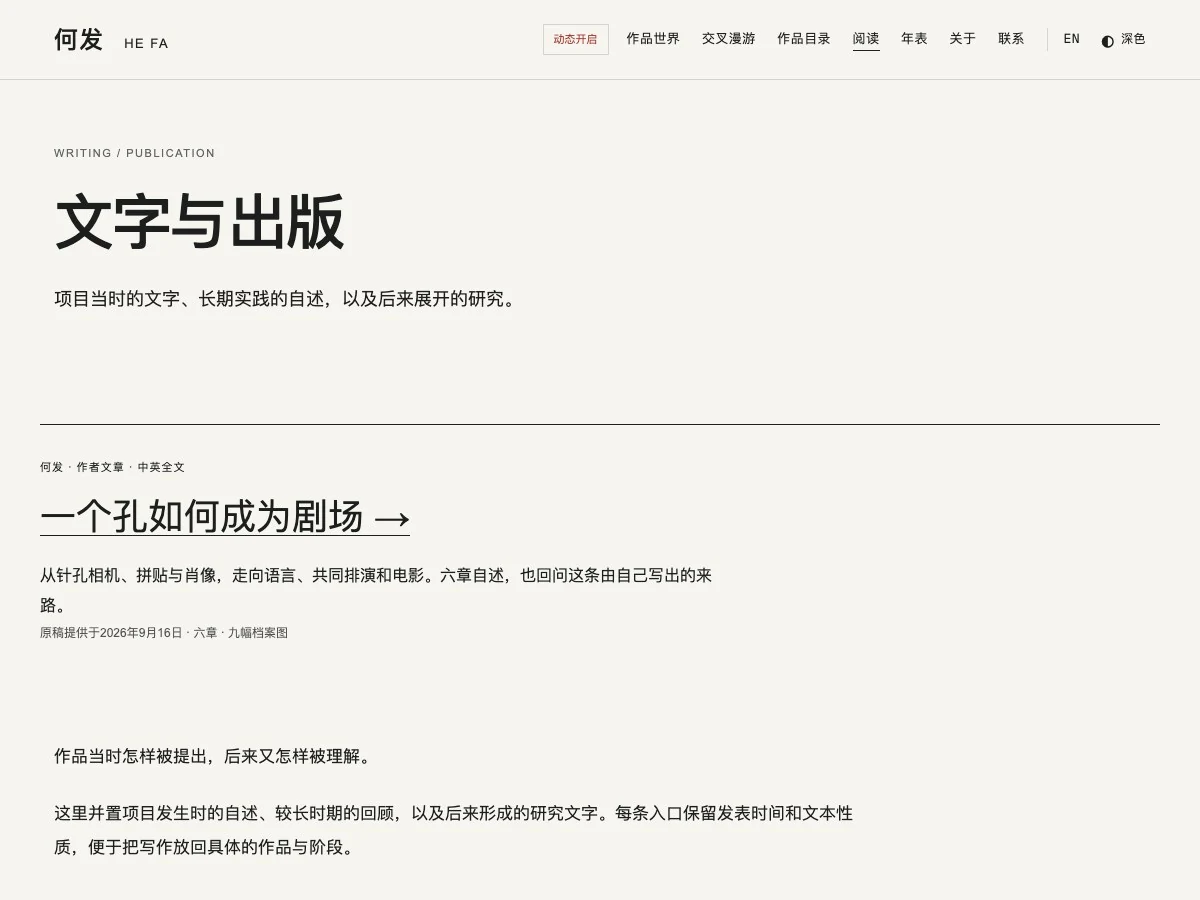
This gives the archive a use beyond promotion. It lets readers compare the initial proposal with what actually happened, examine what different people expressed at the time, and ask whether today’s explanation agrees with the contemporary record. Such comparison is especially necessary for a practice in which live situations and collective creation play a major role. A work cannot be represented solely by its initiator’s retrospective account.
Retrospective writing such as How a Hole Becomes a Theatre attempts to articulate the relationships between photography, language and theatre anew. Its value lies not in proving that every early work anticipated what followed, but in making the author confront his choices again: why he wants others to enter the work, why he repeatedly asks for “one more time”, what documentation and editing can preserve, and what they cannot replace.
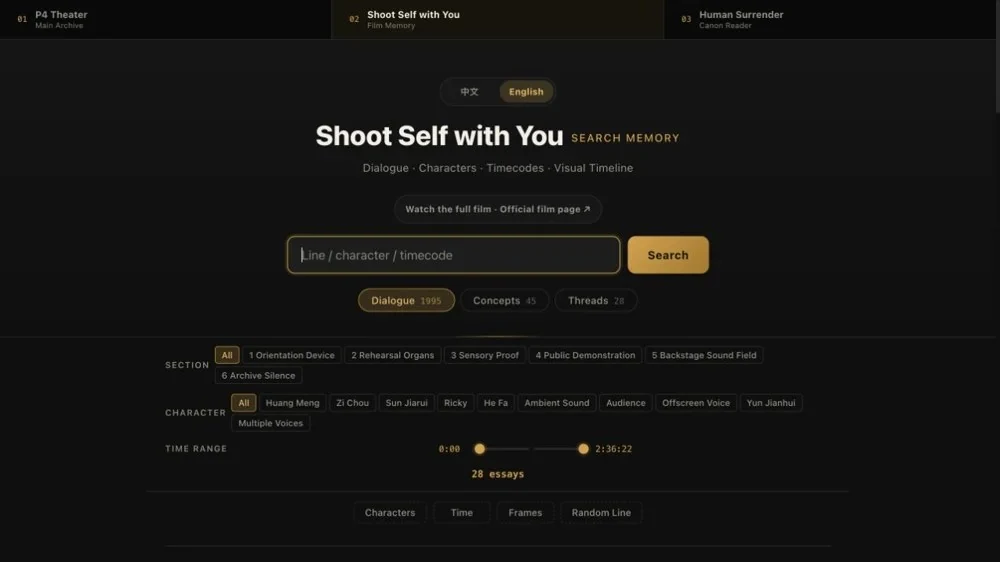
The developing Relational Image Theory turns these questions into a research outline. The existing text explicitly distinguishes between facts recorded by the camera, the experiences of those involved, changes in relations and the understanding produced by cinematic form. It retains its propositions as questions requiring argument, rather than as an already proven unified theory. These distinctions help prevent strong emotions on site from being equated directly with an accomplished artwork, or lived experience from becoming an automatic guarantee of artistic value.[22]
The more recent CA project attempts to turn experiences of collective production towards methods of learning. Its existing methodological draft emphasises beginning with a specific creative question and proceeding through attempts, filming, reviewing and revising. Participants should not merely carry out others’ decisions; they should be able to choose and see what their choices change. At present, this is better described as an ongoing direction of work than as a course with verified outcomes.[23]
Meanwhile, research through Xin Gewu brings the generation of form, materials and the construction of wholes back into the work. This again shows that He Fa’s practice is not a continual abandonment of old media, but a return, under new conditions, to questions that remain unfinished.[2]
Afterword /
Conclusion
Making works—and facing what works cannot do for people
He Fa’s practice cannot be summed up simply as “cross-disciplinary”, because crossing between media is not in itself the most distinctive part of his work.
What is concrete is the set of methods he repeatedly uses and continually changes: rearranging photographs so that a mountain forms between local images; retaining accent and mishearing within translation; allowing screens, seats and bodies to organise viewing together; bringing photographs into the next meeting; creating the conditions for unformed work through recruitment, rehearsal, rules and documentation; and then, through editing, turning a past live situation into a film that another group of people can watch.
These methods differ and need not be compressed into a formula. Together, however, they extend creation beyond “the author expressing himself” towards a more complex field: how works form, how others enter them and how what has happened can be understood again.
Nor does He Fa’s emphasis on process remove the demands of artistic form. A photograph still needs composition, a lamp still needs form and material, a performance still needs time and rhythm, and a film still needs selection, organisation and an ending. Openness cannot replace making; collective creation cannot become a reason to withhold judgement.
Precisely for this reason, his practice continually faces a difficulty: organising materials into a powerful whole while acknowledging that the people entering it cannot be fully explained by the work.
From this perspective, He Fa works not only on the transformation between images and live situations, but also on the distance between a finished artwork and unfinished relations.
A mountain can be reassembled and a film screened again. What has happened between people does not acquire a final explanation simply because one version has been completed.
This article draws on institutional records, contemporary project documents, specialist interviews, work archives and existing research manuscripts checked up to 8 October 2026. Its discussion of creative connections and methodological significance is the article’s analysis. The film section focuses on production methods and credit records; it is not a shot-by-shot review based on a complete viewing of the film.
Text and image sources
Numbers in the text correspond to the sources below. Artwork and event images come from the artist’s and P4’s archives. Captions for some Fafalish exhibition photographs identify CCA/C Archives and the applicable licence. Collaborative works retain their individual credits; event photographs without an explicit photographer credit are not collectively attributed to He Fa.
[1] He Fa: Draft Baidu Baike Entry and Notes on Public Evidence, 23 September 2026. Working document.
[2] He Fa: A Comprehensive Study and Work-by-Work Critique, 13 September 2026. Research manuscript.
[3] CAFA Art Museum: collection records for the 2012 graduating class. cafamuseum.org
[4] He Fa work archive: twelve-water-lamps. hefa.p4theater.cn
[5] CCA/C Archives:2017 Fafalish exhibition documentation。 vault.cca.edu
[6] How a Hole Becomes a Theatre, reading edition of the book manuscript.
[7] P4 Theater: historical and founding records. p4theater.cn
[8] CAFA Art Info: contemporary report on P4 and Shadow Counterpoint. www.cafa.com.cn
[9] He Fa work archive: hamlets-mirror-cafam-proposal. hefa.p4theater.cn
[10] P4 Theater: Shixiang recruitment plan, 21 July 2020. p4theater.cn
[11] Specialist media interview on Shixiang, 2021. www.sohu.com
[12] “P4U’s Red-Hot Recruitment Plan: Let This Winter Burn”, 12 November 2020. p4theater.cn
[13] “P4 Theater: Past, Present, Future, 510”, 18 July 2022. p4theater.cn
[15] “That Night, We Put Theatre in the Boxing Ring”, 19 October 2021. p4theater.cn
[16] “The First Hour: Duel Club on 23 October”, 10 April 2023. p4theater.cn
[17] He Fa: Connections between Works. hefa.p4theater.cn
[18] P4 Theater: Shoot Self with You work page. p4theater.cn
[19] He Fa: Work Credits and Media Materials. hefa.p4theater.cn
[20] Esoteric Film Festival: 2025 winners. esotericfilmfest.ru
[21] He Fa’s works and writing archive. hefa.p4theater.cn
[22] Relational Image Theory: Theoretical Framework and Detailed Outline of Six Parts and Eighteen Chapters. Research working draft.
[23] CA: Beginning with a Creative Choice. Existing methodological draft.
Complete works and documents: hefa.p4theater.cn
Click “Read the original” at the end to enter the work archive.