Contents
- Before We Begin
- Chapter 1 · Starting with a Photograph
- Chapter 2 · The Person Who Says “I Love You”
- Chapter 3 · Once More
- Chapter 4 · The Body Sets Conditions
- Chapter 5 · Who Can Tell the Director to Leave the Stage?
- Chapter 6 · The Camera Separates Us
- Chapter 7 · Behind the White Cloth
- Chapter 8 · How Long Does an Ending Take?
- Chapter 9 · A Work Cannot Live Someone’s Life for Them
Relational Image Theory · He Fa
Chapter 2 · The Person Who Says “I Love You”
A Sentence Changes Its Use
At the beginning of Shoot Self with You, Jia Rui says, ‘I love you.’ A little later, Zi Chou says, ‘The acting is terrible.’[2-1]
¶Between the two sentences, the listener shifts from one role to another. The first offers a declaration of love; the second looks back to assess that expression. Someone who was just reaching toward another person has become a performer being watched. He has finished speaking, yet what his words amount to has become a question again.
¶I do not want to find proof of a feeling hidden beneath the lines of this declaration. Discovering the actors’ private feelings would not make the scene easier to understand. What deserves attention is that two demands fall on the same person at once: he needs to speak to his partner, and he needs to make his speaking worth watching. The other person can receive what he expresses, or step outside it and judge his performance. Acting thus carries an asymmetry: I am still speaking to you, while you are already watching how I speak.
¶This shift also means that what is ‘real’ in a film cannot be measured by intensity of commitment alone. If an actor cries, the tears really occur; what they express still depends on the action in which they appear. Someone who does not cry may also render a difficult grief precisely. Feelings and the ability to express them do not always arrive at the same moment. Demanding that they coincide completely can keep actors so busy proving what is inside them that they have no time to hear the person beside them.
¶‘The acting is terrible’ can, of course, be a useful judgment. Without judgments about expression, rehearsal would struggle to continue. But a judgment needs to contain something that can be answered: what was unclear just now, which action came too soon, or who had not yet been given time to respond. If evaluation stays at the level of real or fake, performers can only keep offering themselves up, waiting for someone else to announce that this time they are finally real enough.
¶I want the film to keep this shift visible. It allows viewers to see how intimate words become work, and how judgments about that work enter the process of people drawing closer. Declarations of love and evaluations each have their uses. When they meet, they can also interrupt one another.
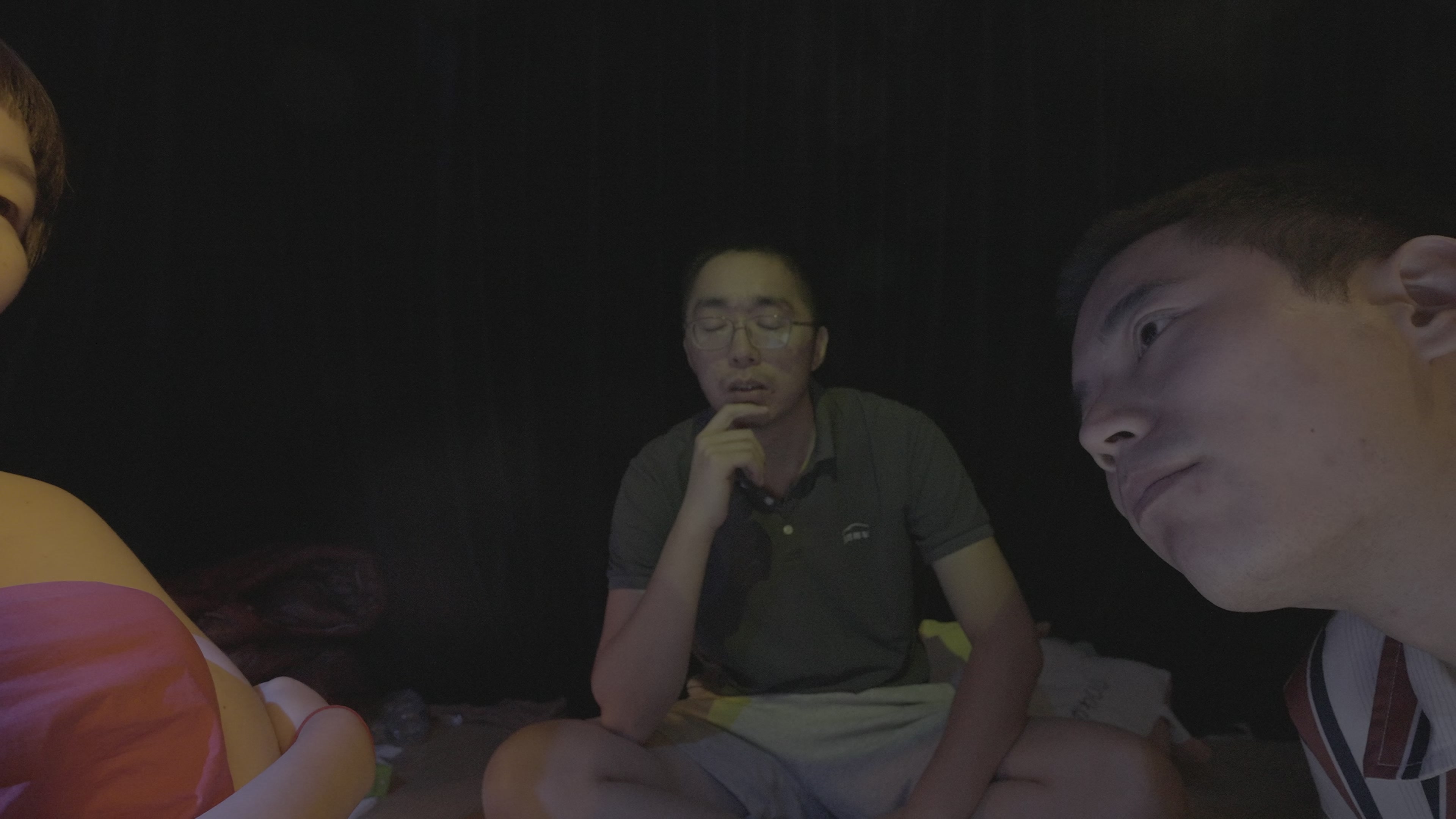
A Role Gives Someone a Position
A role allows someone to do something with others without first having to explain themselves in full. They can say a line that has already been written, carry out an agreed action, or begin by knowing whom to turn toward. Something difficult to say in ordinary life can sometimes take shape through this distance. Fiction gives action a starting point, and leaves the person a little room to retreat: this sentence is happening within the play, so I can try saying it.
¶In an article written before the performance, Sun Jiarui describes how acting allowed him to meet people and become their friend, and how it became a way of feeling needed. He also writes about his dislike of himself in photographs, his surprise after agreeing to perform, and his intention to stop acting.[2-2] These parts should be read together. A role gives him a way in, but may also narrow that entrance. Others need this actor, and so he can remain part of their shared life. How else might he be needed once he leaves the actor’s position? That becomes a harder question to answer.
¶What I see here is a dependence that enthusiasm can easily conceal in creative work. Doing things together produces relations, but those relations may then require a person to keep serving a particular purpose. Someone who is always ready with a reply is expected to keep replying. Someone willing to take on a difficult role is invited to do so again. The ability that first gave them entry gradually becomes the main way others recognize them. The more successful the role, the easier it is for the particular person to be hidden behind it.
¶This does not mean collaboration should have no division of tasks. It is precisely through different abilities that people can work together. The problem is when a person’s assigned part comes to be understood as all that they are. If someone refuses to perform next time, do they lose a work arrangement, or also their place among the others? ‘We’re all friends’ cannot answer that question in advance. It depends on how people continue to see one another after someone stops serving a function.
¶I therefore want to think of a role as a place one can enter and also leave. It should allow tentative attempts: speaking with someone else’s sentences and discovering one’s own voice; completing a task and discovering that one no longer wants to do it this way. The relations a role opens up deserve to be tested beyond that role.
¶Knowing It Is Acting, Still Wanting to Argue Back
After the performance, Sun Jiarui wrote: ‘I know He Fa is acting, but I really do want to argue back.’[2-3]
¶This sentence makes the effect of performance precise. He recognizes it as acting, yet the wish to argue back still arises. Knowing that something belongs to a play does not exempt him from its effects. An actor can know perfectly well that the other person is speaking lines and still be angered or moved by what they say, or feel that an arrangement ought to change. Fiction has real effects precisely because the people taking part in it have not left reality: they are still spending time, waiting for one another, judging the action before them, and carrying it out with their own bodies.
¶Yet we cannot gather all these effects under the phrase ‘getting into character.’ Getting into character is often understood as forgetting oneself, as if actors can only feel something real by temporarily losing the ability to distinguish what is happening. Jia Rui’s words retain that distinction. He knows he is performing, and he has his own judgment. The urge to argue back coexists with his awareness of the play. A person can participate in a framework while also judging it from within.
¶This is part of what makes fiction interesting. It lets someone borrow another situation while retaining some distance from it. A person can try actions they would not ordinarily take and discover their limits in the attempt. Complete immersion is only one state of performance. Remaining aware, hesitating, or occasionally stepping out of a role can also produce powerful expression. A film can bring these different states together, allowing a character’s actions and an actor’s judgments to illuminate one another.
¶Someone may ask: if real relations matter, why not simply talk directly? Because ‘directly’ has conditions of its own. The names we call one another, our habits, and our expectations in ordinary life already determine much of who can say what and how far they can go. Taking on another role can sometimes move those arrangements a little. People do not always have a complete self first and then search for the right sentences to convey it. Sometimes only after speaking and acting do they discover that this is how they respond.
¶I value this discovery, but do not want to possess it. A maker can arrange a task that allows a sentence to be spoken. What that sentence later means to the speaker is something the speaker must go on understanding. The work preserves the expression, while the person’s interpretation continues to change.
¶No Single Kind of Truth Can Answer Everything
At this point, several things that easily become entangled need to be separated. Whether a line was actually spoken is something a recording can help establish. To understand what someone felt while speaking, we need to hear their account. Whether that expression changed how people related to one another requires looking at what they did next. Whether the film gave these changes a forceful organization takes us back to its sounds, images, and rhythms.
¶All four questions matter. When they are mixed together, a work can acquire a value from the weight of lived experience that seems to need no further explanation: someone was really distressed, so this passage must remain; the collaboration was unforgettable, so viewers ought to be moved. But viewers did not share those days. They are facing a film and need to establish a relation to it through what it gives them. A pause familiar to its makers may still be a blank for a stranger. Turning that blank into a waiting the viewer can feel is work the film’s form has to do.
¶Conversely, a moving film does not prescribe how the people involved should remember what happened. Artistic success cannot account for every value of an encounter. Someone may cherish the film while remaining unhappy with a particular arrangement. Someone else may have no interest in the finished film yet cherish an afternoon of working together. These differences should be allowed to remain around the work.
¶My position is therefore clear: art can actively create the conditions under which people meet. It need not wait for an entirely authentic life to appear of its own accord. Roles, sets, lines, and cameras can all give experience ways of being expressed that it did not have before. Art’s strength also comes from a limit: participants can always bring something that the arrangement has not yet included.
¶When someone says ‘I love you,’ they borrow a sentence countless people have spoken, yet still address it, at this moment, to a particular person. The listener may answer, hesitate, or judge the performance. Where the next sentence takes this relation cannot be determined by the first sentence alone. The film’s work begins here: to preserve how a reply is awaited, missed, or changed.
¶Chapter Sources
[2-1] Historical, manually confirmed dialogue ledger for Shoot Self with You, 6 May 2026; opening-scene navigation points 00:04:45.700 and 00:04:53.566. The Chinese wording and speaker attributions follow the manually confirmed fields. Earlier manuscript: Chapter 1, section 1.1; Chapter 8, section 8.1; and Chapter 14. This passage examines how words are used, without inferring the actors’ private relationships.
[2-2] Sun Jiarui, ‘This Is the Last Rehearsal! It’s Real! It’s All Real!’, 19 August 2023.
[2-3] Sun Jiarui, ‘I Disappeared—After Performing The Last Rehearsal’, 2 September 2023. The quotation is from his account after the performance.