Contents
- Before We Begin
- Chapter 1 · Starting with a Photograph
- Chapter 2 · The Person Who Says “I Love You”
- Chapter 3 · Once More
- Chapter 4 · The Body Sets Conditions
- Chapter 5 · Who Can Tell the Director to Leave the Stage?
- Chapter 6 · The Camera Separates Us
- Chapter 7 · Behind the White Cloth
- Chapter 8 · How Long Does an Ending Take?
- Chapter 9 · A Work Cannot Live Someone’s Life for Them
Relational Image Theory · He Fa
Chapter 7 · Behind the White Cloth
This disappearance had a procedure agreed on beforehand.
¶Sun Jiarui describes it clearly in his account after the performance: cover everyone with the white cloth lying on the floor, go backstage, and quietly leave, so the audience sees only a piece of cloth remaining onstage. “It’s a magic trick.”[7-1]
¶Several people have to carry out this arrangement together. Someone picks up the cloth, someone is covered, and everyone leaves by the agreed route. To let an audience see a disappearance, a series of very concrete actions first has to be organized. The cloth has to hide the people; the backstage route has to be passable; what is onstage and where the audience sits have to form a certain relation. Disappearance is given a form that can be carried out.
¶Within this staging, we know what to do next. Yet a question arises as the action nears completion.
¶Jia Rui writes that, when they reached the exit, A Meng suddenly asked whether this was what he wanted: to go somewhere no one was, where no one could find him. The lines were not in the script. He answered, “Yes, yes.” Looking back, he still could not say whether he had wanted to finish the performance quickly or felt that she had indeed touched on something important.[7-1]
¶A planned disappearance left an answer that the plan had not resolved.
¶Who Wants to Disappear?
A Meng’s question turns attention from the action to the wish. An exit performed by several people together suddenly requires an answer from one person: is this what you want?
¶“How to do it” could be settled by discussion. What to cover the bodies with, where to leave, and what to leave for the audience could all be rehearsed beforehand. “Is this what you want?” calls for a different kind of answer. It brings the arranged action back before the person performing it and asks them to explain their relation to it.
¶Sometimes the two coincide. By carrying out an action, someone may indeed express something they have long wanted to say. But an action can also accommodate other reasons: cooperating with a partner, following the rehearsal, bringing things to a smooth close, or simply finishing what is immediately at hand. A single “yes” cannot separate these reasons one by one. Jia Rui’s later account preserves their entanglement.
¶This also makes me reluctant to call an unplanned question a direct route to someone’s inner life. It did change the event, because beyond the scheduled exit, something else now required a response. But what the questioner touched on still has to emerge gradually through the answer, the actions, and later understanding. The suddenness of a question does not automatically make the answer more truthful.
¶In the film’s manually verified dialogue record, A Meng asks, “So is this what you want?” and Jia Rui answers, “Yes.” She then says, “No one can see you,” and he answers again, “Yes.”[7-2] Two affirmations have been spoken, yet the questions are not exhausted.
¶What remains unfinished lies elsewhere: someone has answered without necessarily being able to grasp every reason for that answer.
¶Understanding Continues After the Answer
Everyday life often asks people to know what they want before they act. Actual experience is less orderly. Someone may agree and only later discover that they cannot bear it, or refuse and only afterward realize what they are reluctant to lose. They may still hold several explanations much later.
¶Jia Rui’s writing gives this concrete weight. He does not deny having said “yes,” nor does he erase his answer at the time. He tries to explain it, then stops within the explanation. Wanting the performance to end and being touched by the question are two possibilities he himself proposes. The account does not declare one true and the other false.
¶I cannot choose for him from outside. Nor need this uncertainty be treated as an understanding he has not yet attained, as though asking a few more times would finally yield a pure cause. Some actions are moved by several forces from the outset. Reducing them to a single motive may produce clarity only by subtraction.
¶This does not make every explanation equal. His statement that the exit under the white cloth had been agreed on in advance limits accounts of the whole ending as a sudden departure. His observation that A Meng’s question was not in the script also prevents the entire exchange from being classified as predetermined dialogue. His account provides facts sufficient to change our understanding without giving a psychological answer that accounts for the whole event.
¶What I value is precisely the possibility of keeping both. Specific events can be clarified without closing off someone’s entire experience. A theory that calls every uncertainty profound loses its judgment; a film that treats every answer as a person’s final confession brings that person to an end too soon.
¶At the beginning of his account, Jia Rui also writes that friends came to check on him and express concern. Some thanked him; some said he was sacrificing himself again. Yet he did not understand what he had done to deserve thanks, or what counted as sacrifice. What he could confirm was that he did get himself very dirty after every performance.[7-1]
¶This is a sharp point. People see the same performance and leave with different accounts. Gratitude and concern may be sincere and still miss the experience of the person involved. To see someone as sacrificing himself may praise his commitment while also placing him in a role he does not recognize. Caring about him requires hearing his hesitation about these accounts.
¶The Cloth Does Not Fully Explain a Person
The white cloth also does practical work in the film. It changes how bodies are visible: clothing, faces, and individual positions become hard to distinguish, leaving raised shapes, folds in the fabric, and partial edges. For a time, individuals are gathered beneath a shared material.
¶But the film does not show only this cloth. In the images near the exchange, backstage computers, control equipment, and crew members also appear. After the cloth fills the image, those people and pieces of equipment can be seen again.[7-3] The arrangement for disappearing and the activities that keep the event running thus enter the same passage of film.
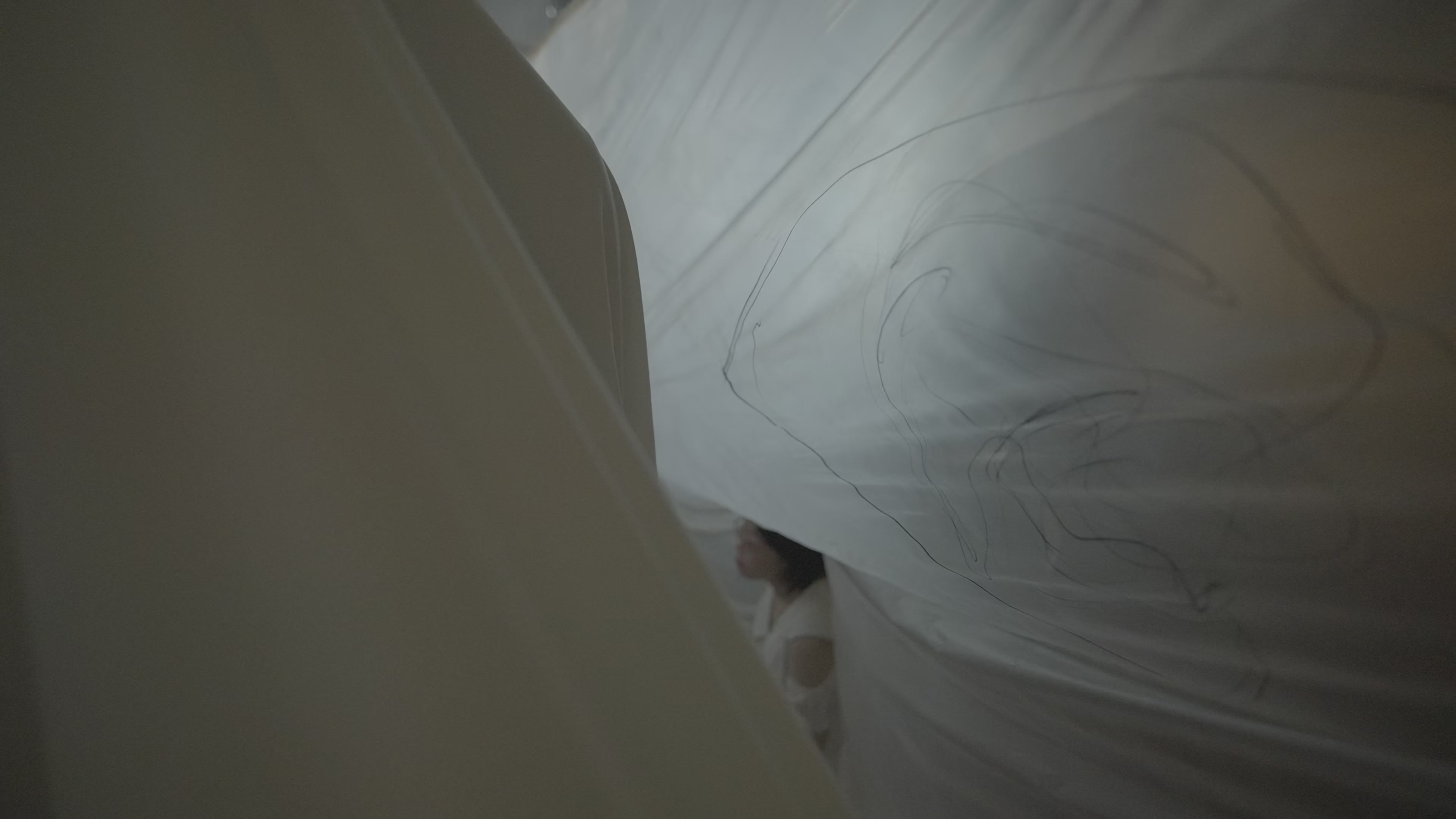
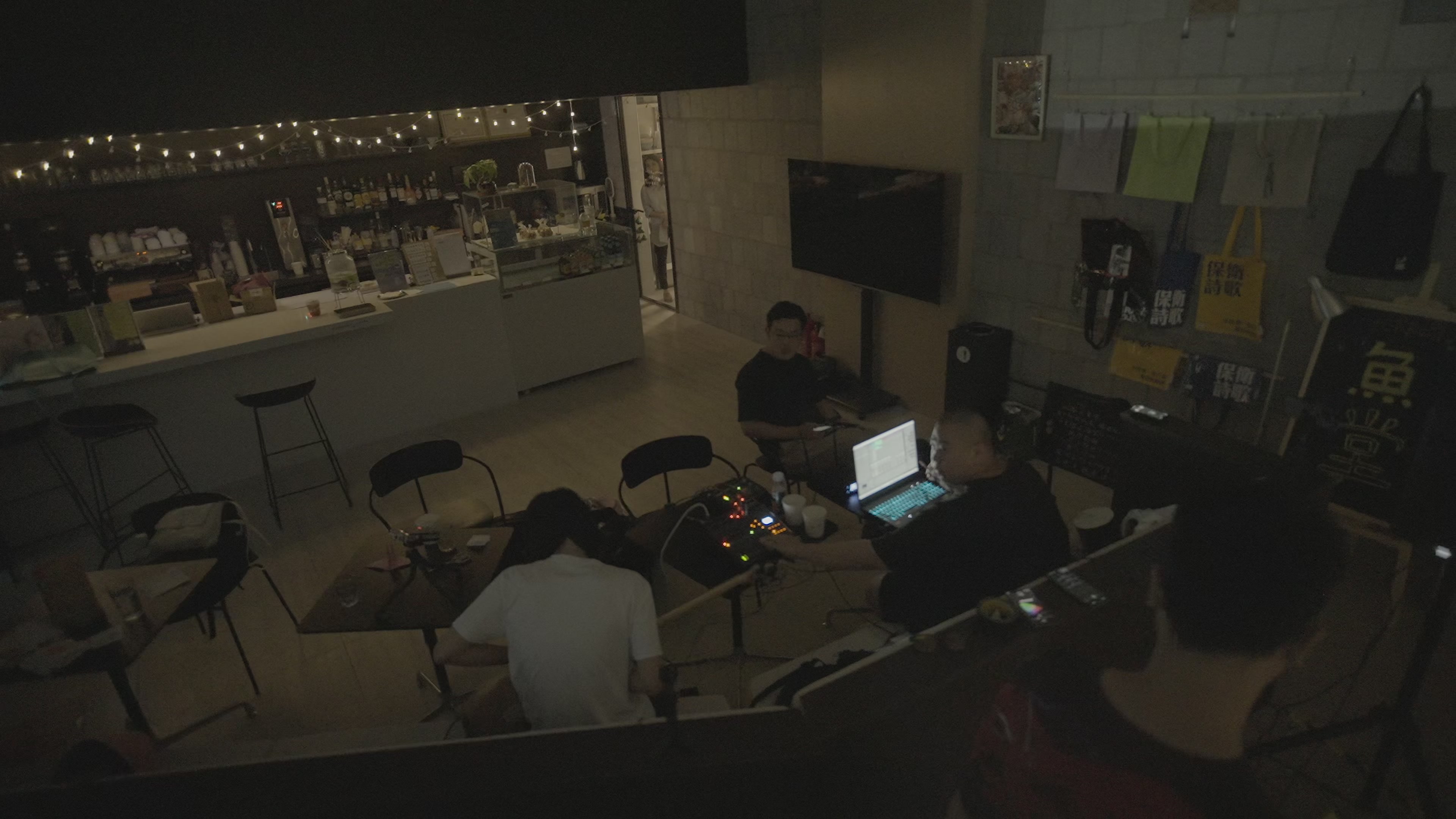
This makes it difficult for the white cloth to stand alone as a complete symbol. If only the image of the covered people remained, we might readily read it as death, collective withdrawal, or some kind of becoming one. The presence of backstage resists these readings. Disappearance still depends on a place where people are working, on sound and equipment continuing to operate. The people and things that do not disappear also constitute this disappearance.
¶I want to preserve that discordance. Art can create an image, and should also make room for the labor that makes it possible. Isolating the white cloth and cropping it into a solemn image would make the exit look like a single, completed decision. Returning it to its concrete space lets us see how many people and stages of work sustain this form together.
¶Film also places another difficulty before disappearance: this disappearance has been filmed. People leave the stage, while the image keeps traces of their leaving. Viewers can watch again and again, but the white cloth cannot guarantee anyone freedom from being watched thereafter.
¶This contradiction need not be resolved. Filming preserves an action that took place, but preserving the action cannot decide for the person involved how they wish to appear in the future. The easier an image is to replay, the more necessary it becomes to remember that it preserves an occurrence, not a definition of someone that holds forever.
¶Several Endings
The staging with the white cloth is meant to end a performance; Jia Rui’s answer responds to a question in the moment; his later account continues to understand that answer. They happen at different times and accomplish different things. Forcing them into a single ending would let one of them decide for the others.
¶The white cloth lets several people disappear together before an audience, giving the ending a visible form. Jia Rui’s later writing loosens that form again. The exit is complete; the meaning of the answer is still changing.
¶Jia Rui said “yes.” Later, he wrote that he did not know.
¶These two statements can remain together. The film need not cross either one out for him when it ends.
¶Chapter Sources
[7-1] Sun Jiarui, “I Disappeared—After Performing The Last Rehearsal”, September 2, 2023. See the opening account of friends’ responses, and the passages beginning “So the play had to go on,” “I was going to use the white cloth on the floor,” and “We reached the exit as usual.” The staging, the unplanned question, and the motives for the answer are treated separately, following his retrospective account.
[7-2] Shoot Self with You, V10 human-confirmed Chinese dialogue and speaker-role ledger, May 6, 2026, HS4G-SUB-0827 through HS4G-SUB-0830. Historical navigation: 02:31:01.700–02:31:10.100. The wording recalled in Sun Jiarui’s article is presented separately from this dialogue record; the two are not conflated as a single verbatim transcript.
[7-3] 《人类投降派 无字幕 28g 4k.mov》, fixed 4K master, 24 fps; saved contact sheets sampled at 2 fps from 02:30:55–02:31:24.5, focusing on 02:31:05–02:31:14.5. This passage uses only the sequence of images to discuss the visible relations among backstage, the cloth, and bodies. Speaker attribution follows [7-2]; visible faces are not used to identify sound sources.