Contents
- Before We Begin
- Chapter 1 · Starting with a Photograph
- Chapter 2 · The Person Who Says “I Love You”
- Chapter 3 · Once More
- Chapter 4 · The Body Sets Conditions
- Chapter 5 · Who Can Tell the Director to Leave the Stage?
- Chapter 6 · The Camera Separates Us
- Chapter 7 · Behind the White Cloth
- Chapter 8 · How Long Does an Ending Take?
- Chapter 9 · A Work Cannot Live Someone’s Life for Them
Relational Image Theory · He Fa
Chapter 4 · The Body Sets Conditions
First, Say It Is Hot
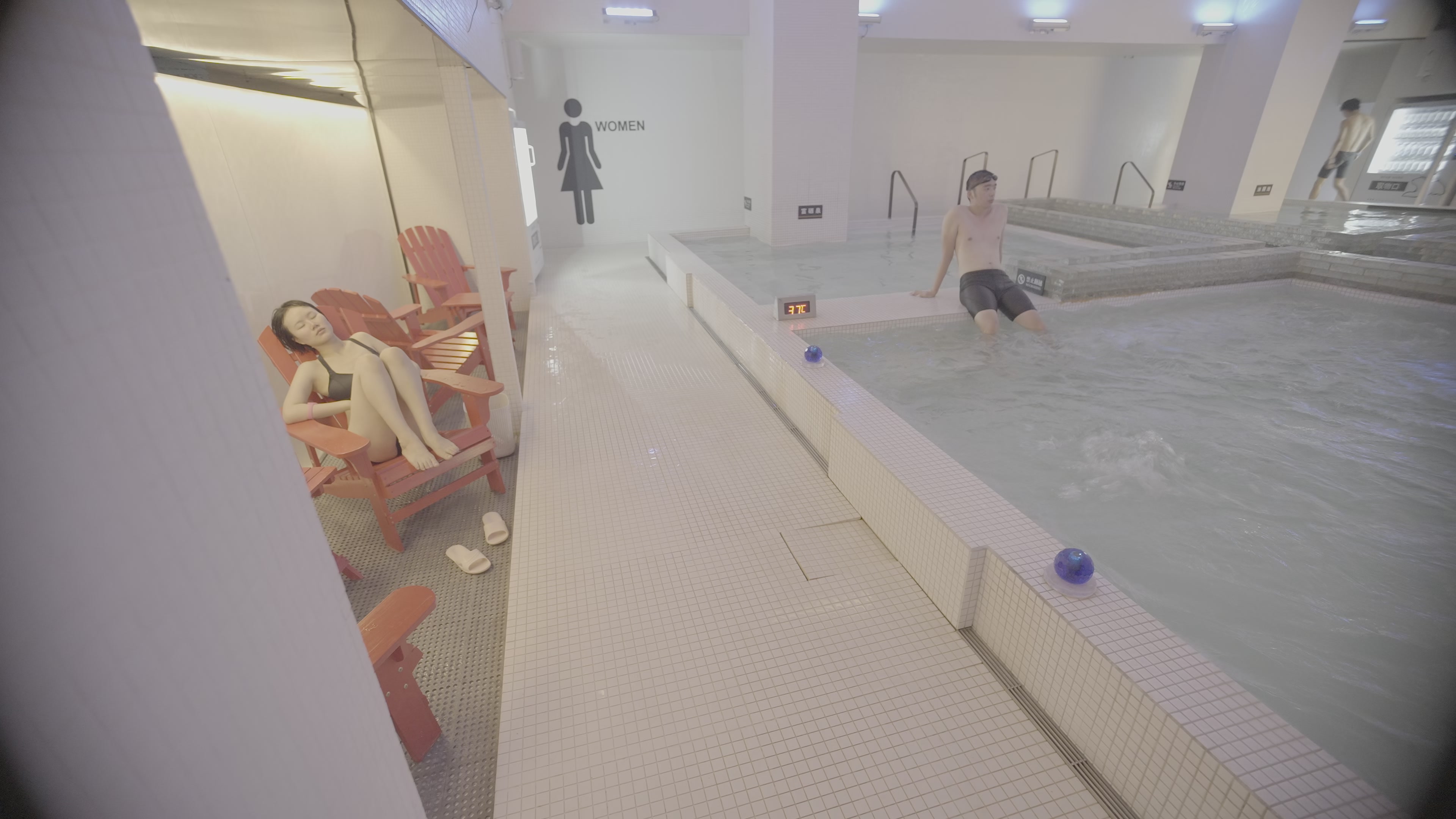
A Meng asks, “Can you hug me?” Zi Chou replies, “I can, but it’s a little hot.”
¶Here, a hug encounters temperature. The answer begins with “I can,” immediately followed by “hot”; a solution is proposed, and brings another kind of discomfort. Before the matter has been reduced to whether or not there is love, the body has already supplied information that needs to be dealt with.
¶I want to understand intimacy from this small point. We often treat the body as the executor of feeling: if two people want to come closer, their bodies should carry out that approach. Yet bodies have their own speeds and conditions. Heat, cold, tiredness, and an inability to bear weight can all change an action. These are not additional problems that arise only after emotion. Feelings take shape within these conditions: wait a little, change position, use less force, or perhaps it cannot be done today.
¶The body’s limits also mean that two people cannot form a whole through willingness alone. What feels right to one person may feel hot to the other; the same action makes different demands on each. Completing something together requires these differences to enter the action, beyond merely obtaining the same answer. Willingness gives a direction; how exactly to proceed remains to be discussed.
¶Awkwardness then has content. It brings the abstract idea of coming closer into contact with two actual bodies. For film, what is worth seeing extends beyond a complete, beautiful hug. How conditions slow an action, and how people deal with that slowing, may reveal their relation more directly. Film can give small mismatches time, allowing viewers to discover that intimacy has no single posture that suits every body.
¶In this dialogue, the air conditioner remains a suggestion. For now, I leave this unfinished point open. Once a possible solution has been voiced, the action may continue, or it may need to change direction. The body’s demands have already changed the request.

From Conditions to Interpretation
Next, Yun Jianhui asks, “Then can you hug me?” Zi Chou replies, “I can.” A Meng then presses, “Then—then why are there so many reasons?” and proposes an explanation of “complicated feelings.”[4-1] A third speaker has joined in: the exchange no longer follows a single line of questions and answers between the same two people.
¶I am concerned with how “reasons” appear here. The earlier heat and cold pointed to the conditions of the action; the later question begins to probe why those conditions are being raised. The question moves from how to hug to what is going on with the person answering. The two kinds of question can help each other, but one can also displace the other.
¶Understanding the other person’s feelings is, of course, necessary. Statements about the body do not always fully express what a person wants. Heat may simply be heat, or it may coexist with hesitation; sometimes people have not yet found the right words and can only begin with the part easiest to say. Serious engagement cannot give up interpretation. But interpretation should give the other person more opportunities to explain themselves, rather than arrive first as an already completed answer.
¶We can compare two ways of asking. “Is there another difficulty?” leaves the original conditions in place and allows new ones to be added. “You are just making excuses” may instead deprive the original words of their effect: the speaker must first prove that they have no other motive before they can return to their immediate discomfort. The two questions leave different amounts of room to continue.
¶Sometimes the strongest interpretation is also the one most likely to block a response. It can absorb hesitation, objection, and silence into a single judgment. If the other person says no, we think they are not yet willing to face it; if they cannot explain, we think we already see deeper than they do. Such understanding leaves the other person no room to correct it. We seem to be discussing their inner life, while actually coming into contact with less and less of it.
¶This set of utterances in the film makes that danger available for thought, but does not settle the characters’ full intentions for us. Further questioning may also be an attempt to find a solution. My judgment concerns how interpretation is used: it should return to action and help us deal with the difficulty before us. Knowing that someone has complicated feelings does not relieve us of continuing to listen when they say they are hot.
¶Being Recognized and Having One’s Needs Met
The person asking for a hug also has a body and wishes of their own. They may simply need a moment of closeness, or may hope to use that closeness to confirm their place in the other person’s heart. That need deserves to be taken seriously. Acknowledging the body’s conditions does not mean excluding the person making the request from the relationship.
¶The difficulty is that both people’s needs are real, yet they may not be met at the same time. One person needs closeness, the other distance. If distance is understood as a rejection of the first person as a whole, intimacy takes on an ever heavier task: every action must prove that the relationship still exists, and every hesitation may be read as its disappearance. A limited request thus comes to demand an almost unlimited answer.
¶I want to bring recognition back into finite actions. Hear the other person’s difficulty and allow it to change what was originally planned; when you cannot meet their need, state your own limits. We do not have to understand another person completely before beginning to respond in this way. Sometimes we do not know where their exhaustion comes from, but can already ease the immediate demand. Conversely, we may know a great deal about someone and still be unwilling to change our arrangements for a difficulty they have voiced.
¶This does not turn every wish into an obligation for others. A refusal can also take a request seriously: I know what you want, but I cannot do it now; this matters to you, but I cannot fulfil it in the way you hope. Refusal brings disappointment and may change a relationship. At least it allows both people to recognize a specific limit, without requiring one of them to keep pretending.
¶The desire for recognition often contains a deeper contradiction. I want confirmation from someone independent of me: their answer matters precisely because I do not decide it myself. Yet I am also afraid that this independent person will give an answer I do not want to hear. The more I need their confirmation, then, the more I may want to control the form it takes. The independence on which desire relies also becomes the part it finds hardest to bear.
¶This contradiction cannot be removed by a single, thorough conversation. Intimacy needs to bear it repeatedly: the other person matters to me, while still not being identical to the person I expect. They can love me and also not want to perform a particular action at this moment. The wish does not thereby become ridiculous, nor does disappointment have to be erased; both need to coexist with the other person’s answer.
¶The Eyes Return More Than My Image
In a 2026 research article, I used the motif “I cannot see myself in your eyes” to discuss approach and confirmation.[4-2]
¶Wanting to see oneself in another person’s eyes is, first of all, an understandable wish. I want my presence to mean something to them; through the way they look at me, I want to know that I am not bearing this relationship alone. But the other person’s eyes are also looking at their own world. They may notice things I have overlooked, bring back judgments I did not expect, and even change how I understand myself.
¶Confirmation draws its force precisely from this difference. An image returned entirely according to my demands comes increasingly to resemble a result I have arranged in advance. I obtain the appearance I want, yet find it harder to believe that it is another person’s response. To dispel the doubt, I may demand more direct declarations, closer proximity, and more intense commitment. Each proof works for a while, then needs to be followed by another. The harder the other person tries to conform to me, the less certain I can be whether what I receive is them or my own demands.
¶I do not want to call this longing narcissism too readily. A vulnerable person may also want a clear answer, and anyone in a relationship may need a moment of firm confirmation. The question is whether, after confirmation, we can still hear difference. When the other person states their own conditions, do we learn more about them, or feel that they have broken the assurance they just gave?
¶This brings intimacy and aesthetics together at the same point. Looking at a face, we may seek only the expression we expect; watching a film, we may likewise seek only images that confirm our existing judgments. Viewing can therefore become narrower the longer we look. To stay a little longer and let an unexpected detail change my understanding is a capacity I want to practise in my work. It does not abolish judgment; it allows the person and material before us to revise it.
¶However close bodies become, this work cannot be spared. A camera can enlarge a face, an arm, or skin and bring details before our eyes, but it cannot take the place of responses between people. A convincing image of intimacy can coexist with two different feelings. Writing and editing should both leave room for that difference.
¶That is why the answer about temperature matters to me. Someone did not immediately produce the expected posture; they stated the conditions through which the action still had to pass. The relationship thus gained something more that could be worked on together: how two people approach, where they stop, and whether they continue.
¶Chapter Sources
[4-1] Historical, manually confirmed dialogue ledger for Shoot Self with You, 6 May 2026; the request for a hug at 01:01:59.933, the answer about temperature at 01:02:06.166, and the follow-up about reasons at 01:02:19.333–21.733. The Chinese wording and speaker attributions follow the manually confirmed fields; the addressees have not been separately confirmed. Earlier manuscript: Chapter 6, sections 6.1–6.2; Chapter 10, sections 10.1–10.3; and Chapter 14. An affirmative answer, a statement of conditions, and the completion of an action are treated separately.
[4-2] He Fa, ‘Imaging with You: The Unowned Second Person and Non-Sovereign Viewing in Shoot Self with You’, 9 June 2026, the passage on “eyes.” Only the motif proposed in the article is used here; its descriptions of actions that have not been independently checked against image and sound are not carried over. This text does not connect the hug-and-temperature exchange and the eyes motif into a causal sequence within the same scene.