Contents
- Before We Begin
- Chapter 1 · Starting with a Photograph
- Chapter 2 · The Person Who Says “I Love You”
- Chapter 3 · Once More
- Chapter 4 · The Body Sets Conditions
- Chapter 5 · Who Can Tell the Director to Leave the Stage?
- Chapter 6 · The Camera Separates Us
- Chapter 7 · Behind the White Cloth
- Chapter 8 · How Long Does an Ending Take?
- Chapter 9 · A Work Cannot Live Someone’s Life for Them
Relational Image Theory · He Fa
Chapter 5 · Who Can Tell the Director to Leave the Stage?
“We have four directors onstage.”
¶During the public performance in Shoot Self with You, Zi Chou counts the directors: the actual director, the director in the film, the director in the play, and another “director who came from who knows where.” Soon afterward, I criticize the acting and tell Ricky, “Just get off the stage and be a spectator.” He answers, “Why? I’m not getting off.”[5-1]
¶Suddenly, the word “director” is no longer enough. Several people can hold the title. One gives an instruction; another can still refuse it. The title does not carry out their next action for them.
¶What interests me in this exchange is how an assessment becomes an instruction. To say someone is acting badly is to judge a performance; to tell them to leave is to change their position within the event. Whether they can still speak, and whether the others carry on, are both affected by this sentence. “Be a spectator” also has concrete consequences here: watching is offered as the position to take after leaving the performance. There is nothing inherently inferior about being a spectator, but in this statement, it is a position assigned by someone else.
¶Ricky then says, “I know the acting is terrible, but you’re the one who asked me to come and act in this play.”[5-1] He does more than argue about the quality of the acting. He brings up why he came in the first place. Someone has been invited to take part, has given their time and taken on a role, and is now suddenly asked to leave the stage. The invitation collides with the assessment. The original arrangement needs to be explained again.
¶This adds something else to what is happening. The people in the scene continue acting, while also arguing about how the play should continue.
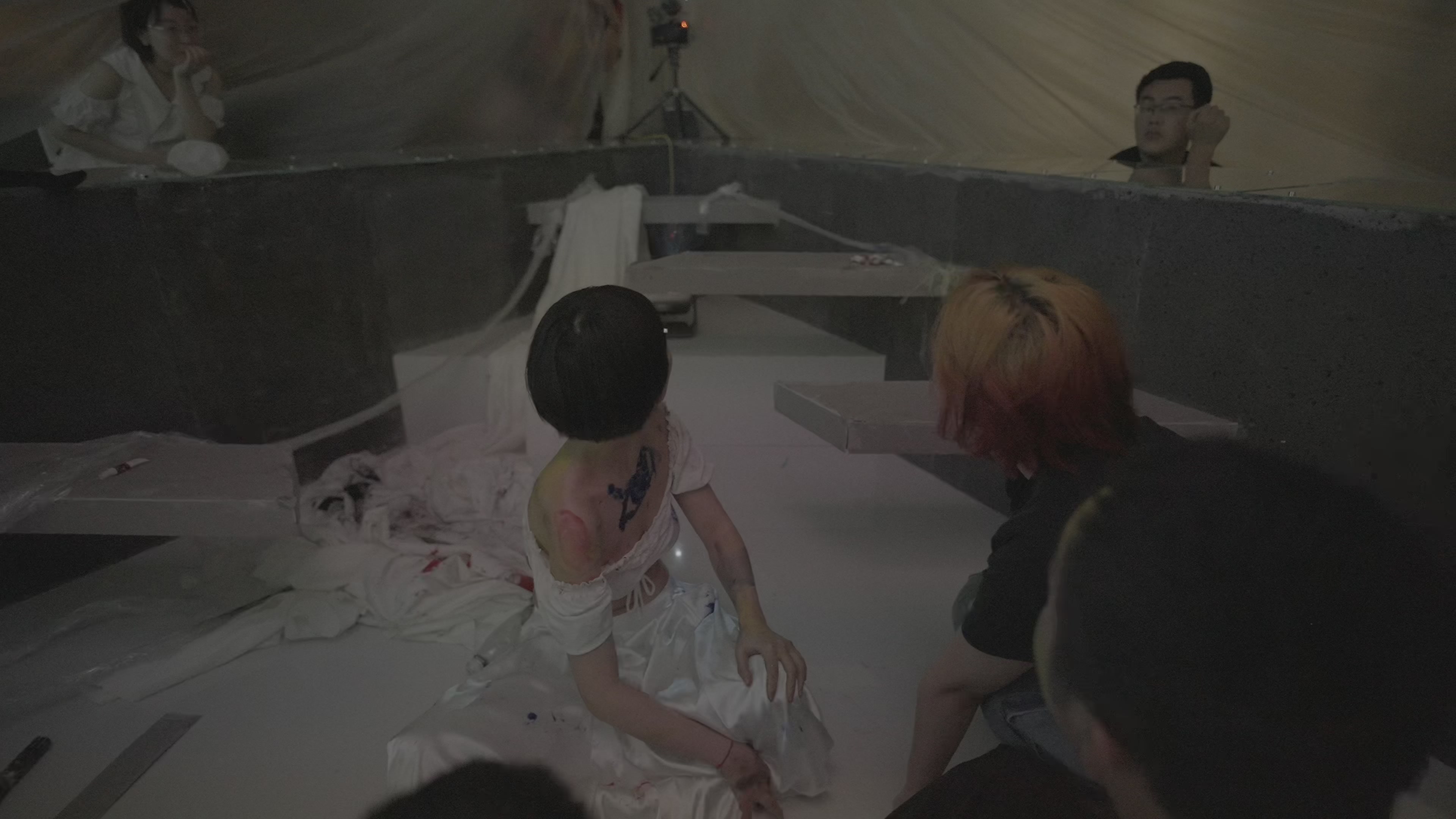
Knowing It Is Acting, Still Wanting to Object
After the public performance in 2023, Sun Jiarui wrote about it from his own position. He felt that the performance had stalled and that Xiang Yubin had moved it forward; I appeared, thought this was no good, and told her to leave the stage. He continued: “I knew He Fa was acting, but I really did want to argue back: this is good, it’s good just like this. But I had no strength left.”[5-2]
¶Jia Rui’s “it’s good just like this” also proposes a measure different from mine. I thought the performance needed to be interrupted; he thought that what had just emerged deserved to continue. Our two judgments did not become one simply because we were part of the same work. I cannot use my position as director to decide his understanding for him, nor can I automatically recast his objection afterward as compelling material that the work required.
¶I want to keep this in the book. What most deserves attention in collaborative creation often emerges when someone refuses to understand it on my terms. That disagreement prevents me from deciding alone what, exactly, we have just accomplished.
¶What Does a Change of Role Change?
P4 experiments with allowing established working roles to change. In a production statement from 2023, I wrote that actors could become directors, camera operators could become actors, those documenting could also act, and performers could also observe.[5-3] This expresses a way of working we hoped for: no one has to remain locked into a single function forever. When someone documenting the work steps in front of the camera, they have to face, in their own body, difficulties they previously watched. When performers help organize the work, they can also propose how they want to appear.
¶The value of such changes depends on whether they alter the concrete next step. If someone is merely called a director but cannot change the task, propose cuts or revisions, or refuse to continue, the new title gives them little room to act. Someone who both films and performs may simply be doing more work, without gaining more opportunities to decide.
¶A shift in working roles therefore needs a response from others. When someone proposes another way of doing things, the others have to make time for it. When someone says they cannot do something now, those present cannot treat this only as an obstacle for the performance to overcome. The measure of collaborative creation lies here: can another person’s presence change my original arrangement?
¶This does not require every disagreement to end in concession. Someone still has to decide how the scene moves forward, and not all views can be accommodated at once. Judgment has to address what the disagreement is about. Ricky gives his reason for coming at someone’s invitation; Jia Rui believes that Xiang Yubin has already moved the stalled scene forward. These are concrete views that can be discussed and also opposed. Classifying them as obedience or disobedience would make the actual questions disappear.
¶There is also a creative gain here. The original plan may not have room for everything a person can do. Outside their assigned role, they may propose a better method, or point out a problem everyone has grown so used to that they no longer notice it. If every change must first be imagined by the person who initiated the project, the others merely increase the number of people carrying it out. Working together matters because I, too, may follow a direction I had not foreseen and find my own work anew within it.
¶Putting My Own Position into the Work
“Who can tell the director to leave the stage?” is also a question I ask myself. An actor can be interrupted; can a director’s arrangements be interrupted in the same way? When someone holding a camera wants a particular image, can the person being filmed make them change that wish?
¶These questions cannot be resolved simply by filming the camera or letting the director appear onscreen. I can place myself inside the work while still deciding how others are seen. Revealing my presence only makes my position visible. What matters next is what kinds of objection that position will accept.
¶In the public performance, at least the judgments and refusals have been spoken. They leave the film with material different from a complete performance: how a scene is stopped, how someone argues for staying and continuing, and how a participant later writes down an objection they could not fully express at the time. Film can bring these things from different moments together, so that the director’s judgment at the time is no longer the only point of entry.
¶But I also have to acknowledge a distinction that collaboration cannot erase. Many people are present, yet the finished film still passes through selection. Who is given more time, whose hesitation is kept, which image precedes an objection—all affect how later viewers understand the dispute. Even if every piece of footage records something that actually happened, its arrangement still comes from specific decisions.
¶Openness during creation makes the work of editing harder. Keeping a disagreement can let different judgments remain at odds. It can also be arranged so that all we see is a generous author and people who seem difficult to work with. Including someone who objects does not mean the film has taken care to preserve their reasons.
¶The demand I can make is that those reasons remain discernible. Why Ricky refuses to leave the stage, and why Jia Rui thinks “it’s good just like this,” cannot be turned entirely into the emotional atmosphere of the scene. Later viewers should have a chance to disagree with me on those grounds. That possibility does not weaken the author’s work. It demands greater precision in the author’s choices: what have I kept here, and what have I deprived of a chance to answer?
¶A collaboratively made film does not turn everyone into the same author. It can allow different people to remain different within the work. The director still has decisions to make, but cannot use those decisions to end the argument on everyone’s behalf.
¶Chapter Sources
[5-1] Shoot Self with You, V10 human-confirmed Chinese dialogue and speaker-role ledger, May 6, 2026. Stable records HS4G-SUB-2012, HS4G-SUB-2016, HS4G-SUB-0722, HS4G-SUB-0724, and HS4G-SUB-0725; historical navigation approximately 02:13:05–02:13:25. The discussion follows the sequence of speech on the basis of the words and their attributed speakers; it does not supply unverified actions or tones of voice.
[5-2] Sun Jiarui, “I Disappeared—After Performing The Last Rehearsal”, September 2, 2023. See the paragraph beginning “Binbin really did save the situation.” This retrospective account is presented separately from the dialogue cited above; they have not been combined into a single verbatim record of the event.
[5-3] He Fa, “The Story of Shoot Self with You—Will the Aliens Return?”, August 18, 2023, the closing postscript and the paragraph that follows it. The account of fluid working roles follows the creator’s public statement at the time; it is not treated as evidence that equal decision-making power had been achieved.