Contents
- Before We Begin
- Chapter 1 · Starting with a Photograph
- Chapter 2 · The Person Who Says “I Love You”
- Chapter 3 · Once More
- Chapter 4 · The Body Sets Conditions
- Chapter 5 · Who Can Tell the Director to Leave the Stage?
- Chapter 6 · The Camera Separates Us
- Chapter 7 · Behind the White Cloth
- Chapter 8 · How Long Does an Ending Take?
- Chapter 9 · A Work Cannot Live Someone’s Life for Them
Relational Image Theory · He Fa
Chapter 8 · How Long Does an Ending Take?
An Ending Also Has an Object
To announce an ending is to state publicly the moment when performing stops. It sends a signal to the audience and the performers; how that signal takes effect still depends on what people do next. A performance can end while each person continues to understand what has just happened.
¶In the dialogue near the end of Shoot Self with You, the announcement that the performance is over is followed by a question about the toilet. “Who peed on the floor in the toilet?” recurs in the record.[8-1] It is easy to overlook, because it does not fit a solemn ending. Yet it also shows precisely that, once the task is over, the space is still in use and there are still things someone needs to deal with.
¶I do not want to elevate this everyday remark into a symbol. The toilet is the toilet. The first significance of leaving it here is that a concrete demand is not covered over by a summing-up. People have spent a long time talking about art, love, and disappearance; life in the room has not paused as a result.
¶The film can choose to cut this sentence or let it remain. If it remains, the ending contains two different directions: the performance is releasing people from its task, while a new demand of daily life has already arrived. They need not cancel each other out. The first has an announcement of its ending; the second has an object of its own.
¶This also keeps a distance between the film’s ending and the way things wind down in life. The film has to decide what to leave at the end. It need not wait for every problem to be resolved, and has no power to resolve them all. What editing decides is where viewers leave the work.
¶Giving Backstage Back to Sound
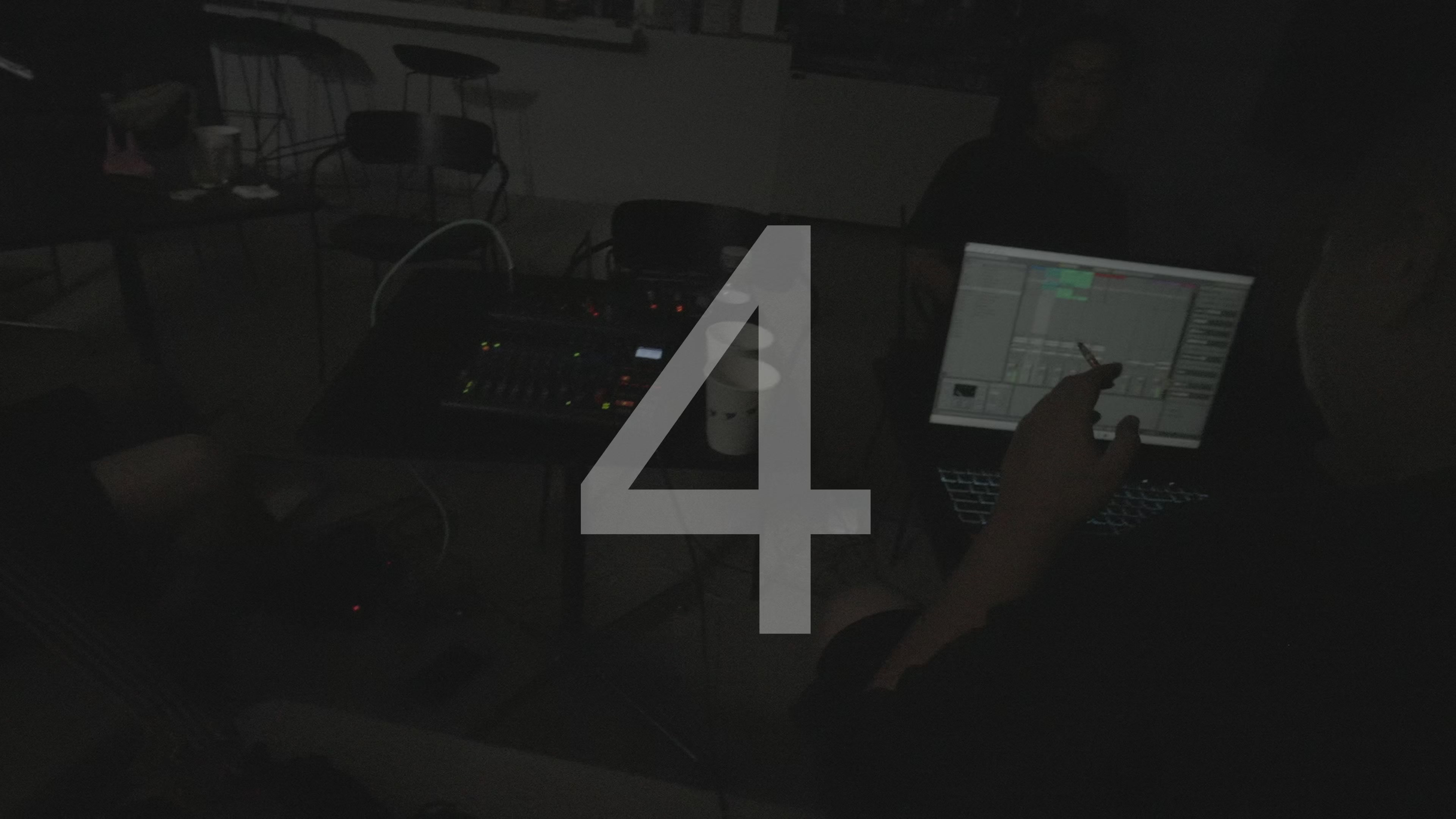
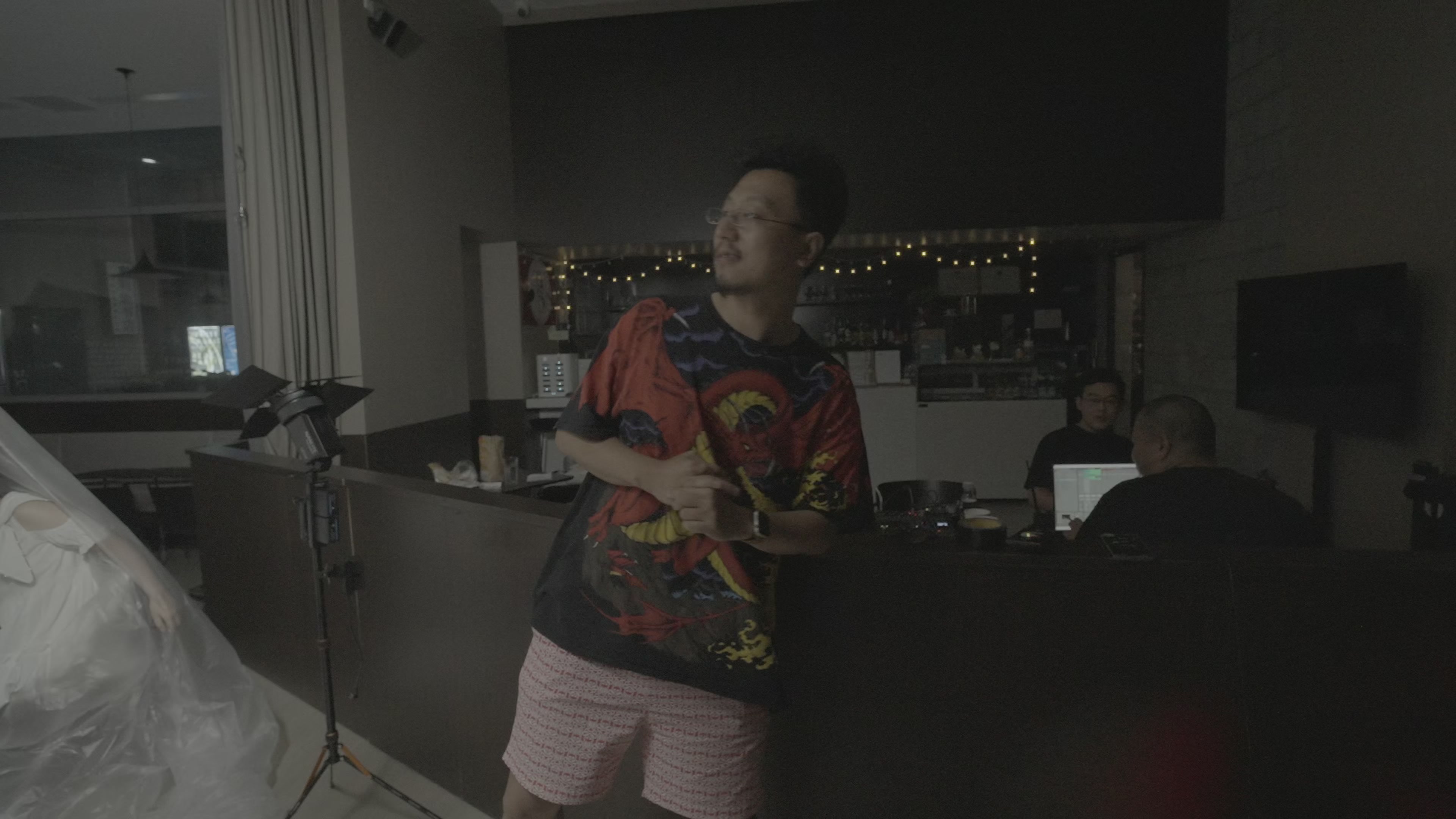
I once made a specific clarification about the divisions of Shoot Self with You: the section between the numbers 4 and 5 is backstage. It involves Ru Meng’s live score, the screen, the space behind the scenes, and the offscreen speech that follows the announcements. The closing section after the number 5 is separate.[8-2]
¶This distinction affects how the whole film is understood. To treat everything after the number 4 as credits and archiving would be to describe work still taking place as material already finished. Backstage has activities of its own; “the performance receding from view” is not enough to describe them.
¶We are used to seeing the stage as the center of an event, with backstage ensuring that the center appears as it should. Lights come on, sound comes through, images enter the screen, and the actions the audience sees can continue. Yet the people producing these conditions are often left outside the work. Once backstage enters the film, what previously counted as support begins to become something we watch.
¶This changes the weight of things. The force of a sentence onstage no longer comes only from the speaker’s emotion. It also depends on how the sentence was heard, through what equipment it entered the event, and what other sounds surrounded it. The person in the image does not necessarily occupy the entire sound field. Someone who never enters the shot can still change the space being viewed through sound.
¶What interests me in this section is allowing the activities that sustain the performance to keep taking visible form. Live scoring is participation in progress; the screen is part of the event; sounds continue to be produced after the announcements. Treating all of this as the remains of a performance deprives these activities of their own place.
¶Nor does backstage become more truthful than onstage simply by being filmed. Someone who has stepped out of a role may still be aware of the camera; leaving the performance area may also be part of an agreement. The distinction between onstage and backstage concerns first the organization of activity: what is being presented, what makes that presentation possible, and where this division of labor is rearranged by a new act of filming.
¶By joining the two, film can make previously unseen dependencies visible. But it has to work on the connection itself. Juxtaposing live sound, offscreen speech, screens, and images does not naturally produce a complete thought. Viewers need to be able to discern, through their relations, how the center of attention moves, what work was previously obscured, and which voices now have a place.
¶I therefore want to write about this section as a backstage still in progress, and then discuss how it moves into the ending. The numbers mark boundaries; they are not labels that flatten everything.

Where Does Time Come From?
By this point, the question of time is no longer only one of length.
¶Completing a task takes time. Waiting for someone’s answer takes time. After the answer arrives, understanding what it means to oneself also takes time. These times sometimes coincide and sometimes come apart. What film can do is make the differences between them something we experience.
¶Suspense can make us wait for an answer. When the answer arrives, the wait is explained. Another situation is more difficult: an answer has appeared, but the scene has not ended because of it. People keep talking, or the original question is asked again. What deserves attention then is what the answer has accomplished and what it has left unresolved.
¶Calling all of this a failure of communication is too hasty. The answer may be perfectly clear, the refusal may already stand, and yet the questioner may still be demanding a different result. Sometimes continued waiting gives someone time to understand; sometimes it refuses to accept the reply they have already given. Duration cannot judge the value of these two kinds of waiting for us.
¶Likewise, someone’s hesitation or uncertainty about what to do in a film does not by itself establish that the work is thinking about time. Hesitation may simply belong to a plot that has not yet been fully explained. As long as the goal and outcome of an action are enough to account for the duration, we can still understand what the film is making us wait for.
¶When Deleuze discusses the time-image, a crucial question concerns the link between perception and action. When action is no longer sufficient to respond to what is seen, the presentation of time calls for another understanding. This differs from a character temporarily having trouble getting something done.[8-3] Following this question, I want to ask whether answering and completion within a relation might also lose their habitual synchronization.
¶Starting from my own material, what interests me more is this: how can a film let an answer already given continue to acquire new meanings?[8-4]
¶For example, a film can end a shot after an answer, let another person’s reaction enter, or follow it with an earlier expression. Each arrangement may change our sense of when something is complete. These are possibilities of form. To say how far a particular film has realized them still requires identifying its actual sequences of sound and image precisely.
¶Understanding time this way preserves reasons for a long film while also allowing criticism of it. Length can give meaning room to change; it can also keep a judgment that has already been established from drawing to a close. Discussing time should not give my work immunity from the question, “Why does this still need to continue?”
¶The Last Sentence
The closer a sentence is to the end, the more easily it is given the power to sum up the whole film. Yet “not caring” does not automatically specify its object, or account for the speaker’s entire experience. To read it as utter failure, final release, or a philosophy of life requires traveling farther than the sentence itself goes.
¶Its force can remain in the statement made at that time. People sometimes use a sentence to stop explaining for the moment, to stop supplying reasons. By preserving it, the film can make that stopping available to view. It can also use the sentence’s position at the end to turn a stop into a conclusion. These are two effects the editor has to face.
¶I do not want to use the last sentence to cancel the attempts to draw close, the objections, and the waiting that came before. Nor do I want to embellish it into a truth the person has finally reached. An ending can concentrate an experience, but should not use concentration as a reason to take away the distinctions within it.
¶The closing credits do something else. They leave names attached to the production, making collaboration recognizable. Credits matter, but they cannot claim someone’s statements on their behalf or take the place of a participant’s account of what it all means to them. A film can end with these names; the people they name will go on living.
A book faces the same difficulty. Writing can make things clear on a page, but clarity does not mean drawing everyone’s experience into the same answer. An ending is best left to a definite but limited judgment: what we did, what the work chose, and what remains for living people to decide.
¶Chapter Sources
[8-1] Shoot Self with You, V10 manually verified Chinese dialogue and speaker-role ledger, May 6, 2026. Historical navigation for He Fa’s “Our performance is over”: approximately 02:32:00.266; Zi Chou’s question about the toilet is recorded at 02:32:22.000, 02:32:25.100, and 02:32:48.100; Jia Rui’s final sentence occurs at 02:33:26.066–02:33:27.166. Historical timecodes serve as locators; they are not presented as absolute timecodes of the fixed master verified word by word through a fresh listening check.
[8-2] He Fa (identified as “作者Owner,” or “Author/Owner,” in the original record), unpublished dialogue correction, May 24, 2026: “Correction to Part Five: The Backstage Sound Field Between 4 and 5, and to the Subtitled Trailer.” The account of Ru Meng’s live score, the screen, offscreen speech after the announcements, and the boundary between Parts Five and Six comes from the author’s record. The analysis develops from that record; still frames are not used to claim that unverified sounds have been heard.
[8-3] Gilles Deleuze, film lecture, February 26, 1985, Cinema and Thought, Lecture 13, English translation by Graeme Thomson and Silvia Maglioni, Purdue University. This passage refers to the discussion of the sensory-motor schema and the presentation of time.
[8-4] Gilles Deleuze, lecture of June 1, 1982, Sur le cinéma : l’image-mouvement et l’image-temps. Discussion of Hitchcock, the relation-image, and objects as bearers of relations. “Relation–time image” is the name this book retains for a question, not a category originally proposed by Deleuze.